

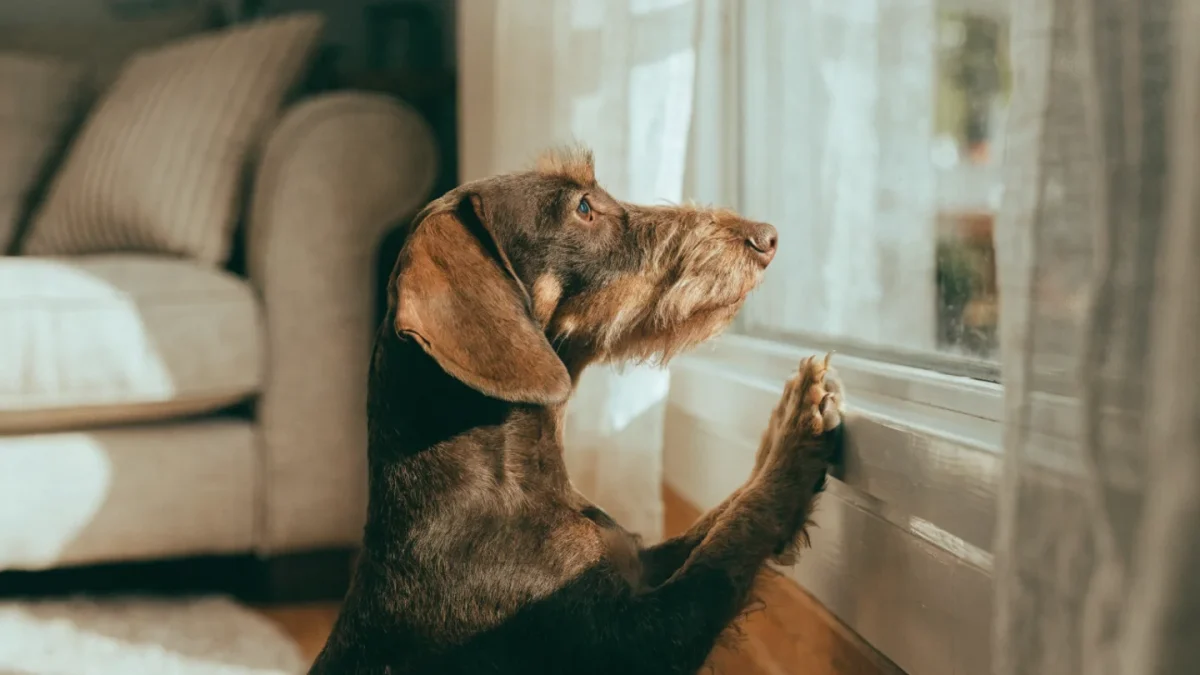
I met a miniature dachshund at a breed specialty in Portland a few years ago — smooth-coated, maybe seven kilograms, standing on a grooming table while his owner brushed him — who stared me down with an expression I can only describe as dismissive. Not aggressive. Not nervous. Just completely unimpressed by my existence. His owner laughed when I mentioned it. "He's been like that since eight weeks," she said. "He decided early on that most things weren't worth his attention."
That's the dachshund temperament in a single moment. This is a dog that was bred to go underground after a badger without human backup — to make its own decisions in total darkness, under enormous physical and psychological pressure, against an animal that would fight back. That kind of selective pressure doesn't produce a dog that defers to authority. It produces a dog with an internal conviction that its own judgment is probably better than yours. Living with that is either delightful or exhausting, depending on how much you need your dog to agree with you.
The Independence Problem
I call it a problem only because most dog ownership advice assumes the dog wants to cooperate. Retrievers want to cooperate. Shepherds want to cooperate. Dachshunds evaluate your request, weigh it against their own priorities, and proceed accordingly.
This isn't a training failure. It's a feature baked into the breed over centuries. A dog bred to follow a badger into a dark underground tunnel — alone, without human guidance, against an animal that could cripple it — needed the capacity to think independently. That meant assessing danger, making tactical decisions, and committing fully to its own judgment. Handlers above ground couldn't see what was happening. The dog had to trust itself.
That self-reliance doesn't evaporate because the burrow has been replaced by a living room. A dachshund on a walk who catches an interesting scent will plant its feet and investigate, regardless of your schedule. One who decides the spot under the blanket is its territory will defend that position with astonishing conviction against dogs twice its size. The independence is hardwired, and it shows up in every interaction.
What this means practically: conventional obedience methods that rely on a dog's desire to earn approval often stall with dachshunds. They understand the command. They've learned what you want. They simply don't consider your preference the deciding factor. The most effective approach treats every interaction as a negotiation, not a command. Motivation-based methods — where the dog sees clear benefit to compliance — produce dramatically better results than repetition-based drilling.
Loyalty That Runs Deep and Narrow
If the independence is the trait people underestimate, the loyalty is the trait that keeps them coming back.
Dachshunds don't distribute their affection evenly. They pick their person — sometimes two people, rarely more — and that bond becomes the organizing principle of their emotional life. A dachshund that's chosen you will follow you between rooms, position itself where it can monitor the door you left through, and greet your return with a level of enthusiasm that borders on theatrical.
This selective attachment is the flip side of their independence. The same dog that ignores your command to drop the sock will also refuse to settle until you sit down, press its body against your leg during a thunderstorm, and watch your face with an attentiveness that suggests it's reading your mood before you've registered it yourself.
The narrowness of the bond matters, though. Dachshunds can be indifferent or even dismissive toward people outside their inner circle. Guests may get a courtesy sniff. Some get a sustained, suspicious stare. This isn't aggression — it's the breed's built-in selectivity about who deserves its attention.
For more context on how this temperament fits within the breed's full physical and health profile, the dachshund complete breed guide covers the broader picture.
The Vocal Signature
Dachshunds were designed to be heard through several feet of packed earth. The bark had to carry from underground to a handler at the surface, which meant a deep, resonant voice entirely disproportionate to the dog's body. That functional trait survived the transition from field to furniture.
A dachshund barks at the doorbell, at the mail carrier, at a dog walking past the window three houses away, at a leaf that moved suspiciously, and sometimes at a sound source only it can identify. The frequency and volume are not quirks to be managed casually — they're a defining behavioral trait. Apartment dwellers and people in shared-wall housing need to consider this seriously. Training can moderate the triggers, but expecting silence from a dachshund is like expecting a border collie not to herd. You're working against centuries of selective pressure.
The bark also serves a social function. Many dachshund owners report that their dogs use distinct vocalizations for different situations — a sharp alert bark for perceived intrusion, a lower grumble for displeasure, an insistent series of barks for demands (dinner, attention, access to a closed door). Whether this constitutes genuine communicative variation or pattern recognition by attentive owners is debatable, but the experience is consistent enough to note.
Prey Drive: Still a Hunter
The hunting instinct is not a historical footnote. It's a living, active behavioral system that influences daily life with the breed.
Dachshunds will chase squirrels, rabbits, and cats with focused intensity. They will dig after burrowing animals with a single-mindedness that can destroy a garden in an afternoon. They will track scent trails with their nose pressed to the ground, oblivious to commands, traffic, or anything else in their environment. Off-leash reliability with this breed is extremely difficult to achieve — when the prey drive activates, recall training often becomes irrelevant.
This has practical implications. Secure fencing isn't optional, and that fencing needs to extend below ground level because dachshunds dig with purpose. Leash walks are the default, not a temporary measure while training progresses. Small household pets — hamsters, guinea pigs, rabbits — need to be kept in genuinely secure enclosures that the dachshund can't access or obsess over.
With Other Dogs
Dachshunds generally do well with other dogs, particularly other dachshunds. Two dachshunds in the same household tend to form a tight partnership that operates as a unit — sleeping together, patrolling together, barking together. The last point is worth emphasizing: multiple dachshunds amplify each other's vocal tendencies considerably.
With larger dogs, dachshunds rarely show appropriate size awareness. They'll engage, play, and occasionally provoke dogs that outweigh them significantly. This confidence usually prevents bullying — most larger dogs don't know what to make of a 10-kilogram animal that acts like it weighs 40 — but the physical mismatch creates injury risk during rough play. Supervised interactions with size-matched playmates are the safer approach.
The breed's resource-guarding tendency can also surface in multi-dog households. Food bowls, favored sleeping spots, and the primary owner's lap can all become contested territory. Early socialization and consistent household rules help manage this, but the tendency is deeply bred and rarely disappears entirely.
What Most People Get Wrong
The most common misconception about dachshund temperament is that small means simple. People see the size and assume a low-commitment companion — a dog that will adapt to their lifestyle with minimal negotiation.
The reality is the opposite. Dachshunds have more personality per kilogram than almost any breed I've covered in a decade of breed journalism. They are opinionated, vocal, selectively obedient, fiercely loyal to their chosen people, and entirely indifferent to anyone else's expectations. They don't want to please you. They want to coexist with you on terms they find acceptable.
If the Labrador is the agreeable colleague who says yes to every meeting, and the German Shepherd is the focused project manager who follows the plan, the dachshund is the freelancer who does exceptional work but only when the project interests them, on a schedule they set themselves.
The Right Owner for This Temperament
The person who thrives with a dachshund finds the stubbornness genuinely entertaining rather than frustrating. Someone who respects the breed's intelligence without mistaking independence for disobedience. Someone who can appreciate that the same dog who ignored the recall command will also wait at the front door for two hours because it heard your car in the driveway and couldn't stand to miss your arrival.
Dachshunds are not for people who need compliance. They are not for people who want a predictable, biddable companion. They are exactly right for people who want a dog with opinions, and who find those opinions — delivered at considerable volume — more charming than inconvenient.
The relationship between dachshund history and modern temperament runs deeper than most realize. The dachshund's origins as a working hunting dog shaped every behavioral trait covered here, and understanding where the breed came from makes living with one considerably less surprising.