

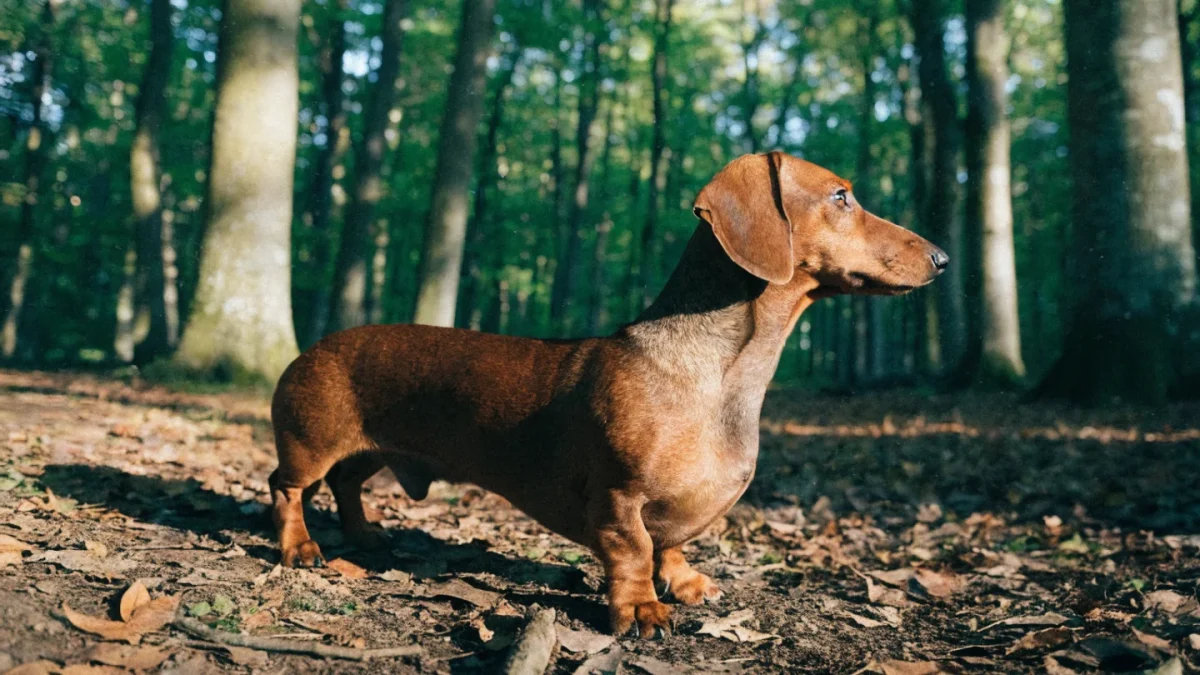
The dachshund was designed to crawl into a badger's den and fight it underground, in the dark, alone. That single fact explains almost everything about the breed — the elongated ribcage, the paddle-shaped front paws, the oversized bark, and the absolutely unreasonable courage packed into a dog that weighs less than a house cat's worth of groceries. When German foresters in the 15th century needed a dog small enough to enter a burrow and tenacious enough to drag out a badger — an animal roughly three times its weight with claws and teeth built for digging — they bred exactly what they needed.
Dachshunds are small hound-type dogs developed in Germany for underground hunting, recognized by their distinctively long bodies, short legs, and three coat varieties. They combine fierce independence with deep owner loyalty and carry significant spinal health risks that demand informed, proactive care. This dachshund breed guide covers what the breed actually is, where it came from, what goes wrong, and whether it belongs in your life.
Most people see a dachshund and think "cute." That's fair. But cute is the least interesting thing about them.
The History Behind the Shape
The name itself is the job description. "Dachs" means badger. "Hund" means dog. Badger dog. German breeders weren't subtle about it.
The breed's development traces back to at least the 15th century, with written references to "badger creepers" and "earth dogs" appearing in German hunting texts from that period. But the deliberate, selective breeding that produced the modern dachshund intensified in the 17th and 18th centuries. German foresters and gamekeepers needed a versatile small-game hunter — one that could go underground after badgers and foxes, track wounded deer through dense brush, and work in packs to flush wild boar.
That versatility requirement shaped everything. The long, narrow ribcage allowed passage through tight tunnels. The loose, thick skin protected against bites and scratches underground without tearing easily. The deep chest housed oversized lungs for sustained effort in low-oxygen burrows. The large, paddle-shaped front feet were built for digging. Even the slightly curved tail served a function — a handler could grab it to pull the dog out of a hole if necessary.
By the early 1800s, two distinct size classes had emerged. Standard dachshunds continued working badgers and foxes, while smaller specimens were selectively bred down to hunt rabbits and weasels. This size split eventually formalized into the standard and miniature classifications still recognized today.
The wirehaired variety appeared in the late 19th century through crosses with terriers and wire-coated pinschers, adding weather resistance for working in thorny underbrush. The longhaired variety likely traces to crosses with small spaniels, producing a coat better suited to cold water retrieval and colder climates. Each coat type carried slightly different temperament tendencies — more on that below.
Dachshunds arrived in Britain and North America in the mid-to-late 1800s, where they transitioned from working hunters to companion animals. Their popularity suffered sharply during both World Wars due to anti-German sentiment — some were kicked in the streets, and breed clubs temporarily renamed them to avoid the association. The breed recovered both times, and by the mid-20th century, dachshunds had become one of the most recognized companion breeds worldwide.
Physical Characteristics
Size Classes
Standard dachshunds typically weigh between 7 and 14.5 kg and stand roughly 20 to 23 cm at the shoulder. Miniature dachshunds weigh under 5 kg and stand around 13 to 18 cm. Some breed registries also recognize a "kaninchen" (rabbit) size class — under 3.5 kg — though this isn't universally standardized.
The weight ranges matter more than the height numbers. Dachshunds are measured primarily by chest circumference in some countries' breed standards and by weight in others. The key point is that a healthy dachshund should be lean and muscular, not round. Excess weight on this body shape is genuinely dangerous — more on that in the health section.
The Three Coat Varieties
Smooth-coated dachshunds have a short, dense, shiny coat that lies close to the body. Minimal grooming required, maximum shedding efficiency — smooth dachshunds shed more than most people expect from a short-coated dog. This is the original coat type and remains the most common globally.
Longhaired dachshunds carry a soft, slightly wavy coat with feathering on the ears, chest, belly, and tail. The coat developed through spaniel crosses, and many longhaired dachshund owners report a somewhat gentler, calmer temperament compared to the other varieties — though "calmer" is relative when discussing dachshunds.
Wirehaired dachshunds have a rough, dense outer coat with a softer undercoat and distinctive facial furnishings — the bushy eyebrows and beard give them a distinct expression. The terrier influence in their lineage often shows in their temperament. Wirehaired dachshunds tend to be the clowniest of the three varieties, the most outgoing with strangers, and sometimes the most stubborn. They need hand-stripping or professional grooming several times a year to maintain proper coat texture.
Color and Pattern
Dachshunds come in more color and pattern combinations than most breeds. Solid colors include red (ranging from deep mahogany to light strawberry) and cream. Two-color combinations include black and tan, chocolate and tan, blue and tan, and Isabella (fawn) and tan. Patterns include dapple (merle), brindle, piebald, and sable.
The dapple pattern deserves specific mention because of its genetic implications. A single dapple gene produces the distinctive mottled coat pattern. But breeding two dapple-patterned dogs together (double dapple) carries a high risk of producing puppies with serious health defects, including blindness, deafness, and malformed eyes. Responsible breeding practices avoid double dapple crosses entirely.
Temperament: What Most People Get Wrong
Here's the misconception that bothers me most about dachshunds: people assume the small size means easy. They see a 10 kg dog and think "starter pet" or "low-maintenance companion." This is backwards.
Dachshunds were bred to enter a dark hole in the ground and fight an animal that could kill them. That required a dog capable of making its own decisions, ignoring fear, and refusing to back down. Those traits don't switch off because the dog now lives in an apartment. A dachshund is a hound with a terrier's attitude compressed into the body of a bread loaf, and it will run your household if you let it.
Independence and Stubbornness
Dachshunds are intelligent — but their intelligence serves their own agenda, not yours. Unlike retrievers or shepherds bred for handler cooperation, dachshunds were bred to work independently underground where no human could direct them. They assess situations, make their own judgments, and follow through on their decisions whether you agree or not.
This means conventional obedience approaches that rely on a dog's desire to please often fall flat. A dachshund understands what you want. It simply weighs that against what it wants, and its own preference frequently wins. Patience and consistency matter enormously. Punishment-based methods tend to make dachshunds more defiant, not less.
Loyalty and Bonding
For all their independence, dachshunds form fierce attachments. They typically bond most strongly with one or two people and can be openly indifferent to everyone else. This isn't aloofness — it's selectivity. A dachshund that trusts you will follow you from room to room, burrow under your blankets at 2 AM, and position itself as a sentry on the back of the couch to monitor the front door.
This bonding intensity has a flip side. Dachshunds are prone to separation anxiety and resource guarding. They can become possessive of their primary person, their sleeping spots, their food, and their toys. Early socialization and consistent boundaries help, but the tendency is deeply bred and shouldn't be ignored.
Vocalization
Dachshunds bark. A lot. They have a bark that sounds like it belongs to a dog four times their size — another underground hunting trait, since handlers needed to hear the dog working below ground. They bark at strangers, at delivery vehicles, at squirrels, at sounds only they can hear, and occasionally at nothing identifiable. If you live in close-quartered housing, this is a genuine lifestyle consideration, not a minor quirk.
Prey Drive
The hunting instinct is alive and strong. Dachshunds will chase small animals, dig after burrowing creatures, and track scents with single-minded focus. Off-leash reliability is extremely difficult to achieve with this breed. When a dachshund locks onto a scent trail, recall commands often become background noise. Secure fencing and leash habits aren't optional.
Health: The Conversation You Can't Skip
Dachshunds are generally robust dogs with lifespans of 12 to 16 years. But their signature body shape — the trait that defines the breed — is also the source of their most serious health vulnerability.
Intervertebral Disc Disease (IVDD)
IVDD is the dominant health concern in dachshunds. Research published in the Journal of the American Veterinary Medical Association (Ball et al., 1982) and in Acta Veterinaria Scandinavica (Stigen, 1991) places the incidence at roughly 19-24% of dachshunds experiencing some form of disc disease during their lifetime — a range further supported by the 2016 DachsLife survey in Canine Genetics and Epidemiology, which found 15.7% prevalence overall and 24.4% among smooth-haired dachshunds specifically. The breed's chondrodystrophic (cartilage-deficient) dwarfism means their intervertebral discs calcify and degenerate earlier than in most breeds. When a disc herniates, it can compress the spinal cord, causing pain, weakness, partial paralysis, or complete paralysis of the hind legs.
IVDD can strike at any age, though it most commonly appears between ages 3 and 7. The condition ranges in severity from mild pain episodes (Grade I) to complete loss of deep pain perception in the hind limbs (Grade V). Mild cases may respond to strict rest and anti-inflammatory medication. Severe cases often require emergency surgery, and even with surgery, recovery isn't guaranteed.
Prevention is management, not elimination. You cannot prevent IVDD in a chondrodystrophic breed — you can only reduce the risk factors that trigger episodes:
- Maintain ideal body weight. Every excess gram of body fat increases the mechanical load on the spine. A lean dachshund is a safer dachshund.
- Limit high-impact activities. Jumping on and off furniture, running up and down stairs, and rough play with larger dogs all stress the spine. Use ramps for furniture access and carry the dog on stairs when possible.
- Support the spine when lifting. Always support both the chest and hindquarters simultaneously. Never pick up a dachshund with one hand under the chest and the back end dangling.
- Moderate exercise. Regular, controlled exercise strengthens the supporting musculature around the spine. Avoid sudden bursts of intense activity after periods of inactivity.
Other Health Considerations
Obesity is the single most controllable risk factor for dachshund health. An overweight dachshund puts exponentially more stress on its spine, joints, and cardiovascular system. Dachshunds are food-motivated and skilled manipulators — they will convince you they're starving when they're not. Strict portion control and regular weigh-ins are essential.
Patellar luxation (slipping kneecaps) occurs in both standard and miniature dachshunds, particularly in the miniature size class. The condition ranges from intermittent and painless to chronic and requiring surgical correction.
Progressive retinal atrophy (PRA) affects some dachshund lines, causing gradual vision loss. Genetic testing can identify carriers.
Dental disease is common, especially in miniature dachshunds. Their small jaws crowd the teeth, creating conditions favorable for tartar buildup and periodontal disease. Regular dental care isn't cosmetic — it's a health necessity.
Bloat (gastric dilatation-volvulus) is overwhelmingly a large- and giant-breed condition — the major epidemiological studies (Glickman et al., 1994, 2000) focused on breeds like Great Danes, Saint Bernards, and Weimaraners, and dachshunds do not appear on standard veterinary risk lists. The Merck Veterinary Manual names Basset Hounds as the one smaller deep-chested breed with documented susceptibility, but does not include dachshunds. That said, any deep-chested dog can theoretically develop GDV, so awareness of the symptoms — unproductive retching, distended abdomen, restlessness — remains worthwhile regardless of breed size.
Grooming by Coat Type
Grooming demands vary significantly across the three coat varieties, and this should factor into your choice if you're deciding between them.
Smooth Coat
The smooth dachshund is the lowest-maintenance option, but "low" doesn't mean "none." A weekly brush with a soft bristle brush or grooming mitt removes loose hair and distributes skin oils. Smooth dachshunds shed moderately year-round, with seasonal increases in spring and fall. Baths every four to six weeks unless the dog gets into something foul.
The smooth coat offers minimal protection from cold weather. In cooler climates, a coat or sweater for winter walks isn't vanity — it's thermoregulation.
Longhaired Coat
Longhaired dachshunds need brushing two to three times per week to prevent matting, especially behind the ears, under the legs, and on the belly feathering. The silky coat picks up debris easily — expect leaf fragments, burrs, and general outdoor detritus woven into the feathering after walks.
Use a pin brush or slicker brush for the body and a fine-toothed comb for the ear feathering. The hair between the paw pads should be trimmed regularly to prevent slipping on smooth floors and accumulation of dirt or ice.
Wirehaired Coat
Wirehaired dachshunds require the most grooming investment. The outer coat should be hand-stripped two to three times per year to maintain its proper harsh texture. Clipping instead of stripping softens the coat permanently, changing both its texture and its weather resistance.
Between stripping sessions, the coat needs weekly brushing with a slicker brush, and the facial furnishings (beard and eyebrows) need regular cleaning — food debris in the beard is a constant reality. The undercoat should be combed out during seasonal shedding periods.
Universal Grooming Needs
All three varieties share these requirements:
- Ears: Dachshund ears fold over the canal, creating a warm, moist environment prone to yeast and bacterial infections. Check and clean the ears weekly. Watch for head shaking, scratching, or odor.
- Nails: Short legs and compact feet mean dachshund nails don't wear down as quickly through walking. Trim every two to three weeks, or whenever you can hear clicking on hard floors.
- Dental care: Daily brushing is the gold standard. At minimum, provide regular dental maintenance through veterinary-recommended methods.
Exercise and Activity Needs
The exercise requirements for dachshunds sit in an awkward middle ground. They need more activity than most people assume for their size, but the type of activity matters as much as the quantity.
Daily Requirements
Two moderate walks of 20 to 30 minutes each is a reasonable baseline for an adult standard dachshund. Miniature dachshunds need somewhat less — two 15 to 20 minute walks. These are minimums, not targets. A young, healthy dachshund will happily walk longer.
Supplement walks with controlled play sessions and mental stimulation. Scent work is exceptional exercise for dachshunds — it engages the brain, satisfies the hunting instinct, and doesn't stress the spine. Hide treats around the house or yard, use puzzle feeders, or explore organized nosework activities if available in your area.
What to Avoid
High-impact activities are the main concern. Specifically:
- Jumping. On and off furniture, in and out of cars, over agility obstacles. The landing impact compresses spinal discs. Ramps and steps are the appropriate solution.
- Stair climbing. Occasional stairs won't destroy a healthy dachshund's back, but daily stair climbing as routine exercise adds unnecessary cumulative stress. Carry them on stairs when practical.
- Rough play with larger dogs. A playful body slam from a Labrador can cause serious injury. Supervise mixed-size play carefully.
- Extended distance running on hard surfaces. Their short legs require substantially more strides per distance than a long-legged breed, and hard surfaces amplify impact.
Swimming
Dachshunds can swim, but their body proportions make it inefficient and tiring. The short legs provide minimal propulsion relative to the long body. Some dachshunds enjoy water; others want nothing to do with it. If yours likes swimming, use a properly fitted canine life jacket and supervise closely. A tired dachshund in water can go from swimming to sinking with little warning.
Living with a Dachshund: The Honest Assessment
If the Lab is the eager-to-please class president and the Golden is the friendly valedictorian, the dachshund is the kid who skipped student government because it was boring and built a tunnel system in the backyard instead. They operate on their own terms.
Home Environment
Dachshunds adapt well to apartments and houses alike. Their small size doesn't require a large living space, but their bark volume requires tolerant neighbors or good soundproofing. A securely fenced yard is a bonus but not a requirement — just be aware that dachshunds dig, and a fence that doesn't extend below ground level is more of a suggestion than a barrier.
Climate matters. Smooth-coated dachshunds in particular are cold-intolerant. Longhaired and wirehaired varieties handle cooler temperatures better, but none of them are outdoor dogs. Dachshunds want to be where their people are, preferably under a blanket.
With Children
Dachshunds and young children require careful management. The breed's long spine is vulnerable to the kind of rough handling that toddlers default to — picking up incorrectly, sitting on, stepping on. A dachshund in pain may snap. Older children who understand gentle handling and respect the dog's space generally do well with the breed.
The dachshund's tendency toward resource guarding also needs active management in households with children. Food bowls, toys, and favorite resting spots can become flash points if the dog hasn't learned to share space comfortably.
With Other Pets
Dachshunds generally coexist well with other dogs, especially if raised together. They often prefer the company of other dachshunds — two dachshunds will form a small, opinionated partnership that operates as a unit. Multiple dachshunds together tend to amplify each other's barking and bravado, which is worth considering.
Cats and dachshunds can learn to live together, particularly if introduced young. The prey drive is the variable — some dachshunds accept household cats as family while treating outdoor cats as fair game. Small pets like rabbits, hamsters, and guinea pigs should be kept securely separated. The dachshund's hunting instinct toward small, fast-moving animals is not something to test.
The Right Owner
I'll be direct about this, because it's the section that actually matters.
A dachshund thrives with an owner who finds stubbornness amusing rather than infuriating. Someone who respects the breed's intelligence without expecting obedience-trial precision. Someone willing to dachshund-proof their home with ramps and gates, maintain strict weight control against a dog that weaponizes sad eyes, and commit to spinal health monitoring for the dog's entire life.
Dachshunds are not a good fit for people who want an eager-to-please dog, need reliable off-leash recall, have very young children without constant supervision capacity, or expect a quiet household. They're not a good fit for anyone who views a small dog as requiring less commitment than a large one.
They are an outstanding fit for people who want a genuinely interesting dog — one with personality, opinions, and enough character to fill a space ten times its body. If you find yourself laughing at defiance rather than frustrated by it, you're probably dachshund people.
Choosing a Dachshund: Coat and Size Considerations
The choice between standard and miniature, and among the three coat types, isn't purely aesthetic. Each combination carries different tendencies.
Standard smooth: The closest to the breed's original type. Generally confident, fairly high prey drive, moderate energy. The simplest grooming needs.
Standard wirehaired: Often the most outgoing and clownish personality. Higher terrier-like energy. The most grooming commitment.
Standard longhaired: Frequently described as the calmest of the three varieties. Still a dachshund — still stubborn, still barks — but often with a slightly softer edge.
Miniature varieties across all coat types tend to amplify certain traits. They can be more prone to anxiety, more reactive to perceived threats (the bark-to-body ratio increases), and more physically fragile. They're also more portable, require less space, and can do well in smaller living situations.
The coat and size choice should reflect your actual lifestyle, not the appearance you find most appealing. A wirehaired standard dachshund is a different ownership experience than a longhaired miniature, even though they're the same breed.
A Brief Note on Breeding Ethics
Dachshund popularity creates demand, and demand creates corners that get cut. Without recommending specific sources, I'll flag what to watch for.
The double dapple issue is non-negotiable. Two dapple-patterned parents should never be bred together. The resulting puppies face high rates of visual and auditory defects. If someone is selling "rare" double dapple puppies, they're either uninformed or indifferent to the consequences.
Extreme miniaturization is another concern. Breeding for ever-smaller dachshunds increases fragility, dental problems, and hypoglycemia risk without benefit to the dog. "Teacup" is not a recognized size class in any major breed standard — it's a marketing term.
Spinal health history matters. Breeding dogs with documented IVDD in their immediate lineage increases the probability in offspring. Health screening of parents doesn't eliminate risk, but it improves the odds.
Frequently Asked Questions
Are dachshunds hard to house-train?
Dachshunds have a reputation for being among the more challenging breeds to house-train, and the reputation is largely earned. Their independence means they don't feel compelled to comply just because you'd prefer they eliminate outside. Cold or wet weather makes the problem worse — many dachshunds flatly refuse to go outside in rain or snow. Consistency, patience, and a reliable schedule produce results, but expect the process to take longer than with more biddable breeds. Some owners find that providing an indoor elimination option for bad weather days reduces accidents significantly.
How much do dachshunds bark?
Frequently and loudly. The deep, resonant bark was a functional trait — underground hunters needed to be heard through soil. Modern dachshunds retain this vocal capacity and deploy it generously. Barking can be managed through training and environmental management, but expecting a silent dachshund is unrealistic. If noise sensitivity is a concern for you or your neighbors, factor this heavily into your decision.
Can dachshunds use stairs?
They physically can, but the question is whether they should as a routine habit. Occasional stair use by a healthy, lean dachshund at low speed is unlikely to cause immediate harm. Daily stair climbing as a regular part of life adds cumulative spinal stress that increases IVDD risk over time. Baby gates at stairway access points and carrying the dog when practical are reasonable precautions, especially for dachshunds over age 3 when disc degeneration risk increases.
Do dachshunds get along with larger dogs?
Many do, especially with proper socialization. Dachshunds rarely recognize their own size limitations, which can work in their favor socially — they don't act submissive around larger dogs, which often prevents bullying behavior. The risk is physical, not behavioral. A large dog playing at normal intensity can accidentally injure a dachshund. Supervised play with size-appropriate partners is the safest approach. Two dachshunds together tend to prefer each other's company, forming a self-contained social unit.
What's the difference between standard and miniature dachshunds beyond size?
Beyond the obvious weight difference (standard: 7-14.5 kg, miniature: under 5 kg), miniature dachshunds tend to be more prone to dental disease due to jaw crowding, more susceptible to hypoglycemia, and often more reactive to environmental stimuli. Standards are generally more physically robust and may have slightly calmer dispositions, though individual temperament varies enormously within both size classes. Both share the same core breed traits: independence, loyalty, vocal enthusiasm, and strong prey drive. The choice between them should factor in your living space, physical fragility tolerance, and whether you need a dog that can comfortably travel in a cabin-sized carrier.