

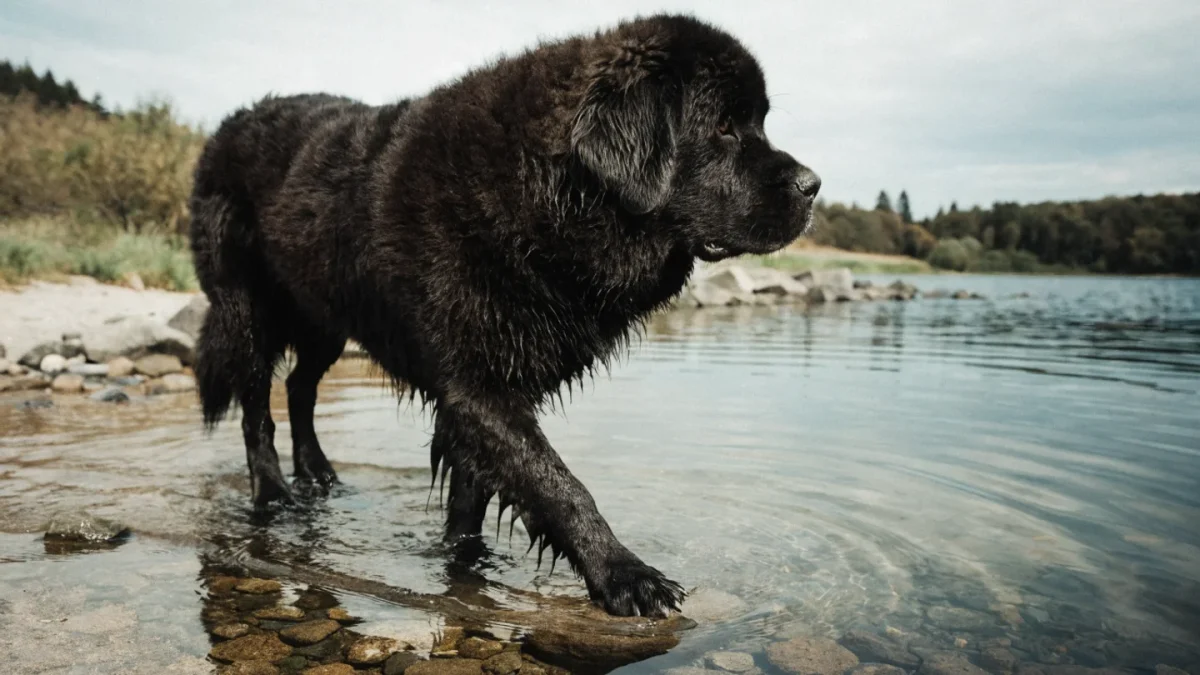
The Newfoundland has been a recognized breed since the early 1800s, and over two centuries of popularity have generated a comfortable mythology that doesn't always survive contact with reality. Some of these myths are minor misunderstandings. Others lead to unprepared owners, poorly managed dogs, and breed-rescue organizations that stay busy year-round.
Here are five misconceptions I encounter repeatedly — and what the evidence actually says.
1. Newfoundlands Are Lazy Dogs
This might be the most damaging myth about the breed, because it attracts owners who want a low-effort pet and end up with a 65-kilogram dog whose needs they aren't meeting.
Newfoundlands are calm. That's different from lazy. The breed was developed for sustained physical labor — hauling fishing nets, pulling carts loaded with gear, and performing water rescues that demanded endurance and power. A working Newfoundland in 18th-century maritime communities was expected to contribute physical effort daily. That capacity didn't disappear because the breed moved into suburban homes.
An adult Newfoundland needs 30 to 60 minutes of moderate daily exercise. The Newfoundland breed guide covers specific activity recommendations, and the Newfoundland exercise guide goes deeper on what that activity should look like — swimming, walking, and why the breed's working history shapes every recommendation. Skip that exercise consistently, and you'll see the consequences: weight gain that accelerates joint problems, restlessness, and a dog that is less content than its reputation suggests it should be.
Calm disposition is an asset. Mistaking calm for zero exercise needs is a setup for failure.
2. They Need a Huge Property
People look at a 70-kilogram dog and assume it requires acres of land. The logic seems sound, but it misses what actually matters to a Newfoundland.
This breed wants to be near its people. A Newfoundland with a five-acre property and an owner who works 60 hours a week will be less happy than a Newfoundland in a modest home with a small yard and an owner who is present most of the day. The Newfoundland temperament is defined by human bonding, not territorial range.
Space helps with logistics — a 65-kilogram dog takes up real square footage indoors, and a yard simplifies bathroom routines. But the critical variable is the owner's availability, not the property's acreage. Owners who fixate on needing a bigger house before getting a Newfoundland often have their priorities inverted. The house can be modest. The time commitment cannot.
3. You Can Manage or Train Away the Drool
Some breeds drool because of excitement or heat. In Newfoundlands, drool is structural. The breed's loose lips and heavy flews don't form a seal around the mouth, so saliva escapes. Constantly. There is no training technique that changes jaw structure, no dietary adjustment that eliminates salivation, and no miracle product that stops a Newfoundland from drooling.
You can manage the volume. Wiping the dog's mouth after eating and drinking, keeping drool cloths accessible, and accepting that your furniture will require protective covers — these are mitigation strategies, not solutions. Some individual Newfoundlands drool less than others, and dogs with tighter lip structure tend to produce less visible drool. But the breed drools. Period.
The owners who thrive with Newfoundlands are the ones who accepted drool as a nonnegotiable feature before they brought the dog home. The ones who thought they'd find a workaround are often the ones who contact rescue organizations two years later.
4. They're Too Big to Be House Dogs
A Newfoundland that lives primarily outdoors is a Newfoundland that suffers.
The assumption behind this myth — big dog, keep it outside — ignores everything about the breed's psychological makeup. Newfoundlands form intense bonds with their families and experience genuine distress when isolated from them. An outdoor-only existence for this breed causes anxiety, depression, and behavioral deterioration.
Inside the home, Newfoundlands are surprisingly unobtrusive for their size. They tend to find a spot — usually wherever their primary person is — and settle there quietly. They're not destructive when their needs are met. They don't ricochet off walls or clear coffee tables with their tails (most of the time). The breed's default indoor setting is "large, warm, gently snoring presence."
The practical accommodations are real: you need a bed large enough for the dog, floor space in your living areas, and a willingness to share your personal space with an animal that doesn't understand the concept of "too close." But the idea that this breed belongs outside because of its size misunderstands what kind of dog it is.
5. They're Basically Oversized Labrador Retrievers
Newfoundlands and Labrador Retrievers share a geographic origin — both breeds trace significant parts of their development to the island of Newfoundland and the surrounding region. They're both large, friendly, and good with families. The comparison ends there.
Labrador Retrievers are high-energy sporting dogs with a seemingly bottomless need for activity and stimulation. Newfoundlands are moderate-energy working dogs whose exercise needs are lower and whose temperament is more sedate. A Lab will fetch a ball until your arm gives out. A Newfoundland will fetch it three times, decide that's sufficient, and lie down.
The breeds also differ in sensitivity. Newfoundlands are deeply attuned to human emotion and tend to be more reactive to household stress than Labradors, who generally maintain their cheerful equilibrium regardless of ambient mood. Newfoundlands shut down under harsh correction in ways that Labradors typically don't.
Choosing between the two breeds is not a matter of preferring a bigger or smaller version of the same dog. It's a matter of wanting fundamentally different energy levels, exercise commitments, and emotional dynamics. Getting this comparison wrong is how people end up with a Newfoundland and wonder why it doesn't behave like the Labrador they grew up with.