

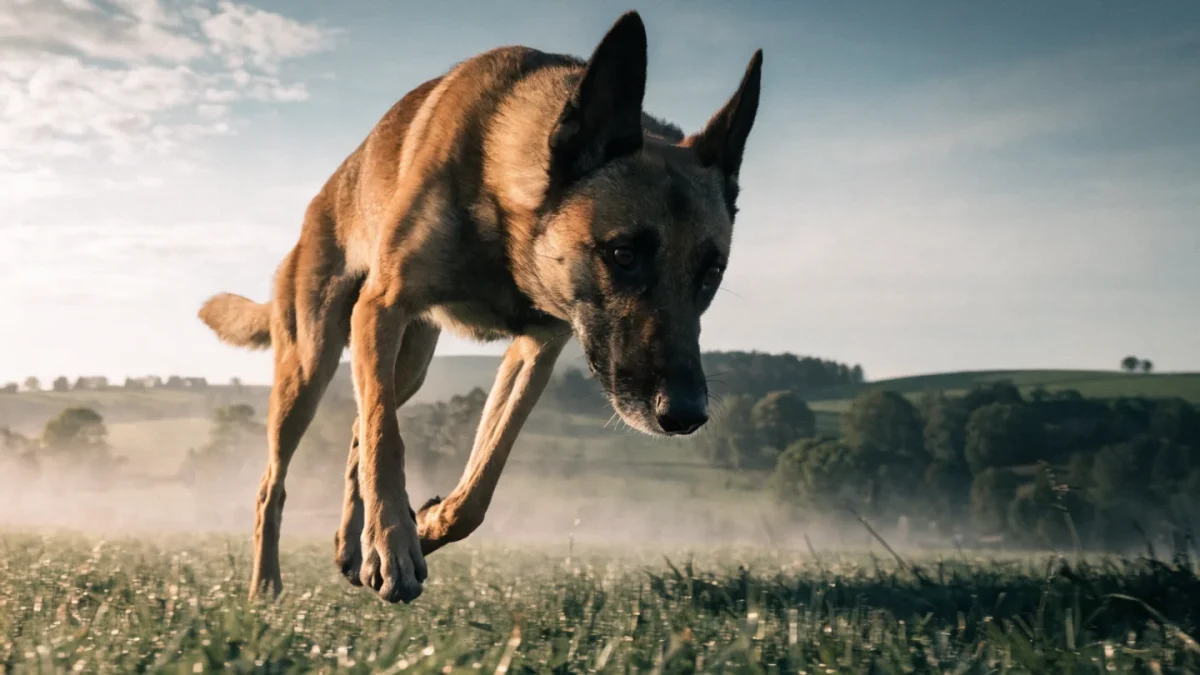
On September 29, 1891, the Club du Chien de Berger Belge held its founding meeting in Brussels, and nobody outside Belgium paid much attention. The men in that room — veterinarians, shepherds, and livestock farmers — were trying to organize the chaotic population of sheepdogs working across Belgium's provinces into something formally recognizable. They didn't know they were laying the groundwork for what would become the most sought-after military working dog on the planet.
The story of the Belgian Malinois is a story about a working dog that kept finding harder jobs. From herding sheep on flat Flemish farmland to detecting explosives in combat zones, the breed's trajectory across 130 years tracks almost perfectly with the twentieth century's escalating demands on working canines.
The Belgian Shepherd Problem
In the late 1800s, Belgium's rural provinces were populated with sheepdogs that shared a common function but varied wildly in appearance. Some had long black coats. Others were wire-haired and fawn. Some were short-coated. Some were enormous; others were lean and medium-sized. They were all called Belgian sheepdogs, and they were all doing the same job — herding livestock, guarding property, and serving as general-purpose farm dogs.
Professor Adolphe Reul of the Belgian School of Veterinary Sciences took it upon himself to sort this out. In November 1891, he assembled 117 of these dogs at the Cureghem hippodrome near Brussels for examination. His conclusion: they represented a single breed with four distinct varieties, distinguished primarily by coat type and color.
The short-haired fawn dogs with black masks, predominantly from the area around the city of Malines (Mechelen in Dutch, about 25 km south of Antwerp), became the Malinois. The long-haired black variety from the village of Groenendael became the Groenendael. The long-haired fawn variety associated with the area around Tervuren became the Tervuren. The rough-haired fawn variety connected to the Laeken district of Brussels became the Laekenois.
This classification remains one of the most debated topics in Belgian Shepherd circles. Some breed registries treat all four as varieties of a single breed. Others classify them as four separate breeds entirely. The practical consequence for the Malinois has been significant — in registries that maintain them as one breed, intervariety crosses are sometimes permitted, which affects the breed's genetic diversity.
From Fields to Police Beats
The transition from herding dog to police dog happened remarkably fast. By the early 1900s — barely a decade after the breed club's founding — Belgian municipalities were already training Malinois for police patrol work. The city of Ghent established one of the first formal police dog programs in 1899, using Belgian Shepherds extensively.
What made the Malinois particularly suited to this work wasn't just trainability — plenty of breeds are trainable. It was the speed of learning, the intensity of engagement, and a particular quality that handlers of the era described as "wanting to work." The Malinois didn't perform tasks because it was compelled to. It performed them because the work itself was rewarding.
Belgian Ring Sport, formalized in the early 1900s, became the proving ground for the breed's working capabilities. The sport tested courage, agility, obedience, and controlled aggression through a series of exercises that remain challenging even by modern protection sport standards. Malinois dominated the competition circuits from the beginning, establishing a reputation that spread beyond Belgium's borders.
Two World Wars
World War I devastated Belgium, and its dogs went to war alongside its people. Belgian Shepherds — Malinois among them — served as messenger dogs, carrying communications between trenches. They worked as ambulance dogs, locating wounded soldiers on battlefields. They served as sentries, warning of enemy approach. The trenches of the Western Front were brutal working conditions, and the dogs that survived them had been tested in ways no training protocol could replicate.
The breed's population took a serious hit during the war. Breeding programs were disrupted, dogs were killed in service, and post-war recovery was slow. The interwar period saw efforts to rebuild the breed's numbers, but World War II inflicted further damage. Belgium's occupation from 1940 to 1944 made organized breeding nearly impossible — nobody kept clean population figures for a dog breed during four years of German occupation, so exact pre- and post-war numbers don't exist, but the disruption to breeding programs and the losses in service both took a real toll.
In the post-war decades, the breed rebuilt steadily in Belgium and gradually gained footholds in other countries. But for most of the mid-twentieth century, the Belgian Malinois lived in the long shadow of the German Shepherd's parallel development — a breed that had captured the public imagination through film, television, and a much more effective marketing apparatus.
The Military Pivot
The shift that transformed the Belgian Malinois from a respected but niche working breed to the world's most in-demand military dog began quietly in the 1980s and 1990s.
Military and law enforcement agencies that had relied on German Shepherds for decades began encountering a problem. The German Shepherd's popularity had driven breeding volumes up and, in many lines, working quality down. Show-line German Shepherds, bred for conformation rather than function, were producing dogs with diminished drive and increasing structural health problems — particularly in the hips and back. Working-line German Shepherds remained capable, but the overall pool was diluted.
Meanwhile, the Malinois had been preserved almost exclusively as a working dog. The breed's lack of mainstream popularity had, ironically, protected it. There was no show ring culture pulling the breed toward appearance over function. The dogs being bred were the dogs doing the work.
Military units began selecting Malinois for specific advantages: lighter body weight (easier to carry, rappel with, or parachute), higher speed and agility, longer working lifespan (12 to 14 years vs. 9 to 13 for German Shepherds), faster learning acquisition, and sustained intensity over long operational periods. The breed's compact frame and explosive athleticism made it better suited to the physical demands of modern special operations — entering vehicles, scaling walls, fast-roping from helicopters.
By the early 2000s, the Belgian Malinois had become the dominant breed in elite military and law enforcement units across multiple countries. The breed saw service in virtually every major military operation of the twenty-first century. Its public profile exploded after the 2011 raid on Osama bin Laden's compound in Abbottabad, Pakistan — the dog was a Belgian Malinois named Cairo, partnered with Navy SEAL Will Chesney, who later confirmed the details in his own account of the mission. The immediate aftermath was murkier, with early reporting unsure of the breed and unwilling to name the dog at all, but that's since been settled.
The Popularity Problem
The breed's military fame created a demand wave that mirrors what happened to German Shepherds decades earlier — and breed historians watch it with the same concern.
Social media accelerated the cycle. Videos of Malinois performing impressive feats — wall climbs, long jumps, complex protection scenarios — accumulated millions of views and generated a surge of interest from buyers who had no framework for managing the breed's intensity. Shelters and rescue organizations began reporting increasing numbers of surrendered Malinois, typically between 8 and 18 months of age, the exact period when adolescent drive peaks and untrained dogs become unmanageable.
The breed now faces a tension that defines many working dogs thrust into popularity: the qualities that make it exceptional in professional roles are the same qualities that make it unsuitable for most pet homes. Speed, drive, intensity, environmental awareness, and physical power are assets when directed by experienced handlers. Without that direction, they're liabilities.
Whether the Belgian Malinois will follow the German Shepherd's trajectory — splitting into working and show populations with increasingly divergent capabilities — remains an open question. Some breeders argue the split has already begun. Others maintain that the breed's culture, rooted in working trials rather than conformation showing, provides a defense that the German Shepherd never had.
The Malinois started as a farmer's dog in a small Belgian city. It became a police dog, a war dog, and eventually the working dog of choice for the most demanding military roles humans have devised. That journey says everything about what this breed is and what it needs: not a home, but a purpose.
For the complete picture on what that means for modern ownership, see the full Belgian Malinois breed guide.