

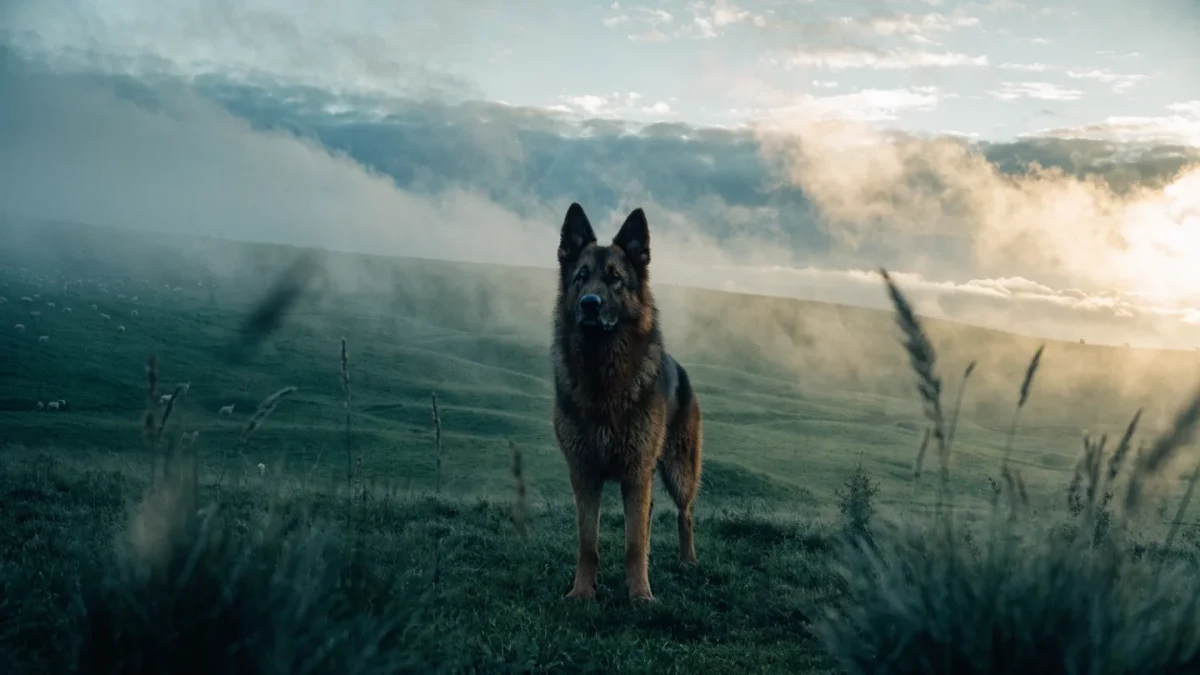
On April 3, 1899, a German cavalry officer walked into a dog show in Karlsruhe, Germany, and saw exactly what he had been looking for. The dog was medium-sized, wolf-gray, and moving with the kind of fluid, ground-covering trot that spoke to real working ability. Its name was Hektor Linksrhein. Within hours, Max von Stephanitz had bought it, renamed it Horand von Grafrath, and set in motion the creation of what would become the most versatile working breed in history.
This is not a story about a dog. It is a story about a man with an obsession, an engineering mindset applied to biology, and a breed that was designed — deliberately, systematically, and ruthlessly — to be useful above all else.
Before There Was a Breed
Germany in the late 1800s had no shortage of herding dogs. Across Thuringia, Franconia, Swabia, and Württemberg, regional sheepherding dogs had been working livestock for centuries. These were not standardized breeds. They varied in size, coat type, ear carriage, and temperament from valley to valley. What they shared was function: they moved sheep efficiently across varied terrain, in all weather, with minimal human direction.
Max von Stephanitz, born in 1864 into a wealthy family and trained as a cavalry officer at the Berlin Veterinary College, spent years studying these regional dogs before Karlsruhe. He was not interested in appearance. He was interested in capability. He traveled across Germany observing sheepdogs at work, noting which traits correlated with the best performance: medium build, strong but not heavy, alert and responsive, able to sustain a working trot for hours.
His frustration was that nobody was breeding for consistency. Each region produced capable dogs, but there was no standard, no registry, and no systematic effort to consolidate the best traits into a predictable, reproducible type. Von Stephanitz saw this as an engineering problem with a biological solution.
Horand and the Founding of the SV
When von Stephanitz registered Horand von Grafrath as SZ 1 — entry number one in a new breed registry — he simultaneously founded the Verein für Deutsche Schäferhunde, the SV, on April 22, 1899. The SV was not a hobby club. It was a breeding management organization with von Stephanitz as its autocratic president. He would hold that position for 36 years.
Horand was not a flawless dog. Von Stephanitz himself described the animal as "medium size, with powerful bones, beautiful lines, and a nobly formed head. Clean and sinewy in build." But Horand was also reportedly high-strung and difficult to manage in some contexts. Von Stephanitz chose him anyway because Horand embodied the physical working traits he valued: endurance, structural soundness, and that tireless trot.
The breeding program that followed was aggressive and focused. Horand was bred extensively, and his sons — particularly Hektor von Schwaben and Beowulf — carried forward the foundation lines. Von Stephanitz directed breeding decisions across the fledgling breed, advising (and sometimes demanding) specific matings. The early gene pool drew heavily from Thuringian dogs, known for wolf-like appearance and higher drive, and Württemberg dogs, known for heavier build and calmer temperament. The modern german shepherd carries both influences.
The Working Test Mandate
Von Stephanitz's most consequential decision was tying breeding eligibility to working ability. By 1901, the SV required that dogs pass a herding or obedience test before being bred. This was radical for the time. Most breed clubs evaluated dogs on appearance alone. Von Stephanitz's maxim — "Utility and intelligence. Utility and intelligence. That is the motto for the shepherd dog" — was not a suggestion. It was policy.
The Schutzhund test, developed in 1906, formalized this requirement. Dogs had to demonstrate obedience, tracking, and protection work. Failing any component disqualified them from breeding, regardless of their physical beauty. This single rule kept the breed functionally sound for its first several decades and is the reason the german shepherd became the world's preeminent working dog breed rather than just another handsome herder.
But von Stephanitz was fighting a trend he could see coming. Even during his lifetime, some breeders began prioritizing appearance over working ability. In the 1920s, he wrote bitterly about "beauty breeders" who were producing dogs that looked impressive but couldn't herd a sheep across a pasture. That tension — function versus form — has only deepened in the century since.
Two World Wars and a Global Breed
World War I turned the german shepherd from a German specialty into a global phenomenon. The German military deployed an estimated 48,000 dogs during the war, most of them german shepherds, for sentry duty, message carrying, casualty detection, and ammunition hauling. They performed reliably under conditions that broke men — artillery barrages, gas attacks, trench warfare.
Allied soldiers noticed. When the war ended, returning servicemen from Britain, France, the United States, and Australia brought german shepherds home. In Britain, lingering anti-German sentiment led the Kennel Club to rename the breed "Alsatian Wolf Dog" in 1919, later shortened to "Alsatian." That name persisted officially until 1977.
American interest exploded in the 1920s. An American soldier named Lee Duncan had rescued a german shepherd puppy from a bombed war-dog kennel in Lorraine, France, in September 1918. He named the dog Rin Tin Tin, trained it, and eventually brought it to Hollywood. Rin Tin Tin starred in 27 films for Warner Bros. and is credited by some historians with saving the studio from bankruptcy. The dog's popularity drove german shepherd registrations in the U.S. to the highest of any breed — and triggered exactly the kind of irresponsible mass breeding that von Stephanitz had feared.
World War II deepened the breed's military reputation. German shepherds served on all sides of the conflict. The post-war decades saw the breed become the dominant choice for police, military, and search-and-rescue work worldwide. By the 1960s, the german shepherd was arguably the most recognized dog breed on earth.
The Great Divergence
Starting in the late 1960s, a split began forming that would fundamentally alter the breed. Show breeders, particularly within the German SV system, began selecting for increasingly angulated rear structure — the dramatic slope from withers to croup that produces the breed's distinctive "flying trot" in the show ring.
Working-line breeders, meanwhile, continued selecting for structural soundness, drive, and performance. Their dogs retained straighter toplines, more moderate angulation, and compact builds suited to sustained physical work.
By the 1980s, the two populations looked noticeably different. By 2000, the gulf was dramatic. A modern German show-line dog and a working-line Czech or Belgian-bred german shepherd bear only superficial resemblance to each other. They move differently, carry different health risk profiles, and behave with different baseline intensities.
The temperament of the modern german shepherd reflects this split directly. Working lines retained the high-drive, handler-focused character that von Stephanitz selected for. Show lines developed calmer, lower-drive temperaments better suited to the conformation ring and pet ownership.
Von Stephanitz died in 1936. It is reasonable to wonder what he would make of this divergence. His entire breeding philosophy centered on working ability as the non-negotiable foundation. The breed he built has, in significant part, moved away from that foundation.
The Modern German Shepherd
Today, the german shepherd is consistently among the top three most registered breeds worldwide. It serves in police departments, military units, search-and-rescue teams, and detection programs across every continent. It is also one of the most popular pet breeds, a role von Stephanitz never intended but which the breed's intelligence and loyalty make possible.
The breed faces genuine challenges. Health problems — particularly hip dysplasia, degenerative myelopathy, and the structural consequences of extreme angulation — are more prevalent than they should be in a breed with over a century of organized breeding. The show-line versus working-line divide continues to widen. Irresponsible breeding by operations that prioritize volume over health testing remains common.
But the german shepherd endures because the core traits von Stephanitz selected for — intelligence, trainability, loyalty, physical versatility — remain genuinely extraordinary. No other breed matches the german shepherd's range of working capability. From narcotics detection to guide work to disaster search to competitive obedience, this one breed excels across more disciplines than any other.
The full german shepherd breed guide covers the practical details of living with the breed that von Stephanitz built — health screening, exercise requirements, grooming, and whether this dog actually fits your life. But the history matters because it explains why the german shepherd is the way it is. Every behavioral trait, every structural feature, every health predisposition traces back to decisions made by a cavalry officer who believed that a dog's worth was measured by what it could do, not what it looked like.
That belief built a breed. Whether the breed still honors it depends on who is doing the breeding — and who is buying the dogs.