

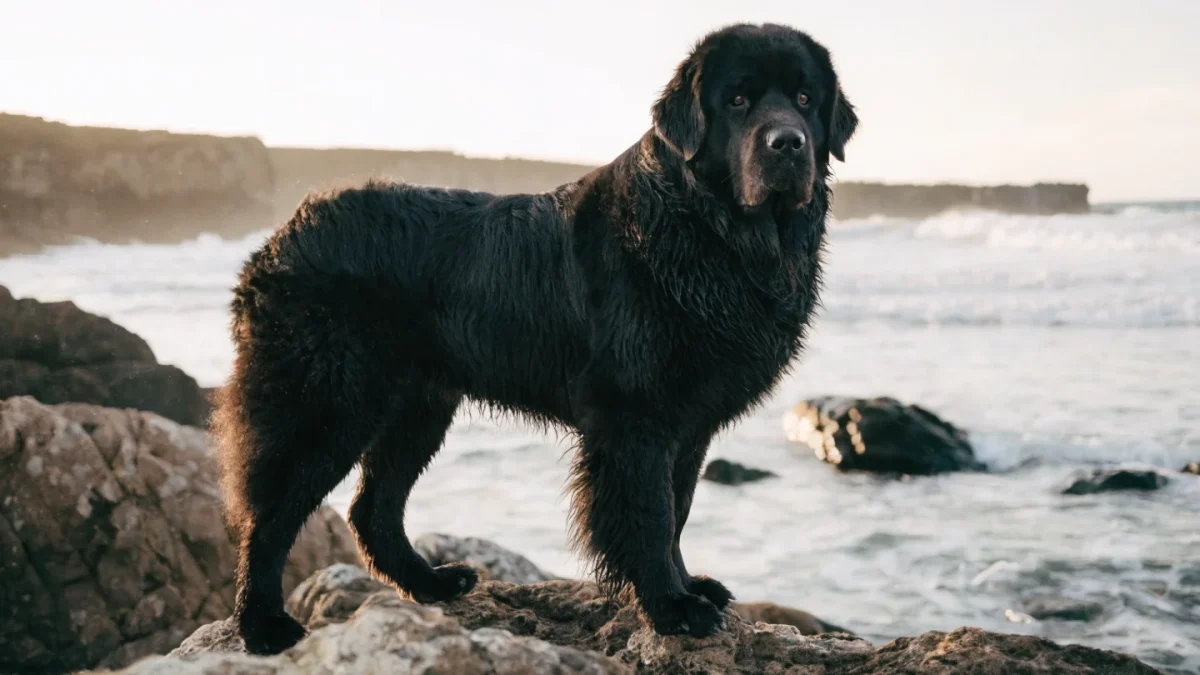
A Newfoundland changes the room. Not metaphorically — physically. When a mature male walks in, he fills the space the way a piece of large furniture fills it: the visual mass, the shift in the air, the awareness that something substantial has arrived. Then he lies down with an audible exhale, and somehow the room becomes calmer. That combination — monumental size, monumental patience — is what Newfoundland owners are trying to describe when they say this breed is unlike other giant dogs. They're not wrong.
At 60-plus kilograms and over 70 cm at the shoulder, the Newfoundland is one of the largest dog breeds in the world. The outer coat is coarse and water-resistant; the undercoat is thick enough to keep the dog functional in water temperatures that would immobilize a person in minutes. The head is broad and substantial, the tail is a rudder, the feet are webbed. Everything about the physical architecture traces back to centuries of work in the North Atlantic — hauling nets, towing boats, pulling carts loaded with salted fish through snow. The breed was a working tool before it was anything else.
What makes the Newfoundland unusual among giant working breeds is the temperament that came along for the ride: calm, patient, people-oriented to a degree that surprises people who expect a dog this large to be more independent. This guide covers the full picture — the history, the physiology, the heart condition every prospective owner needs to understand before they commit, and what daily life with 60 kilograms of affectionate dog actually looks like.
Origins and History
The Newfoundland's origins are tangled in competing theories, and the honest answer is that nobody has settled the question definitively. What's clear is that large, heavy-coated working dogs existed on the island of Newfoundland by the 1600s, used by European fishermen — primarily English, Irish, and Portuguese — for hauling nets, retrieving equipment that fell overboard, and pulling carts of salted cod to market.
The breed likely descends from a mix of indigenous dogs kept by the Beothuk and Mi'kmaq peoples and large European breeds brought by settlers — possibly including mastiff-type dogs, Portuguese water dogs, and various livestock guardians. The Great Pyrenees is sometimes cited as an ancestor, which would explain the breed's massive bone structure and heavy coat, though genetic confirmation of specific ancestral breed contributions remains incomplete.
By the 1700s, Newfoundlands were being exported to England, where they became fashionable among the landed gentry and were prized as water rescue dogs. The breed caught the attention of notable figures — Lord Byron kept a beloved Newfoundland named Boatswain and wrote a famous epitaph for him in 1808 that praised the dog's qualities over those of humans. The painter Edwin Landseer featured Newfoundlands so frequently in his work during the 1830s and 1840s that the black-and-white variety of the breed eventually took his name.
For a deeper look at how this breed moved from fishing boats to parlors to rescue stations, see the full history of the Newfoundland.
Physical Characteristics
Size and Build
This is a genuinely massive dog. Males stand 71 cm on average at the shoulder and weigh 59 to 68 kg. Females are slightly smaller, typically standing 66 cm and weighing 45 to 54 kg. Individual dogs regularly exceed these ranges. The overall impression is one of raw power — broad chest, heavy bone, strong hindquarters, and a wide, slightly rounded head with a short, broad muzzle.
The body is slightly longer than tall, with a level topline and a deep rib cage that extends well back. The legs are straight and heavily boned. Everything about the Newfoundland's build is designed for sustained effort in cold water — nothing is streamlined or elegant. Function dictated form, and it shows.
Coat
The double coat is thick, dense, and water-resistant. The outer coat is moderately long, coarse, and either flat or slightly wavy. The undercoat is soft and dense — particularly thick in winter and during cold-water exposure. The coat is oily to the touch, a feature that enhances water resistance and helps the dog shed moisture after swimming.
Standard coat colors are black, brown, grey, and white-and-black (the Landseer pattern). Black is the most common and historically the most traditional. The brown ranges from chocolate to bronze. Grey Newfoundlands are recognized by some breed registries — the Canadian Kennel Club and FCI accept grey, while the AKC standard recognizes black, brown, gray, and white-and-black.
Feet and Swimming Adaptations
The Newfoundland's feet deserve special mention because they reveal how thoroughly this breed was shaped by water work. The feet are large, round, and — critically — webbed. The webbing between the toes functions like a paddle, significantly increasing swimming efficiency. Combined with the powerful, broad tail that acts as a rudder, the heavy bone structure that provides ballast without compromising buoyancy (the oily coat traps air), and the massive lung capacity, the Newfoundland is one of the most capable natural swimmers in the canine world.
Their swimming style is distinctive too. Unlike most dogs that paddle with a rapid, inefficient dog-paddle motion, Newfoundlands use a modified breaststroke — a sweeping, lateral movement of the front legs that generates far more thrust per stroke. This allows them to tow boats, pull drowning people, and swim for extended periods in rough water without exhausting themselves.
Temperament and Behavior
The Newfoundland temperament is the reason people fall in love with this breed and the reason they stay. If the German Shepherd is the disciplined officer and the Golden Retriever is the enthusiastic volunteer, the Newfoundland is the unflappable paramedic — calm under pressure, gentle by default, and capable of decisive action when something goes wrong.
For a comprehensive look at what living with this temperament actually involves day to day, see the full Newfoundland temperament guide.
What Most People Get Wrong About This Breed
The most common misconception I encounter is that Newfoundlands are lazy dogs. They're not. They're calm dogs — and there's an important distinction. A lazy dog lacks motivation. A calm dog conserves energy for when it matters. Newfoundlands were bred to work in short, intense bursts — hauling a net, pulling a drowning person to safety, dragging a loaded cart — interspersed with periods of rest. That work pattern produced a dog that's remarkably quiet and composed indoors but capable of explosive strength and sustained effort when needed.
The second misconception is that their size makes them clumsy. Newfoundlands are surprisingly agile for their mass. In water, they're graceful. On land, a well-conditioned Newfoundland moves with a rolling, ground-covering gait that's efficient rather than lumbering. They can be destructive in tight spaces simply because of physics — a wagging tail at counter height will clear surfaces — but that's geometry, not clumsiness.
Temperament with Children
Newfoundlands have a documented history of protectiveness toward children that goes beyond simple tolerance. J.M. Barrie chose a Newfoundland as the nursemaid dog Nana in Peter Pan (1904) — not as fantasy, but because Newfoundlands serving as child guardians was a recognized trait by the early 1900s. They instinctively position themselves between children and perceived threats, and their patience with rough handling from small children is notably high.
That said, a 60 kg dog can knock a toddler flat without trying. Supervision is always necessary, regardless of temperament.
Drive and Instincts
The water drive in this breed is not optional — it's hardwired. Many Newfoundland owners discover this when their dog launches into any accessible body of water without invitation. Some Newfoundlands will attempt to "rescue" swimmers who don't need rescuing, gently towing them toward shore by the arm. This is instinct, not misbehavior, and it's a feature of the breed that owners need to understand and manage.
Health Profile
Giant breeds face health challenges that shorter-lived, smaller dogs don't, and Newfoundlands carry their own specific set of genetic concerns on top of the standard giant-breed risks.
Subvalvular Aortic Stenosis (SAS)
SAS is the single most important health issue in Newfoundlands and the one every prospective owner must understand. It's a congenital heart defect where a ridge or ring of abnormal tissue forms below the aortic valve, partially obstructing blood flow from the heart. The condition ranges from mild (a faint murmur, no clinical signs, normal lifespan) to severe (sudden death from cardiac arrhythmia, sometimes with no prior warning signs).
SAS is hereditary and particularly prevalent in Newfoundlands compared to other breeds. Screening via cardiac auscultation and Doppler echocardiography is standard practice, and puppies should be evaluated by a veterinary cardiologist — not just a general practitioner. Even with screening, the genetics are complex — suspected to be polygenic with variable penetrance — and not fully characterized by a single-gene DNA test, so affected puppies occasionally appear in litters from screened parents.
Cystinuria
Cystinuria is an inherited metabolic disorder that causes the kidneys to excrete excessive amounts of the amino acid cystine into the urine. The cystine forms crystals and eventually bladder or kidney stones, which can cause urinary blockages — a potentially life-threatening emergency, particularly in males. A DNA test exists for the Newfoundland-specific mutation (Type I cystinuria), and responsible breeders test breeding stock. Males are disproportionately affected by stone formation due to urethral anatomy, even though both sexes can carry the genetic mutation.
Other Health Concerns
- Hip and elbow dysplasia: Common in giant breeds. Screening of breeding stock is standard but doesn't eliminate risk.
- Cruciate ligament tears: The combination of heavy body weight and active movement makes cruciate injuries more likely. Surgical repair costs are substantial in giant breeds.
- Gastric dilatation-volvulus (GDV/bloat): A life-threatening emergency where the stomach twists on its axis. Deep-chested giant breeds are at highest risk. Feeding smaller, more frequent meals and avoiding vigorous exercise immediately after eating are standard precautions.
- Hypothyroidism: Underactive thyroid, manageable with daily medication.
- Osteosarcoma: Bone cancer occurs at higher rates in giant breeds generally.
Lifespan
Newfoundland lifespan averages 8 to 10 years, consistent with most giant breeds. Some individuals reach 12, but expecting that as a baseline isn't realistic. The relatively short lifespan is one of the genuine costs of owning this breed, and anyone considering a Newfoundland should make peace with it beforehand.
Grooming Requirements
There is no way to sugarcoat this: grooming a Newfoundland is a significant time commitment. The thick, oily double coat requires regular, thorough maintenance to prevent matting, manage shedding, and keep the skin healthy.
Coat Care
Brush the entire coat thoroughly at least three times per week. During the two annual shedding seasons — spring and fall — daily brushing with an undercoat rake becomes necessary. A slicker brush handles the outer coat, while a long-toothed metal comb works through the dense undercoat and the heavy feathering on the legs, chest, and tail.
Pay special attention to behind the ears, the armpits, the area where the rear legs meet the body, and the thick ruff around the neck. These are the zones where mats form fastest. Mats in a Newfoundland coat can tighten against the skin and cause irritation or hot spots if left unattended.
Bathing
Bathing a Newfoundland is a project. The coat is so thick and water-resistant that getting it fully saturated takes time, and getting it fully dry takes longer. Many owners use a high-velocity dryer. Leaving the coat damp creates conditions for bacterial and fungal skin infections. Bath every four to eight weeks depending on the dog's activities and living environment.
The Drool Factor
Newfoundlands drool. Some drool more than others — dogs with looser flews (lip folds) produce more than those with tighter lip lines — but all Newfoundlands drool to some degree. After drinking, after eating, when hot, when excited, when watching you eat. Strategic placement of towels near water bowls and in the car is standard Newfoundland ownership practice. If drool is a dealbreaker, this is not your breed.
Exercise and Activity Needs
Despite their size, Newfoundlands have moderate exercise requirements compared to high-energy sporting breeds. About 30 to 60 minutes of daily activity is appropriate for a healthy adult, but the type of exercise matters more than the duration.
Ideal Activities
- Swimming: The best possible exercise for this breed. It's low-impact on joints, leverages their natural abilities, and provides excellent cardiovascular conditioning without the skeletal stress of land-based exercise.
- Moderate walks: Leisurely to moderate-pace walks of 30 to 45 minutes suit most adult Newfoundlands. Avoid forced running, especially on pavement.
- Carting and draft work: Newfoundlands were bred to pull loads, and organized carting activities tap into that instinct. Many breed clubs offer carting tests and titles.
- Water rescue training: Structured water rescue work — the breed's historical purpose — provides physical and mental stimulation simultaneously.
Heat Sensitivity
The thick double coat that insulates against Atlantic waters makes Newfoundlands vulnerable to overheating. Exercise in hot or humid conditions should be limited. Provide shade and fresh water at all times, exercise during cooler morning or evening hours in warm climates, and never leave a Newfoundland in a vehicle on a warm day. Heat stroke in giant, heavy-coated breeds can progress from mild to fatal rapidly.
Puppy Exercise Caution
Newfoundland puppies grow at an alarming rate, and their skeletal system lags behind their body mass during development. Over-exercising growing puppies — especially on hard surfaces or with repetitive high-impact activities — risks lasting damage to developing joints and growth plates. The general guideline of five minutes of structured exercise per month of age, twice daily, is a reasonable starting framework for giant breed puppies. Let them swim, explore soft terrain, and play freely, but avoid forced jogging, stair climbing, or jumping until growth plates have closed — typically not until 18 to 24 months in this breed.
Nutrition Fundamentals
Feeding a Newfoundland correctly requires attention both to quantity and to the unique nutritional demands of giant-breed growth and maintenance.
Feeding Approach
Feed measured meals rather than free-feeding. Two meals per day is standard for adults. Puppies need three to four meals daily until about six months, then transition to two. Because Newfoundlands are susceptible to GDV, avoid feeding one large meal per day, use slow-feeder bowls if the dog eats rapidly, and restrict vigorous exercise for at least an hour after eating.
Giant-breed puppies must not be overfed or fed diets with excessive calcium, as rapid growth and mineral imbalances contribute to developmental orthopedic disease. Formulations specifically designed for giant-breed puppies control growth rate without restricting overall nutrition.
Weight Management
Excess weight on a Newfoundland accelerates joint degeneration, increases the load on an already-at-risk cardiovascular system, and shortens an already-brief lifespan. At a healthy weight, you should be able to feel the ribs without pressing hard, and there should be a visible waist when viewed from above. Given the heavy coat, visual assessment alone is unreliable — hands-on rib checks are essential.
Living Situation Compatibility
Newfoundlands need space, but not necessarily a sprawling estate. A house with a moderately sized fenced yard and reasonable access to water for swimming is ideal. They can adapt to larger apartments if their exercise and social needs are met, but the practical realities of a 60+ kg dog in a small space — including the drool, the shedding, the water consumption, and the sheer physical footprint — make apartment living challenging.
Indoor Life
This breed wants to be with its people. Newfoundlands that are isolated in a yard or kenneled long-term develop anxiety, destructive behavior, and depression. They're house dogs that happen to be enormous. Expect them to claim the coolest spot on the floor, position themselves in doorways and hallways (they like to keep tabs on household traffic), and lean against your legs with their full body weight as a form of affection.
Climate Considerations
Newfoundlands thrive in cold climates. Snow, cold rain, and frigid water are where this breed comes alive. Hot, humid climates pose a genuine welfare concern. If you live in a consistently warm climate, you need air conditioning, shade, access to water for cooling, and willingness to restructure exercise schedules around temperature. This breed was built for the North Atlantic, and asking it to thrive in sustained heat is asking against its biology.
The Right Owner for This Breed
A Newfoundland is the right dog for you if:
- You have the physical space — and patience — for a dog that weighs as much as a person and sheds like two
- You can commit to thorough grooming multiple times per week
- You live in a moderate or cold climate, or can provide adequate cooling
- You want a calm, deeply bonded companion rather than a high-energy sporting partner
- You're prepared for cardiac screening, potential orthopedic costs, and a lifespan that maxes out around 10 years
- Drool on your ceiling, walls, and clothing doesn't bother you (yes, ceiling — they shake their heads)
- You have access to safe water for swimming, ideally year-round
A Newfoundland is the wrong dog for you if:
- You want a clean, low-maintenance home
- You live in a hot climate without reliable air conditioning
- You're away from home for long stretches with no dog care plan
- The financial reality of giant-breed veterinary care — higher doses, larger imaging, more expensive surgery — isn't something you can absorb
- You want a guard dog with sharp edges — Newfoundlands are protective but not aggressive
- A 10-year commitment feels too short for the investment
Newfoundlands don't just take up space in your house. They take up space in your life in a way that's disproportionate to even their considerable size. The people who love this breed love it fiercely, and they'll tell you the short lifespan is the only thing wrong with it. They're not wrong.
Frequently Asked Questions
How much do Newfoundland dogs drool?
All Newfoundlands drool to some extent, but the amount varies by individual and depends partly on the tightness of the lip line. Dogs with looser flews drool more. Drool increases after drinking, during meals, when hot, and when excited. Most owners keep towels strategically positioned around the house and in the car. If you're considering this breed, visit an adult Newfoundland in person before committing — the drool situation needs to be experienced, not described.
Are Newfoundlands good apartment dogs?
It's technically possible but practically difficult. A healthy adult Newfoundland weighs 50 to 68 kg and needs room to move, lie down comfortably, and exist without bumping into everything. Add the grooming requirements, the shedding volume, the drool, and the need for regular access to outdoor exercise (ideally swimming), and apartment living creates friction at every turn. A house with a yard and proximity to safe water is the realistic recommendation.
How much does it cost to own a Newfoundland per year?
Costs vary significantly by location, but giant-breed ownership is consistently more expensive than owning a medium-sized dog. Food costs are higher by volume. Veterinary costs are higher because medication doses, anesthesia quantities, and surgical procedures all scale with body weight. Grooming costs are higher whether you do it yourself (equipment) or use a professional (giant-breed surcharges are standard). Cardiac screening should be annual. Expect to budget meaningfully more than you would for a 25 kg dog across every category.
Can Newfoundlands live in warm climates?
They can survive in warm climates with proper management, but they don't thrive in sustained heat. Air conditioning is mandatory, not optional. Exercise must be restricted to cool morning and evening hours. Access to water for swimming provides essential cooling. The thick double coat should never be shaved — it provides insulation against heat as well as cold, and shaving disrupts the coat's temperature-regulating function. If you live somewhere that's consistently above 30 degrees Celsius for months at a time, this breed will require significantly more accommodation than in a temperate or cold climate.
How does the Newfoundland compare to a Labrador Retriever?
Both breeds trace part of their development to the island of Newfoundland, but they are fundamentally different dogs. Labrador Retrievers are high-energy sporting dogs that need sustained activity and thrive on constant engagement. Newfoundlands are moderate-energy working dogs — calmer, heavier, and built for strength rather than speed. A Lab will fetch a ball until your arm gives out. A Newfoundland will fetch it a few times and then decide that's sufficient. The exercise requirements, grooming demands, and temperament profiles are meaningfully different.
What's the difference between a Newfoundland and a Landseer?
The Landseer is a white-and-black color variety of the Newfoundland. In some countries, particularly in continental Europe, the Landseer is registered as a separate breed (the Landseer European Continental Type, or ECT) with slightly different conformation — longer legs, a less massive head, and a generally more athletic build. In North America and the UK, the white-and-black Newfoundland is simply a color variant within the Newfoundland breed, not a separate breed. The name comes from the painter Sir Edwin Landseer, who depicted black-and-white Newfoundlands in many of his 19th-century works.