

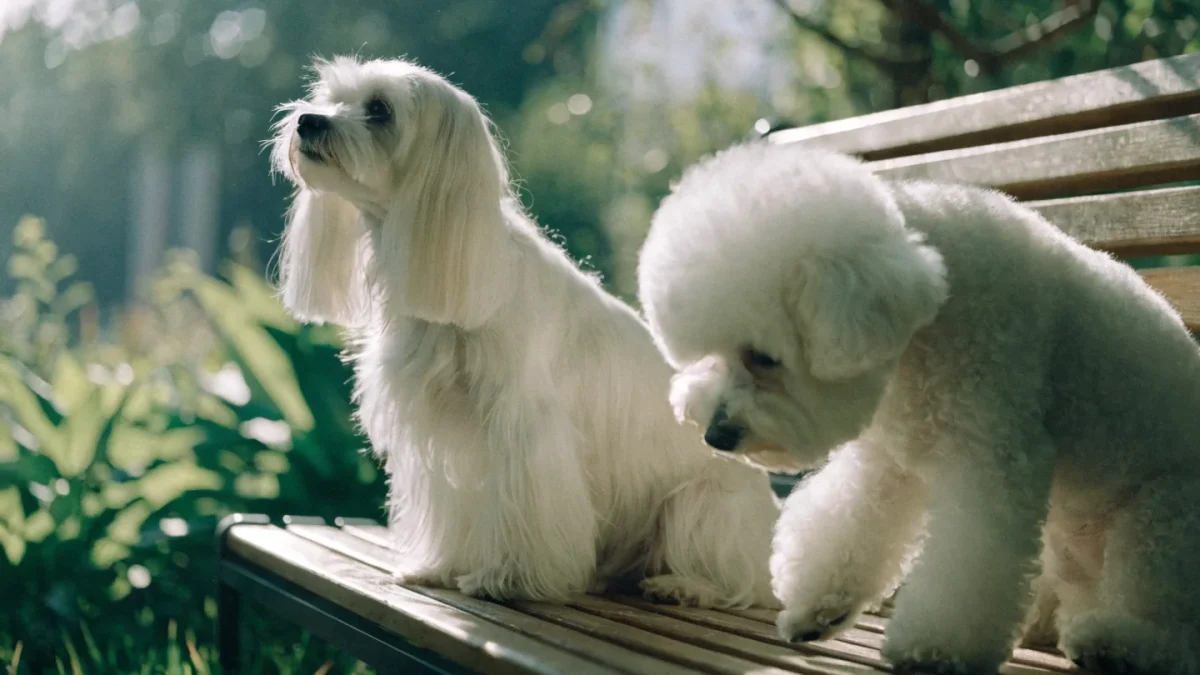
The Maltese may be the oldest toy breed in existence — depictions of small white dogs matching its description appear in Greek and Roman art from 500 BCE. The Bichon Frise descends from water spaniels in the Mediterranean and gained fame as a companion to Spanish and French nobility during the Renaissance. Both breeds have spent centuries in laps. But they got there via different routes, and those differences shape what it's like to live with each one today.
These two get confused constantly because they're both small, white, and fluffy. Beyond color, they're quite distinct. Here's how they compare using the full comparison framework.
Size and Build
| Trait | Maltese | Bichon Frise |
|---|---|---|
| Height | 20–25 cm | 23–30 cm |
| Weight | 1.8–3.2 kg | 3–5 kg |
| Build | Fine-boned, delicate | Sturdier, more compact |
| Coat texture | Long, silky, straight | Curly, dense, plush |
The Bichon is the bigger dog by a meaningful margin — nearly double the weight of a small Maltese. The Maltese is delicate in frame; the Bichon is more robust. You can feel the difference immediately: the Maltese feels fragile, the Bichon feels solid.
Temperament
Maltese tend to be one-person dogs. They bond intensely with their primary human and can be reserved or even aloof with everyone else. They're alert, spirited, and surprisingly bold for their size — the Maltese has no concept of being small and will stand its ground against much larger dogs (which is a management concern, not a virtue).
Bichons are social generalists. They love everyone — family, guests, other dogs, strangers at the park. The Bichon's default setting is cheerful, and they bring genuine playfulness that persists well into their senior years. They're less possessive and more adaptable to multi-person households.
Both breeds struggle with separation anxiety. The Maltese may express it through barking and destructive behavior; the Bichon may express it through housebreaking regression and anxiety-related behaviors.
Grooming — The Real Commitment
Both breeds demand serious grooming. Anyone who tells you these are low-maintenance dogs because they "don't shed" is leaving out the rest of the story.
The Maltese coat grows continuously and, when kept long, requires daily brushing to prevent matting. That pure white, floor-length coat you see at dog shows is maintained through hours of weekly brushwork, regular bathing, and wrapping individual coat sections between shows. Most pet owners keep Maltese in a shorter "puppy cut" — more practical, still requiring professional grooming every 4 to 6 weeks.
The Bichon Frise coat is curly and dense. It doesn't shed in the traditional sense (loose hairs get caught in the curls) but mats aggressively if not brushed regularly — three to four times per week minimum. Professional grooming every 4 to 6 weeks maintains the rounded, powder-puff silhouette the breed is known for.
Both breeds are sometimes called "hypoallergenic." They produce less dander than many breeds and shed minimally, which may reduce allergic reactions for some people. But no dog is truly hypoallergenic. Individual reactions vary.
Health
| Health Factor | Maltese | Bichon Frise |
|---|---|---|
| Top concern | Collapsed trachea, dental disease | Bladder stones, allergies |
| Lifespan | 12–15 years | 12–15 years |
| Joint issues | Luxating patella | Luxating patella |
| Eye issues | Tear staining, PRA | Cataracts |
| Dental | Severe crowding, early tooth loss common | Moderate dental issues |
The Maltese is particularly prone to dental problems — the tiny jaw creates severe crowding, and many Maltese lose teeth early in life even with regular dental care. Collapsed trachea is another significant concern, made worse by collar pressure (harnesses are strongly recommended).
Bichon Frises face higher rates of bladder stones (calcium oxalate stones particularly) and skin allergies. Both breeds have similar lifespans and share luxating patella as a common orthopedic issue.
Exercise
Both breeds need 30 to 45 minutes of daily activity. Indoor play, short walks, and interactive games satisfy both. Neither is an endurance athlete, and both overheat easily due to their small size.
The Bichon tends to be slightly more energetic and playful throughout the day. The Maltese is content with shorter activity bursts followed by extended lap time.
Which Fits Your Life?
Choose the Maltese if you're a single-person or couple household, want an intensely bonded companion, and can commit to daily coat care. The Maltese thrives with a dedicated owner who's home frequently.
Choose the Bichon Frise if you have a busier household with multiple family members or visitors, want a more universally social dog, and prefer the curly coat that, while still high-maintenance, is slightly more forgiving day-to-day than the Maltese's silky hair.
If you're weighing the Maltese against the Yorkshire Terrier, that's a different comparison with different dynamics. For a full profile of the Bichon Frise covering its Renaissance history, grooming requirements, and health considerations, see the Bichon Frise complete breed guide. For a deep look at the Maltese's 2,500-year history as a Mediterranean companion breed and its dental and tracheal health profile, the Maltese complete breed guide covers the breed in full.