

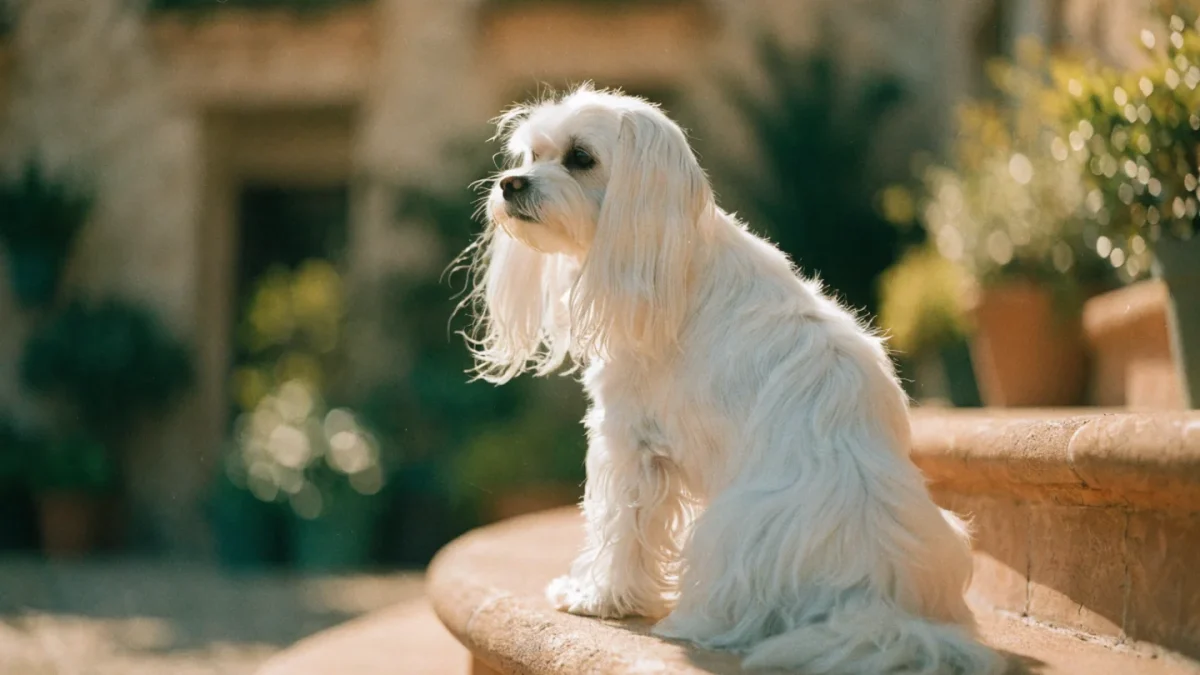
The Maltese appears in a Greek amphora from roughly 500 BCE — a small white dog perched on a woman's lap with the inscription "Melitaie," the ancient word for the island of Malta. That makes this breed older than most nations. While other toy breeds were engineered in the last few centuries to fill companion niches, the Maltese was already there, doing the same job it does today, when Aristotle was cataloguing animals in his Historia Animalium around 350 BCE. He mentioned a small dog of the "Melita" type, noting its diminutive and perfectly proportioned build.
The Maltese is a toy companion breed weighing 3 to 4 kg, defined by a pure white silk coat that grows to floor length, a bold personality that routinely surprises people who expect passivity from small dogs, and a health profile that demands informed ownership. If you want a maltese dog breed guide that addresses the breed honestly — the history, the temperament realities, the grooming commitment, and the health concerns that matter — this is it.
This is one of the most misunderstood toy breeds. People see the white coat and the small frame and assume they're looking at a fragile, passive lapdog. They're wrong on every count.
Origins and History
The Maltese's geographic origin is debated, though the name ties it to Malta in the central Mediterranean. The breed likely developed across the broader Mediterranean trade network — Sicily, southern Italy, Malta, and possibly the coastal Adriatic. Phoenician traders likely carried small companion dogs along trade routes as early as 1500 BCE — breed historians widely accept this connection, and archaeological evidence from ancient Egypt depicts similar small dogs — though direct evidence linking those specific dogs to the modern Maltese remains circumstantial.
What's documented is that by the classical Greek and Roman periods, the breed was established, valued, and written about. The Roman poet Martial wrote an epigram in the first century CE about a lapdog named Issa, owned by the Roman governor Publius — describing the dog as whiter than a dove's feather and more delicate than a kiss. Whether Issa was a Maltese in the modern sense is impossible to confirm, but the description matches the breed's profile closely enough that scholars have made the connection for centuries.
Through the medieval period, the Maltese remained a companion of European aristocracy. The breed was especially prized in the courts of France, Spain, and England during the Renaissance. Henry VIII's daughter Mary Queen of Scots reportedly kept Maltese dogs, and an eyewitness account by Robert Wynkfield describes a small dog found hidden beneath her skirts after her execution in 1587 — though the breed of the dog is debated, with some sources identifying it as a Skye Terrier rather than a Maltese.
The breed nearly disappeared in the 17th and 18th centuries due to misguided attempts to breed it smaller — some breeders tried to produce Maltese the size of squirrels. The resulting health failures reduced the breeding population dramatically. Recovery came through crosses with miniature spaniels and small East Asian toy breeds, which stabilized the population but introduced genetic variation that took generations of selective breeding to refine back toward the original type.
By the mid-1800s, the Maltese had recovered sufficiently to appear at early dog shows in Britain. The breed was among the first shown at the Westminster Kennel Club in 1877.
Physical Characteristics
Size and Build
The Maltese is a true toy breed. Adults weigh between 3 and 4 kg, with a height of roughly 20 to 25 cm at the shoulder. The body is compact, slightly longer than tall, with a level topline and moderate bone for its size. Despite the toy classification, the Maltese should feel solid when picked up — not frail. A well-built Maltese has substance relative to its frame.
There's an ongoing issue with undersized dogs being marketed as "teacup" Maltese. These are not a recognized variety. They're simply dogs bred below standard weight, and the practice concentrates health problems — hypoglycemia, fragile bones, liver shunts, collapsed trachea — into an already-small package. Breed standards exist for a reason, and that reason is functional health.
Coat
The coat is the breed's signature feature. It's single-layered — the Maltese lacks the dense undercoat of double-coated breeds — which means minimal shedding but intensive maintenance. The hair is long, straight, and silky in texture, growing continuously rather than cycling through shed phases. Left uncut, it reaches floor length, parting along the spine and draping evenly on both sides.
The color is white. Period. Some Maltese show light ivory or lemon tinting on the ears, which is tolerated but not preferred in breed standards. Any significant color patches indicate crossbreeding somewhere in the pedigree.
The hair structure is closer to human hair than to typical dog fur, which contributes to the low-shedding reputation. This does not make the breed hypoallergenic — the proteins that trigger allergic reactions come from dander, saliva, and urine, not from the coat itself. Reduced shedding may make the Maltese more tolerable for mildly allergic individuals, but "hypoallergenic" as commonly understood is a myth. No dog breed is truly hypoallergenic.
Distinguishing Features
The head is slightly rounded on top with a moderate stop. The eyes are large, dark, and round — set to create an alert, expressive face. The nose should be black, though some Maltese develop "winter nose" (temporary fading to brown or pink during cold months with less sun exposure). The ears are set low and heavily feathered, hanging close to the head and blending into the coat.
The tail is plumed and carried curved over the back, with the feathering falling to one side. In motion, the Maltese has a smooth, flowing gait — the long coat creates an impression of the dog gliding rather than stepping.
Temperament and Behavior
If the Havanese is the Velcro dog that sticks to your side, the Maltese is the small aristocrat who expects you to come to it — and then climbs into your lap anyway. There's a boldness in this breed that's disproportionate to its size and that catches people off guard.
What Most People Get Wrong About This Breed
The most persistent misconception: Maltese are delicate, passive lapdogs.
They're not. The Maltese has a terrier-like confidence that shows up in unexpected ways. They'll bark at dogs ten times their size. They'll hold their ground when a larger animal approaches. They'll make direct eye contact with strangers and hold it. This isn't aggression — it's self-assurance that has been bred into the line for millennia. A breed that survived as a companion across multiple civilizations didn't do so by being timid.
The flip side of that confidence is that Maltese can develop small-dog behaviors that owners inadvertently reinforce. Excessive barking, possessiveness over their person, and snapping when boundaries are challenged — these aren't breed-inherent traits. They're management failures that happen when owners treat bold behavior as cute rather than addressing it.
Social Dynamics
Maltese typically bond deeply with one or two primary people. They're affectionate within their inner circle but can be reserved with strangers — not fearful, just selectively social. They'll warm up on their own terms, not on a stranger's timeline.
With other dogs, the Maltese is generally non-aggressive but not always diplomatic. The breed's lack of size awareness can create situations where a Maltese challenges a much larger dog and the larger dog takes the challenge seriously. Supervision during interactions with bigger breeds is essential — not because the Maltese is fragile, but because it doesn't always recognize when discretion would be the wiser choice.
With children, caution is warranted. The Maltese's small size makes it vulnerable to accidental injury from young children who don't yet understand gentle handling. Older children who can interact calmly do well with the breed. Toddlers and Maltese are generally a poor match.
Separation and Attachment
The breed attaches intensely to its people and does not handle isolation well. A Maltese left alone for extended periods — consistently eight or more hours — is likely to develop separation anxiety, which manifests as excessive barking, destructive behavior, and house-training regression. This is a breed that was designed to be with a person. Leaving it alone all day violates its fundamental purpose.
For a deeper examination of the breed's behavioral profile, the Maltese temperament analysis covers attachment patterns and social behavior in detail.
Health Profile
The Maltese is generally a long-lived breed, but "long-lived" doesn't mean "problem-free." Several breed-specific health predispositions require awareness and proactive screening.
Dental Disease
This is the single most common health issue in the breed. The Maltese's small jaw creates crowding, which traps food particles, accelerates plaque accumulation, and leads to periodontal disease at rates significantly higher than in larger breeds. By age three, the majority of Maltese have some degree of dental disease. Regular professional dental cleanings and daily home dental care are not optional — they're mandatory maintenance.
Untreated dental disease in toy breeds doesn't just cause tooth loss. The bacteria can enter the bloodstream and affect the heart, kidneys, and liver. It's a systemic risk that owners frequently underestimate.
Patellar Luxation
Slipping kneecaps are common in toy breeds, and the Maltese is no exception. The patella dislocates from its normal groove, causing intermittent lameness — the classic sign is a dog that suddenly skips on one hind leg for a few steps, then walks normally again. Severity ranges from grade I (manually dislocatable but self-correcting) to grade IV (permanently dislocated). Mild cases may require no treatment beyond monitoring. Severe cases require surgical correction.
Portosystemic Liver Shunt
This is a congenital condition where blood bypasses the liver rather than flowing through it for filtration. Toxins that the liver would normally remove remain in the bloodstream, causing neurological symptoms, poor growth, and urinary issues. The Maltese has a higher incidence of liver shunts than most breeds. Symptoms often appear in puppies and young dogs — stunted growth, disorientation after eating, excessive urination, and seizures.
Diagnosis requires bile acid testing and imaging. Treatment ranges from dietary management to surgical correction depending on the type and severity.
Progressive Retinal Atrophy (PRA)
A group of genetic eye diseases that causes gradual blindness. PRA in Maltese is progressive and currently incurable, though affected dogs typically adapt well to vision loss in familiar environments. DNA testing can identify carriers for some forms of PRA in certain breeds, though breed-specific tests for the Maltese are not yet universally available, making annual ophthalmoscopic examination by a veterinary specialist the primary screening tool.
Other Health Concerns
- Collapsed trachea: The tracheal rings weaken and flatten, causing a honking cough, especially during excitement or leash pressure. Management includes using harnesses instead of collars and maintaining healthy weight.
- Hypoglycemia: Low blood sugar, primarily a concern in puppies and very small adults. Frequent small meals help prevent episodes.
- Tear staining: Those reddish-brown streaks below the eyes are caused by porphyrins in tears and are extremely common in white-coated breeds. Cosmetic rather than medical, but managing tear staining is a daily commitment.
- White dog shaker syndrome: Also called steroid-responsive tremor syndrome. Causes generalized tremors in small white dogs, thought to be immune-mediated and involving inflammation in the cerebellum. Typically responsive to corticosteroid treatment, with tremors resolving within one to two weeks.
Lifespan
Maltese typically live 12 to 15 years, with well-cared-for individuals sometimes reaching 16 to 18 years. This is one of the longer-lived breeds, and the extended lifespan is a genuine advantage — but it also means a long-term commitment to the grooming, dental care, and veterinary screening that keeps those years healthy.
Grooming Requirements
Grooming a Maltese is not a casual weekend task. It's a daily commitment that defines the ownership experience as much as the breed's personality does.
Coat Care
A Maltese in full coat requires daily brushing and combing to prevent matting. The silk texture tangles easily, especially behind the ears, in the armpits, and around the hindquarters. Use a pin brush followed by a fine-toothed metal comb, working section by section from the skin outward. Misting the coat with a light detangling spray before brushing reduces breakage.
Many pet owners opt for a "puppy cut" — the coat trimmed to roughly 2 to 5 cm all over. This dramatically reduces daily maintenance while preserving the breed's appearance. A puppy cut still requires brushing several times per week, but the sessions are measured in minutes rather than the 30 to 45 minutes a full coat demands.
Bathing frequency for a white Maltese is every one to two weeks. The coat shows every speck of dirt, and regular bathing prevents the yellowing discoloration that makes white coats look dingy. Use a whitening or brightening shampoo formulated for white coats, and always condition after shampooing to maintain the silk texture.
Tear Stain Management
Reddish-brown staining beneath the eyes is arguably the Maltese's most high-maintenance cosmetic issue. The stains come from porphyrins — iron-containing molecules in tears and saliva that oxidize to a rust color when exposed to air. Every white Maltese produces these compounds. Managing them requires daily wiping of the under-eye area with a damp cloth or eye wipe, keeping facial hair trimmed short, and ensuring tear drainage isn't blocked by excess hair.
Diet, water quality, and individual tear production all influence staining severity. There's no permanent solution, only management.
Nails, Ears, and Teeth
Nail trimming every two weeks keeps nails at functional length. Ear cleaning weekly prevents moisture and debris from building up in the heavily feathered ear canals. And dental care — daily brushing or at minimum every other day — is the single most impactful health maintenance task for this breed. The dental disease predisposition makes this non-negotiable.
Exercise and Activity Needs
The Maltese needs less exercise than sporting or working breeds, but "less" is not "none." Plan for 20 to 30 minutes of moderate daily activity — walks, indoor play sessions, or short training exercises. The breed has enough energy for more on good days and enough sense to rest when it's tired.
Short walks at a moderate pace provide physical exercise and sensory stimulation. The Maltese is a curious explorer that benefits from new environments, smells, and surfaces. Indoor play — fetch in a hallway, tug with a small toy, hide-and-seek with treats — supplements outdoor activity and is essential on days when weather makes walks impractical.
Mental stimulation matters disproportionately for a breed this intelligent. Puzzle feeders, trick training, and scent games tire a Maltese more effectively than a longer walk. Boredom produces barking, and a bored Maltese is a loud Maltese.
Puppies need shorter, more frequent activity sessions with rest periods between. Avoid repetitive high-impact exercise on hard surfaces while growth plates are still developing.
Nutrition Fundamentals
A 3-to-4 kg dog has a small stomach, fast metabolism, and very specific caloric needs. Overfeeding by even small amounts adds weight rapidly on a toy-breed frame, and excess weight compounds every health issue the breed faces.
Feed measured portions twice daily for adults. Puppies need three to four smaller meals to prevent hypoglycemia. Caloric needs vary by individual, but most healthy adult Maltese require somewhere around 200 to 350 calories per day — consult a veterinary professional rather than relying on package feeding guidelines, which often overestimate for toy breeds.
Weight management is straightforward but unforgiving. At this body size, an extra 500 grams represents a meaningful percentage of total body weight. The ribs should be easily felt without pressing. A visible waist from above and a slight abdominal tuck from the side indicate healthy condition.
Living Situation Compatibility
The Maltese is one of the most apartment-compatible breeds in existence. Its small size, moderate exercise needs, and indoor adaptability make it viable for living spaces where larger breeds would struggle. The breed does well in urban environments as long as it gets daily walks and interaction.
The critical variable is companionship, not space. A Maltese alone in a large house is worse off than a Maltese in a studio apartment with an owner who works from home. The breed needs presence. Determining whether the Maltese matches your lifestyle depends more on your schedule and availability than your floor plan.
Heat tolerance is moderate — the single coat provides less insulation than a double coat, which is an advantage in warm climates but offers less protection in cold weather. In winter, a Maltese may benefit from a coat or sweater during outdoor walks, which is practical necessity rather than fashion.
The Right Owner for This Breed
The Maltese is the right dog for you if:
- You can commit to daily grooming — either maintaining a full coat or keeping a puppy cut trimmed every four to six weeks
- You're home frequently or can bring the dog with you — this breed needs human presence, not just a comfortable crate
- You understand that bold temperament in a small dog still requires boundaries and consistent behavior management
- You can maintain a daily dental care routine for the duration of the dog's 12-to-15-year lifespan
- You appreciate a dog with personality and opinions, not just quiet compliance
The Maltese is the wrong dog for you if:
- You want a low-maintenance pet that requires minimal grooming
- You're away from home 8+ hours daily with no care plan for the dog
- You have very young children who can't yet interact gently with a 3 kg animal
- You're unwilling to address barking and small-dog behaviors with consistent training
- You want a robust outdoor adventure companion — this is a companion breed, not a trail dog
A breed that has survived in essentially the same role for over two millennia earns respect for what it is. The Maltese knows its job. It's been doing it longer than almost any other breed alive. The question is whether you're prepared for the commitment that comes with one of the most enduring partnerships in the history of domestic dogs.
Frequently Asked Questions
Do Maltese dogs shed?
The Maltese has a single-layer silk coat that sheds minimally compared to double-coated breeds. You won't find tumbleweeds of fur around your home. However, the coat grows continuously and requires daily brushing to prevent matting — the trade-off for reduced shedding is significantly increased grooming. Hair that isn't brushed out tangles against the skin and can cause painful mats within days.
How big do Maltese dogs get?
Adult Maltese typically weigh between 3 and 4 kg and stand 20 to 25 cm at the shoulder. They are one of the smaller toy breeds. Dogs marketed as "teacup" Maltese are simply undersized individuals bred below the standard weight range, and the practice is associated with increased health complications including hypoglycemia, fragile bones, and liver shunts.
Are Maltese good apartment dogs?
Excellent apartment dogs, provided their social and grooming needs are met. Their small size, moderate exercise requirements, and indoor adaptability make them well-suited to smaller living spaces. The main apartment concern is barking — Maltese are vocal dogs, and sound carries in shared-wall buildings. Consistent training to manage barking behavior is essential for apartment living.
How long do Maltese live?
The typical lifespan is 12 to 15 years, with some individuals reaching 16 to 18 years. This makes the Maltese one of the longer-lived breeds. That longevity requires sustained investment in dental care, weight management, and regular veterinary screening — particularly for patellar luxation, liver function, and eye health — throughout the dog's life.
What health problems are common in Maltese?
The most prevalent health concerns are dental disease (affecting the majority of individuals by age three), patellar luxation, portosystemic liver shunts, progressive retinal atrophy, collapsed trachea, and hypoglycemia in puppies and very small adults. Tear staining is a universal cosmetic issue in white-coated individuals. Regular veterinary screening and proactive dental care significantly reduce the impact of most breed-specific conditions.