

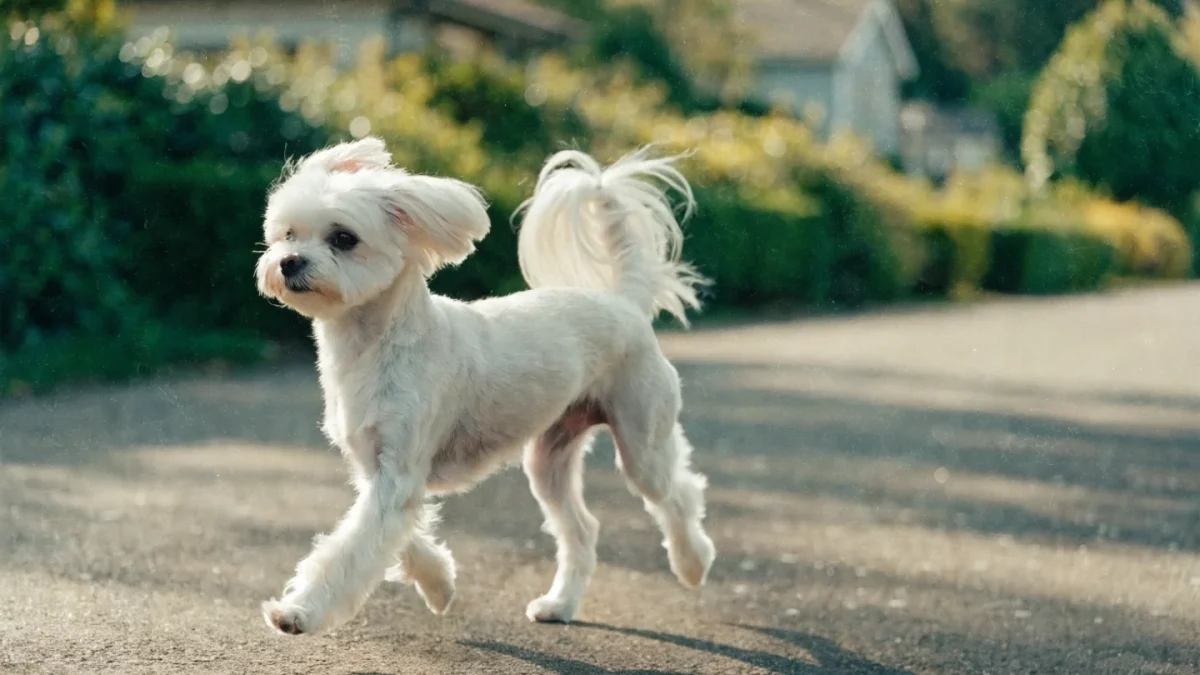
The Maltese was bred to travel from a chair to a lap. That's roughly 60 centimeters of engineered athletic performance, refined over more than twenty centuries. Nobody in the ancient Mediterranean looked at a small white companion dog and thought, "this animal needs a five-kilometer run." And yet the idea that a toy breed requires zero exercise has done real damage to real dogs — turning a manageable, moderate activity need into a complete absence of activity, with predictable consequences.
Maltese exercise needs are modest by any standard. This is not a breed that requires trail runs, retrieving sessions, or structured sporting work. But modest and nonexistent are different categories, and the space between them is where weight gain, chronic barking, and behavioral deterioration live.
The Baseline
A healthy adult Maltese benefits from 20 to 30 minutes of daily activity. That's a minimum, not a prescription — some individuals, particularly younger adults, will happily accept more. The activity works best split across two sessions: a morning walk of 10 to 15 minutes and an afternoon session of play, training, or a second short walk.
Pace matters less than consistency. The Maltese isn't covering ground for conditioning — it's getting sensory input, physical movement, and interaction. A moderate stroll with opportunities to sniff and investigate satisfies the physical requirement. What the breed can't tolerate is consecutive days of nothing: no walk, no play, no structured engagement beyond bathroom trips.
Puppies under a year need shorter, more frequent bursts. The general guideline of five minutes per month of age for structured walks is reasonable — a five-month-old gets two 25-minute sessions, or three shorter ones. Free play on soft surfaces can be more generous since the puppy controls intensity. Avoid forced exercise on hard surfaces while joints and growth plates are developing.
Senior Maltese often stay active well into their later years. The breed's long lifespan — 12 to 15 years — means an older Maltese at 12 or 13 may still want and benefit from 15 to 20 minutes of gentle daily movement. Adjust for the individual, but don't assume age eliminates the need.
Mental Stimulation Over Distance
The maltese temperament personality profile reveals a breed that's smarter than people expect. That intelligence requires input, and mental exercise tires a Maltese more efficiently than physical distance alone.
A 10-minute training session — teaching a new trick, practicing known commands with variation, working through a puzzle feeder — can produce the same settled calm as a 20-minute walk. A Maltese that gets a short walk plus a short training session is typically more content than one that gets a longer walk with no cognitive engagement.
Puzzle feeders work well for this breed. Maltese are food-interested enough to work at treat-dispensing puzzles but typically don't have the destructive intensity to demolish the toy in frustration. Snuffle mats, Kong toys with frozen filling, and hide-and-seek games with treats placed around a room all provide low-effort mental stimulation you can deploy daily.
Trick training doubles as both mental exercise and bonding. The Maltese responds well to short sessions with frequent variety — spin, shake, weave through legs, touch a target. These are not obedience-for-obedience's-sake dogs. They learn best when the session feels like a game.
Indoor Activities
A substantial portion of the Maltese's exercise needs can be met indoors, which makes the breed viable for apartment dwellers, people with limited mobility, and anyone facing weather that makes outdoor walks impractical.
Short indoor fetch — a hallway or living room provides enough space for a Maltese to chase a small ball or toy. Tug games offer interactive physical engagement. Structured training indoors combines exercise with mental work and requires nothing but a handful of treats and five minutes.
The distinction that matters is active interaction versus passive proximity. A Maltese lying next to you on the couch while you read is content but not exercised. The breed needs moments each day when you're actively engaging with it — playing, training, moving together — not just occupying the same room.
Outdoor Considerations
Walks remain the foundation. Even a short walk provides sensory stimulation — new smells, different surfaces, encounters with the environment — that indoor activity can't fully replicate. The Maltese is a curious dog that benefits from exploring outside its home.
Keep walks weather-appropriate. The Maltese's single coat offers less protection than a double coat, which means reduced cold tolerance. In winter, a coat or sweater during walks isn't fashion — it's thermal management for a 3-to-4 kg animal with minimal insulation. In summer heat, walk during cooler morning or evening hours. The breed's low ground clearance means its body absorbs more radiant heat from hot pavement than a taller dog would.
Dog parks are viable for well-socialized Maltese in designated small-dog areas. Mixed-size areas introduce risk — not because the Maltese is timid, but because the breed's boldness may provoke a reaction from a larger dog that creates a genuine physical danger. Supervised small-dog playgroups are a better option.
Signs of Insufficient Exercise
A Maltese that's not getting enough activity communicates through behavior:
- Escalating barking — at sounds, at movement, at nothing identifiable
- Attention demands that increase in intensity: pawing, whining, jumping
- Weight gain, which is visible quickly on a toy-breed frame
- Restless evening behavior — pacing, inability to settle, disturbed sleep
- Destructive chewing on household items
These are exercise and stimulation deficits, not personality flaws. Addressing the deficit resolves the behavior in most cases.
A Practical Routine
For a healthy adult Maltese: a morning walk of 10 to 15 minutes, an afternoon session of play or training lasting 10 to 15 minutes. On days when outdoor walks aren't possible, substitute with indoor activity and increase the mental stimulation component.
The breed's flexibility is one of its strengths as a companion. A Maltese that gets a stimulating outing on Saturday and a quieter routine on a hectic Tuesday adapts without falling apart. What matters is the overall pattern across weeks — consistent, moderate daily activity matched to the individual dog's age and condition. If you're weighing toy breed options, the chihuahua's exercise needs follow a nearly identical framework — same modest daily totals, same indoor-exercise logic, and similar cold-sensitivity considerations.