

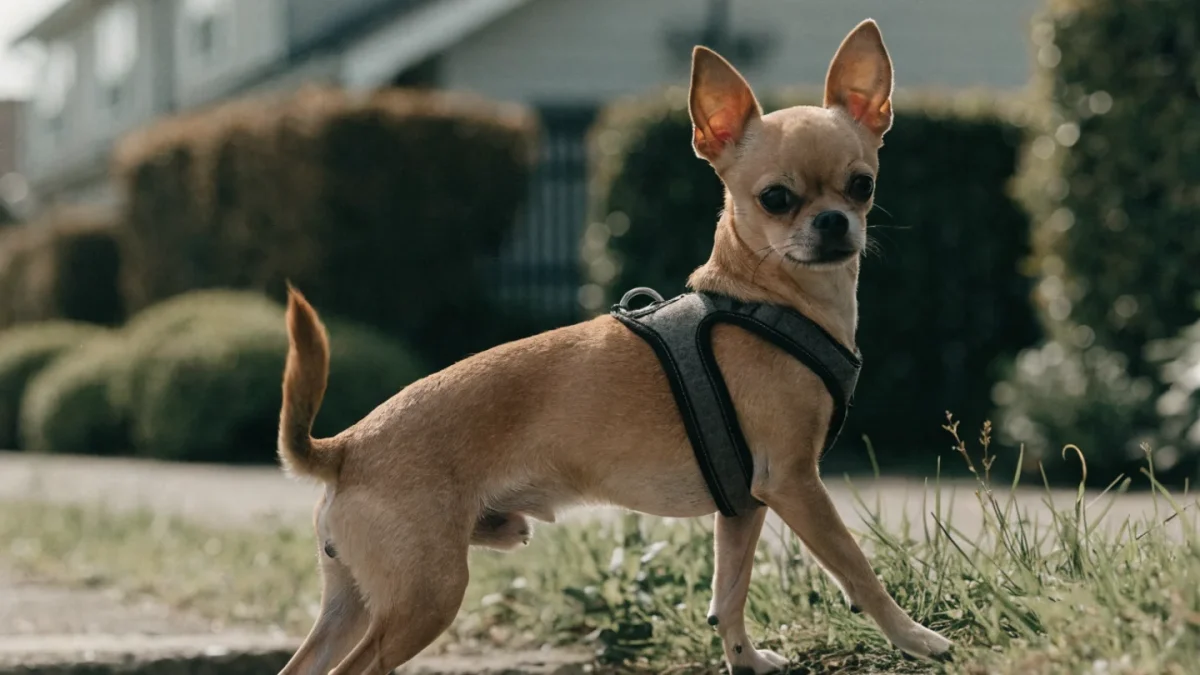
A chihuahua's legs are roughly 10 centimeters long. At full stride, those legs cover ground at a rate that most humans would describe as a brisk shuffle. This isn't a breed built for marathon sessions at the dog park — and yet chihuahuas that receive no deliberate exercise develop the same boredom-driven behavioral problems as under-exercised dogs three times their size. The scale is different. The principle is identical.
Chihuahua exercise needs sit in an unusual category: low in total volume, high in importance. Skipping exercise with a Labrador produces a dog that eats your couch. Skipping exercise with a chihuahua produces a dog that barks incessantly, becomes increasingly reactive, gains weight on a frame that can't support it, and develops anxiety behaviors that compound over time. Twenty minutes a day prevents all of it.
The Numbers
An adult chihuahua in good health needs 20 to 30 minutes of daily exercise. That's a genuinely modest requirement compared to most breeds — a beagle needs three times as much, and a border collie would consider 30 minutes an insult. But "modest" doesn't mean "optional."
Split the time between at least two sessions. A morning walk of 10 to 15 minutes and an afternoon indoor play session of similar length works well for most chihuahuas. A single 30-minute block is less effective because the breed's small body fatigues in bursts — short, active periods with rest in between match the chihuahua's natural energy pattern better than sustained effort.
Puppies under six months often get sufficient exercise through indoor play alone. Their joints and growth plates are fragile, and formal leash walks should be short and on soft surfaces. The general guideline of five minutes per month of age, twice daily, applies here — a three-month-old puppy gets about 15 minutes of structured activity per session, maximum.
Senior chihuahuas slow down but still benefit from 10 to 15 minutes of gentle daily movement. As the chihuahua breed guide covers, this breed lives 14 to 16 years, so the senior phase can extend for several years and maintaining mobility throughout matters.
Why Indoor Exercise Counts
Here's what most people get wrong about exercising small breeds: they assume that outdoor walks are the only legitimate form of exercise and that indoor activity is just play.
For a chihuahua, indoor exercise is exercise. A 2 kg dog chasing a toy across a living room is covering proportionally meaningful distances relative to its stride length and body mass. Tug-of-war, fetch down a hallway, hide-and-seek with treats, and interactive puzzle toys all provide genuine physical and mental stimulation.
This matters for practical reasons. Chihuahuas are cold-sensitive — smooth-coat chihuahuas especially lose body heat fast through their skin, and walks in cold or wet weather can be genuinely uncomfortable and even risky for very small individuals. Indoor exercise provides a temperature-controlled alternative that doesn't depend on weather conditions.
It also matters for owners with limited mobility, small living spaces, or schedules that make regular outdoor walks difficult. A chihuahua can get a perfectly adequate workout inside a studio apartment. Very few breeds can honestly say that.
Walks: Practical Considerations
When you do walk a chihuahua outdoors, a few breed-specific adjustments make the experience safer and more productive.
Use a harness, not a collar. Chihuahuas are prone to tracheal collapse, and any pressure on the throat from leash tension against a collar risks worsening or triggering the condition. A well-fitted harness distributes force across the chest and shoulders.
Pace yourself to the dog, not the other way around. A chihuahua at walking speed is moving at a near-trot — those short legs are working significantly harder than yours to maintain the same pace. Slow down. Let the dog sniff. A ten-minute walk where the chihuahua explores scent marks at its own speed produces better behavioral results than a twenty-minute forced march at human tempo.
Watch the ground surface. Hot pavement burns small paw pads faster than large ones — the pads have less mass to absorb heat. In summer, test the surface with the back of your hand. If it's uncomfortable for you after five seconds, it's already damaging for the dog. Similarly, ice, snow, and cold wet surfaces drain heat from a 2 kg body far more rapidly than from a 25 kg one.
Terrain awareness matters too. A curb that a Labrador steps over without noticing represents a significant jump for a chihuahua. Repeated jumping on and off elevated surfaces strains the knees and contributes to patellar luxation progression over time. Use ramps or lift the dog when encountering height changes.
Mental Stimulation
Chihuahuas are alert, curious, and smarter than their reputation suggests. Mental exercise tires them efficiently and addresses the behavioral issues — barking, reactivity, anxiety — that stem from boredom rather than physical energy surplus.
Puzzle feeders work well. Scatter the dog's meal across a snuffle mat or inside a treat-dispensing toy and let the chihuahua work for its food. This engages the dog's problem-solving capacity and slows down eating, which helps with the digestive issues common in small breeds that inhale their meals.
Training sessions of five to ten minutes count as mental exercise. Teaching new commands, practicing tricks, or running through a sequence of known behaviors provides cognitive engagement that a walk alone doesn't. The chihuahua's temperament includes a stubborn streak that makes training a negotiation — but negotiation is itself mentally stimulating for the dog.
Novel experiences count too. A car ride to a new location, a different walking route, exposure to new sounds and surfaces — all of it provides mental input that prevents the environmental monotony that drives anxious behaviors.
What to Avoid
Chihuahuas are not jogging partners. Sustained running on hard surfaces overstresses joints that are already predisposed to patellar luxation. Dog parks with large-breed dogs present an obvious physical safety risk — a chihuahua underfoot during large-dog play can be seriously injured in seconds.
Jumping is the activity most worth restricting. Chihuahuas that habitually jump on and off furniture, leap from beds, or vault off laps are placing repeated stress on knee joints that may already have subclinical luxation. Pet stairs or ramps for access to beds and couches are not excessive precautions — they're joint-preservation tools for a breed that commonly needs patellar surgery.
Swimming is possible but not instinctive for most chihuahuas, and their small body mass means they chill rapidly in water. Supervised, shallow-water wading in warm conditions is fine. Deep water or cold water is not appropriate.
The Right Routine
The simplest effective routine for an adult chihuahua: a short morning walk (10 to 15 minutes at the dog's pace, harness only), an afternoon indoor play session (fetch, tug, or puzzle toys for 10 to 15 minutes), and regular puzzle-feeder meals for incidental mental stimulation. On cold or wet days, the outdoor walk converts to an indoor session without any loss of exercise quality.
A chihuahua that gets this baseline consistently is a calmer, quieter, healthier dog than one that gets nothing because the owner assumed a small dog doesn't need exercise. The volume is low. The consistency matters.