

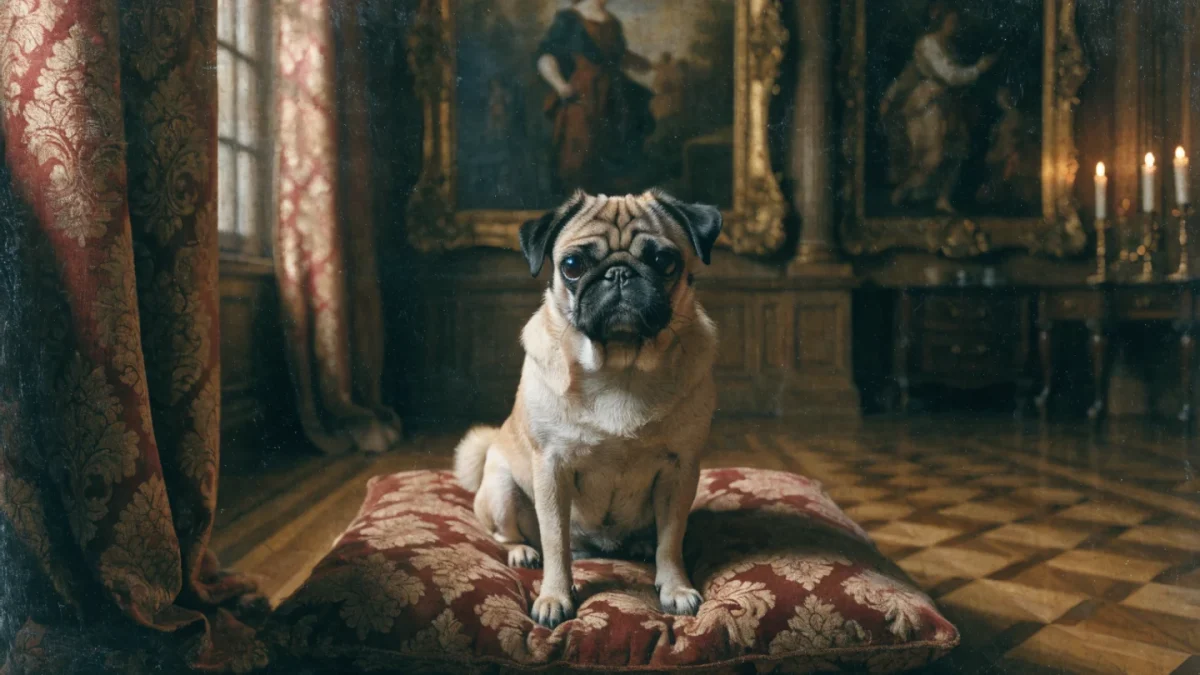
What do you actually want when you get a pug? That's not a rhetorical question — it's the one worth sitting with before you read any breed history, because the pug is one of those animals where the answer to "where did this dog come from" explains almost everything about what it's like to own one.
The pug is maximalist. Compressed into eight to ten kilograms is an enormous personality, a face that communicates exaggerated emotion at all times, and roughly two thousand years of humans selecting for exactly that intensity of expression and companionship. There is no working history here, no herding instinct, no retrieving drive, no guarding function to speak of. The pug was designed from the beginning to be present — to be watched, to watch back, and to be exceptionally good at occupying a room. Imperial palaces in China. Dutch royal courts. Napoleon's bedroom. The breed has always gone where the humans were, and the humans who kept them were never the type to underdo things.
Understanding where the pug came from makes the dog make sense. The history isn't a footnote — it explains why this particular shape, with this particular face, has survived unchanged in its essential purpose for over two millennia.
Imperial China: The First Thousand Years
The pug's origins lie in ancient China, where flat-faced dogs were bred as companions for the ruling class. Historical evidence suggests that pug-type dogs existed during the Han Dynasty (206 BC to 200 AD), making the breed roughly contemporaneous with the Pekingese and predating most European breeds by well over a millennium.
These early dogs — referred to in Chinese texts as Lo-sze — were not pets in the modern sense. They were status symbols, court fixtures, and to some extent ritual objects. The wrinkled forehead pattern that breeders selected for was believed to form the Chinese character for "prince" (王), and dogs with the clearest wrinkle pattern were considered the most valuable specimens. Ownership was restricted to the nobility. Commoners who acquired these dogs faced punishment — historical accounts record that theft of an imperial dog was punishable by death in some periods, a level of protection consistent with other Chinese palace breeds like the Pekingese.
The exact genetic origin of the Lo-sze is debated. Some breed historians believe they share ancestry with the Tibetan Mastiff through miniaturization, which would link them to the same root stock as the Pekingese. Others argue for an independent line of development. Without genetic evidence from ancient specimens, the question remains open. What's clear is that by the Tang Dynasty (618-907 AD), small flat-faced dogs were firmly established in Chinese court culture and were beginning to appear in artwork, poetry, and official records.
The Tibetan Connection
Buddhist monasteries in Tibet reportedly kept small flat-faced dogs that may have been closely related to — or ancestral to — the Chinese court dogs. Trade and tribute exchanges between Tibet and the Chinese imperial court were well established by the Han Dynasty, and dogs were among the gifts exchanged. Whether the monastery dogs came before the court dogs, after them, or developed in parallel from a shared ancestor remains unresolved. The historical record simply doesn't reach back far enough.
From East to West: The Trade Route
Pugs arrived in Europe through the maritime trade networks that connected China to the West during the 16th century. Portuguese traders were among the first Europeans to establish direct trade with China in the early 1500s, and Dutch merchants followed within decades. The dogs arrived as exotic curiosities — trade goods alongside silk, porcelain, and tea.
The Dutch East India Company, founded in 1602, intensified trade with East Asia and almost certainly transported pugs among other luxury goods. By the mid-1500s, pugs were appearing in European courts and wealthy households, initially as rare novelties and increasingly as fashionable companions.
The critical moment — Pompey's alleged rescue of William the Silent in 1572 — transformed the pug from curiosity to icon in the Netherlands. After William's assassination in 1584 (a later, successful attempt), the pug's association with the House of Orange was firmly established. When William III of Orange traveled to England in 1688 to claim the British throne during the Glorious Revolution, he brought pugs with him, their collars reportedly adorned with orange ribbons.
European Royal Courts
Once established in both Dutch and British aristocratic circles, pugs spread rapidly through the interconnected royal houses of Europe.
France
Marie Antoinette kept pugs before the French Revolution. More famously, Josephine Bonaparte's pug Fortune became a notorious figure in Napoleon's household. Fortune reportedly slept in Josephine's bed and bit Napoleon on the leg on their wedding night in March 1796, leaving a scar — a story corroborated by multiple contemporary accounts. Fortune had earlier earned Josephine's lifelong devotion by carrying concealed messages during her imprisonment in the Reign of Terror. Napoleon, who was not a man accustomed to being defied by anything, apparently tolerated the dog until Fortune was killed by a cook's larger dog some time later.
Italy
The breed was popular in Italian aristocratic households during the 17th and 18th centuries. Pugs appear in paintings by Italian masters and were dressed in matching outfits with their owners for formal occasions. The Italian association with the breed was strong enough that when European kennel standards were being developed in the 19th century, Italy was considered one of the breed's primary European strongholds.
England
Queen Victoria's personal involvement in pug breeding during the 1860s and 1870s was instrumental in shaping the modern breed. She preferred apricot-fawn pugs and was an early advocate of organized breed standards. Victoria's kennel produced dogs that influenced British pug bloodlines for generations. She was also, notably, opposed to the ear-cropping that was common practice for pugs at the time — a stance that eventually became the standard.
The Black Pug
Until the late 1800s, virtually all pugs in Europe were fawn. Black pugs were introduced to European bloodlines around 1886, reportedly from dogs imported directly from China. Lady Brassey is credited with popularizing the black variety in England after displaying them at shows. The arrival of black pugs expanded the breed's genetic base and introduced a color variant that, while initially controversial, became fully accepted by breed standards within a few decades.
Victorian Show Ring and Standardization
The modern pug took shape during the Victorian era's explosion of organized dog breeding and showing. The formation of kennel clubs and the development of breed standards in the 1870s and 1880s imposed formal definitions on what had previously been a loosely defined type. The Shih Tzu's history traces a parallel Chinese imperial lineage that reached European courts through similar trade and diplomatic channels — the two breeds share deep roots in the same court culture.
The first pug breed standard emphasized a compact, cobby body, a large round head, and prominent facial wrinkles. Crucially, the early standards did not call for the extremely flat face that characterizes modern pugs. Photographs from the late 1800s and early 1900s show pugs with noticeably longer muzzles, less pronounced facial folds, and more moderate skull shapes than today's show dogs.
The shift toward extreme brachycephaly occurred gradually through the 20th century, accelerating after the 1950s as show-ring preferences increasingly rewarded flatter faces, rounder skulls, and more prominent wrinkles. Each generation was bred slightly more extreme than the last, and the cumulative effect over 70 years was dramatic.
The Modern Pug: Health and Controversy
The pug's history has taken a contentious turn in the 21st century. Veterinary organizations in multiple countries have raised formal concerns about the breed's welfare, citing the respiratory compromise, eye vulnerability, and spinal issues that result from extreme brachycephalic breeding.
The Netherlands restricted the breeding of dogs with muzzles shorter than one-third of the skull length in 2019, a regulation that affects pugs directly. Norway's 2022 court ruling restricting the breeding of English Bulldogs prompted renewed discussion about whether similar restrictions should apply to pugs. These legal actions reflect a growing veterinary and public consensus that the breed's physical form has been pushed past the point where "breed standard" and "animal welfare" are compatible.
Some breeding programs are responding by selecting for longer muzzles, wider nostrils, and more moderate skull proportions — sometimes called "retro pugs" or "sport pugs." These dogs more closely resemble the pugs of 100 years ago and generally breathe more easily. Whether this movement gains enough traction to shift the breed's trajectory is an open question.
What the History Tells Us
The pug's 2,000-year story is unique among dog breeds. No other breed has maintained such a consistent purpose across such a span of time — pure companionship, from Chinese palace to modern apartment. The complete pug breed guide covers the practical realities of owning this breed today, while the pug temperament article explores the personality that 20 centuries of companion breeding produced.
But the history also carries a warning. The same breed that delighted emperors, saved a prince, and charmed European aristocracy for centuries has, in its most recent chapter, been reshaped by aesthetic preferences that compromise its ability to breathe. The pug didn't choose its face. We did. What we do next matters more than what came before.