

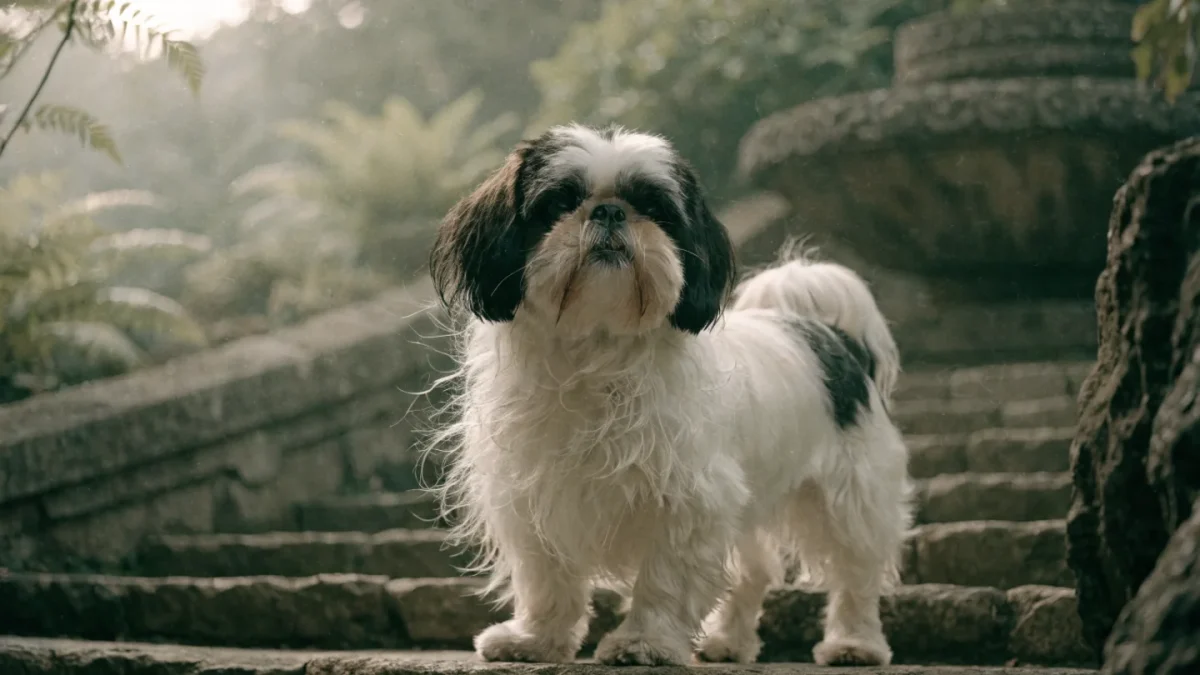
Sometime around 1645 — the exact year is disputed, the consequences are not — the Dalai Lama sent a diplomatic gift of small, long-haired dogs from Tibet to the imperial court of the Shunzhi Emperor, who had just established the Qing dynasty. Those dogs, almost certainly Lhasa Apsos, entered a palace that already kept its own small companion breeds, particularly the Pekingese. What happened next inside the Forbidden City's walls would eventually produce the shih tzu, though it would take centuries for anyone outside the palace to know it.
The history of the shih tzu is a story of palace secrecy, near-extinction, and a genetic bottleneck so narrow that every shih tzu on earth today can trace its ancestry to roughly fourteen individual dogs. It's also a story that's been repeatedly embellished, mythologized, and confused with the histories of related breeds — which makes getting the facts straight both difficult and necessary.
Tibetan Origins and the Palace Connection
The Lhasa Apso-to-Pekingese cross theory is the most widely accepted origin story, but the details resist simple timelines. Tibet and China exchanged dogs over centuries, not in a single event. Small, long-coated dogs held spiritual significance in both Tibetan Buddhist monasteries and the Chinese imperial court. In Tibet, they guarded temple entrances and served as sentinel companions for monks. In China, they served the imperial family as living lap warmers, alarm dogs, and symbols of Buddhist authority.
The name "shih tzu" translates to "lion dog," a title carrying deep religious weight. The lion is the protector of dharma in Buddhist tradition, and because lions are not native to China or Tibet, small dogs resembling stylized lion imagery became living stand-ins. Temple art and palace records reference "lion dogs" as far back as the Tang dynasty (618-907 CE), though these early references almost certainly describe ancestor breeds rather than the shih tzu as it exists today.
The deliberate crossing of Tibetan and Chinese palace dogs — Lhasa Apsos with Pekingese — likely occurred during the late Ming dynasty (1368-1644) or early Qing dynasty (1644-1912). The Qing emperors, who were Manchu rather than Han Chinese, maintained particularly elaborate palace dog programs as part of the broader court culture of ornamental display.
The Cixi Era: Peak Palace Breeding
The breeding programs reached their zenith under Empress Dowager Cixi, who effectively controlled the Chinese government from 1861 until her death in 1908. Cixi was devoted to the palace dogs — shih tzus, Pekingese, and pugs — to a degree that made them a recognized feature of court life. She reportedly maintained separate breeding kennels for each type, supervised by palace eunuchs who specialized in small dog husbandry.
Cixi's influence on the modern shih tzu temperament was probably significant. By accounts from the period, she selected breeding pairs based on appearance and disposition, favoring dogs that were calm, affectionate, and attentive to their handlers. Whether these accounts are precisely accurate or embellished by nostalgia for the dynasty is debatable, but the temperament consistency in modern shih tzus — the steady warmth, the composure, the regal self-assurance — suggests that someone, at some point, was selecting for exactly those traits. For more, see Cavalier King Charles Spaniel.
After Cixi's death in 1908, the palace breeding programs began to deteriorate. When the Qing dynasty fell in 1912, the imperial kennel system collapsed entirely. Dogs were dispersed — given as gifts, sold, abandoned, or simply left to fend for themselves as the court dissolved. Within a generation, the breed that had been cloistered inside palace walls for centuries was scattered, unprotected, and dangerously close to disappearing.
Survival Through Fourteen Dogs
The survival of the shih tzu as a breed hinges on a startlingly small number of individual dogs exported from China between the late 1920s and the early 1950s.
Lady Brownrigg and her husband, General Sir Douglas Brownrigg, brought several shih tzus from Beijing to England in 1930. These dogs, along with a few others imported by Mrs. Hutchins and other English fanciers during the 1930s, formed the British foundation stock. Simultaneously, Scandinavian imports — dogs brought to Norway by diplomat and explorer Henning Haslund-Christensen and others to Sweden and Denmark — established a parallel but separate European line.
The total foundation: approximately fourteen dogs (seven male, seven female) from which all modern shih tzus descend. By any standard of population genetics, this is a dangerously narrow base. The breed was saved, but the genetic consequences of that bottleneck persist in the form of reduced genetic diversity and elevated frequencies of certain heritable conditions.
The Pekingese Cross of 1952
In 1952, a deliberate outcross to a Pekingese dog named Dogie de Doyen was introduced into the English shih tzu breeding program. The decision was controversial then and remains debated now. The argument for the cross was genetic necessity — the English gene pool was so limited that inbreeding depression was becoming visible, with declining litter sizes and increasing health problems. The Pekingese shared enough ancestry with the shih tzu to be a logical outcross without radically altering breed type.
The argument against it was purity. Some breeders felt any outcross compromised the breed's identity and that the shih tzu should remain genetically distinct from the Pekingese it had already separated from centuries earlier. Both positions had merit. The cross happened, the resulting dogs were absorbed into the breed, and subsequent generations showed broader genetic health without dramatic departures from type.
After 1952, no further authorized outcrosses were introduced. The breed has been closed since, meaning all breeding occurs within the existing shih tzu gene pool.
Global Recognition and Popularity
The path to formal recognition was surprisingly slow for a breed with such distinguished ancestry. The Kennel Club in Britain recognized the shih tzu in 1946 — sixteen years after the first imports. Early confusion with the Lhasa Apso complicated matters; the two breeds were initially lumped together and shown interchangeably until breed-specific standards were established.
Recognition by other major registries followed through the 1950s and 1960s. It was not until 1969 that several major international registries formally recognized the breed. By that point, the shih tzu had already built a substantial following among companion dog enthusiasts.
The breed's popularity surged through the 1970s and 1980s as apartment living became more common and demand grew for dogs suited to smaller living spaces. By the early 2000s, the shih tzu had established itself consistently among the most popular breeds in multiple countries worldwide. That popularity brought the usual consequences: increased commercial breeding, variable quality, and a wider gap between carefully bred dogs and mass-produced puppies.
What the History Means Today
Understanding the shih tzu's complete breed profile requires understanding where it came from. The breed's temperament — affectionate, composed, mildly stubborn — maps directly onto centuries of selection for palace companionship. The grooming demands trace to a coat developed in climate-controlled palace environments, not for outdoor functionality. The health vulnerabilities connect to the fourteen-dog bottleneck and the brachycephalic structure that was either present from the beginning or intensified through centuries of palace breeding.
Every shih tzu alive today is roughly 300 years of imperial Chinese history walking around on short legs, trailing a silk coat. The palace that created them is gone. The breed, against considerable odds, is not.