

There's a theory — unproven but persistent among breed historians — that Chinese imperial court dogs were selectively bred not just for appearance but for their ability to entertain. Pugs were fashionable court pets at least as far back as the Song Dynasty (960-1279 AD), and historical accounts from other Chinese dynasties describe small dogs trained to perform tricks for imperial guests — including, in one Tang Dynasty account, dogs that could lead horses by the rein and carry lit torches. Whether pugs specifically filled this role is less clear, but the breed's deliberate comedic sensibility suggests that entertainment value was part of the selection criteria. Whether or not that's verifiable, the result is a breed that performs comedy with what looks suspiciously like intention.
Pug temperament personality is unlike anything else in the dog world. This is not a breed that's incidentally funny because it's clumsy or clueless. Pugs are deliberate. They repeat behaviors that get reactions. They time their antics. They play to an audience. If you've never lived with a pug, this sounds like anthropomorphism. If you have, you're nodding.
The Velcro Factor
Pugs are contact-dependent in a way that goes beyond the typical "my dog follows me around" experience. This breed was developed for 2,000 years with a single selection criterion: be as close to a human as possible and make that human want you there. The result is a dog that doesn't just prefer your company — it considers your company a biological requirement.
A pug in a household will typically choose one primary person and shadow them with remarkable persistence. Bathroom trips include the pug. Moving from the couch to the kitchen includes the pug. Working at a desk means a pug on your feet, in your lap, or wedged behind your back on the chair. This is not a phase. It doesn't moderate with age. It's the breed operating exactly as designed.
For people who want this level of attachment, it's deeply satisfying. For people who value personal space, it becomes claustrophobic within the first week.
Separation Responses
The flip side of intense attachment is poor tolerance for its absence. Pugs left alone for more than three to four hours regularly show signs of distress: pacing, whining, destructive chewing (particularly of items that smell like their person), refusal to eat, and excessive grooming that can produce raw patches on the skin.
This isn't a training problem to be solved through desensitization alone, though gradual conditioning helps. It's a breed characteristic rooted in 2,000 years of selection for precisely the opposite of independence. Expecting a pug to be content alone for a full workday is expecting it to suppress its most fundamental behavioral drive.
The Comedy
I've researched dozens of breeds, and I've never encountered another one where the word "comedian" appears as consistently in owner descriptions. Pugs perform. Specific behaviors to watch for:
The head tilt. All dogs tilt their heads. Pugs tilt their heads with theatrical timing, holding the position exactly long enough to get the reaction, then doing it again from the other side.
The zoom. Brief, explosive bursts of running — often in tight circles on a rug or down a hallway — that appear without warning, last thirty seconds, and end with the dog collapsing dramatically. These aren't random energy releases. Pugs frequently initiate zooms when they sense their person needs entertainment.
The stare. Pugs make sustained eye contact to a degree that's unusual among dogs. Combined with the large, dark eyes and wrinkled brow, this creates an expression that reads as everything from profound concern to exaggerated offense. They deploy this deliberately when they want something.
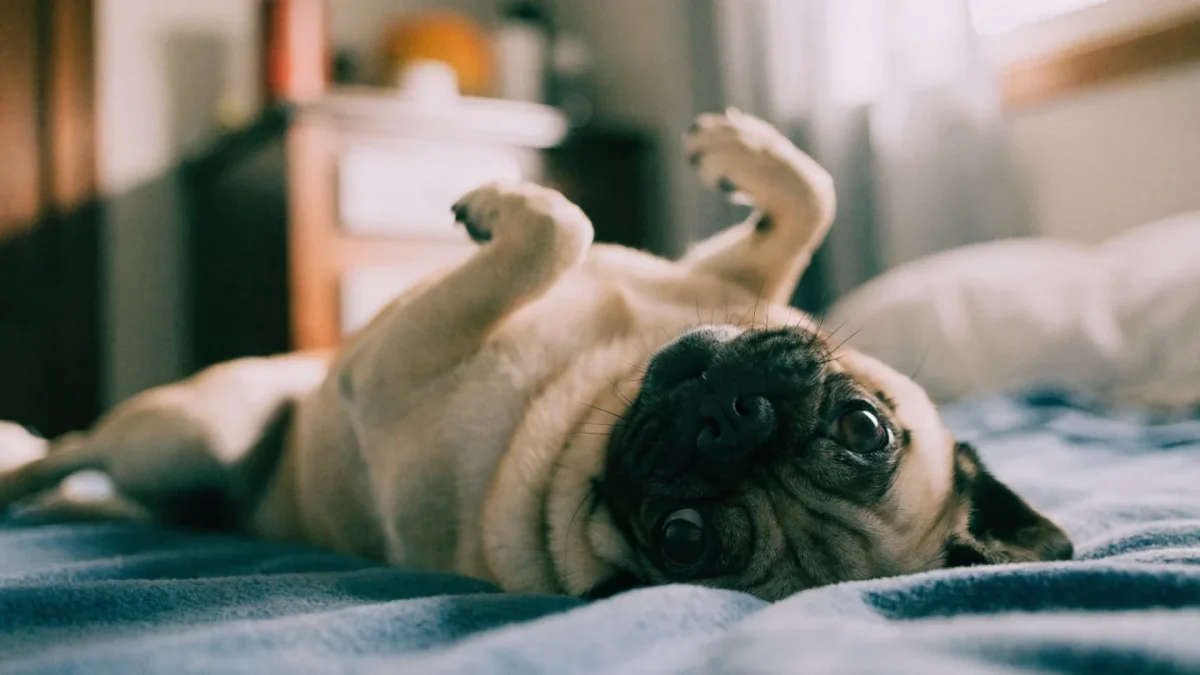
The flop. Pugs don't lie down. They collapse. The transition from standing to fully horizontal happens with a theatrical thud that seems engineered for maximum comedic effect. This is especially pronounced when the dog is expressing displeasure — the "I'm so put-upon" flop is a pug signature.
Emotional Intelligence
This is the dimension of pug temperament that surprises most new owners. Pugs are acutely sensitive to human emotional states — more so than many breeds with higher working-intelligence scores.
A pug in a household where someone is upset will typically position itself physically against that person, make sustained eye contact, and remain unusually still. The breed seems to distinguish between ordinary routine and emotional disturbance, and its response to the latter is consistent enough that multiple sources describe pugs as "emotional barometers." They don't try to fix the problem the way a retriever brings you a toy. They sit with you in it.
This sensitivity cuts both ways. Pugs in households with frequent conflict or high-stress environments absorb that tension. Chronic stress in the home produces anxious pugs — and an anxious pug develops physical symptoms (gastrointestinal upset, skin irritation, over-grooming) alongside behavioral ones.
Stubbornness — or Something Else
Pugs regularly appear in "most stubborn breeds" lists, and the label isn't entirely wrong, but it misidentifies the mechanism.
A truly stubborn dog resists direction passively. A pug doesn't resist — it negotiates. It processes the command, evaluates the incentive, and makes a decision. If the incentive is sufficient (a treat, your obvious delight, the prospect of a preferred activity), compliance is immediate and enthusiastic. If the incentive is insufficient, the pug will look at you with an expression that clearly communicates "I heard you, and no."
This is not disobedience. It's economic reasoning applied to social interactions. Pugs will work for rewards, affection, and reactions. They will not work for abstract concepts like "because I said so." Adjusting your expectations from obedience to cooperation changes the dynamic entirely — and makes training a pug considerably less frustrating.
With Other Animals
Pugs lack prey drive in any meaningful sense. They were never bred for hunting, chasing, or any work involving other animals. Most pugs coexist comfortably with cats, other dogs, and small animals, provided introductions are gradual.
With larger dogs, the dynamic requires monitoring. Pugs don't recognize size differentials — they'll initiate play with dogs five times their weight and have no instinct to back down from rougher play than their bodies can handle. The prominent eyes are particularly vulnerable during wrestling with larger dogs. Flat-faced breeds can also be harder for other dogs to read — the compressed facial structure reduces the expressiveness that dogs use to communicate with each other, which occasionally leads to misunderstandings during play. The French Bulldog's complete breed profile describes a brachycephalic companion with a notably calmer temperament baseline — a useful reference point for anyone comparing the two breeds.
Energy Curve Across the Lifespan
Pug puppies (under two years) are substantially more active than the breed's reputation suggests. Expect short, intense play bursts, persistent mouthing, and an investigative curiosity that drives them to examine every accessible object in the house. Puppy pugs are fast — surprisingly fast for their build.
Adult pugs (two to seven years) settle into the pattern most people associate with the breed: active play periods interspersed with long rest periods. The ratio shifts toward rest as the dog ages, but a healthy adult pug should still show genuine interest in play and interaction daily.
Senior pugs (seven years and older) become less active but, in my experience, become more emotionally attuned. Older pugs often intensify their attachment behavior — resting in physical contact more frequently, monitoring their person's movements more closely, and responding to emotional shifts with greater sensitivity.
The Right Match
The pug temperament works best for people who genuinely want a shadow. Not figuratively — literally a living creature that follows you from room to room, wants physical contact for most of your waking hours, and reads your moods with unnerving accuracy.
The complete pug breed guide covers the full picture — health, grooming, exercise. But temperament is where the decision starts. If constant companionship sounds like a burden, the pug's deepest strength becomes its biggest liability.
The people who are happiest with pugs are the ones who walked in knowing exactly how needy this breed would be — and couldn't wait for it. They're also the ones who recognize the common misconceptions about pugs and choose the breed on honest terms.