

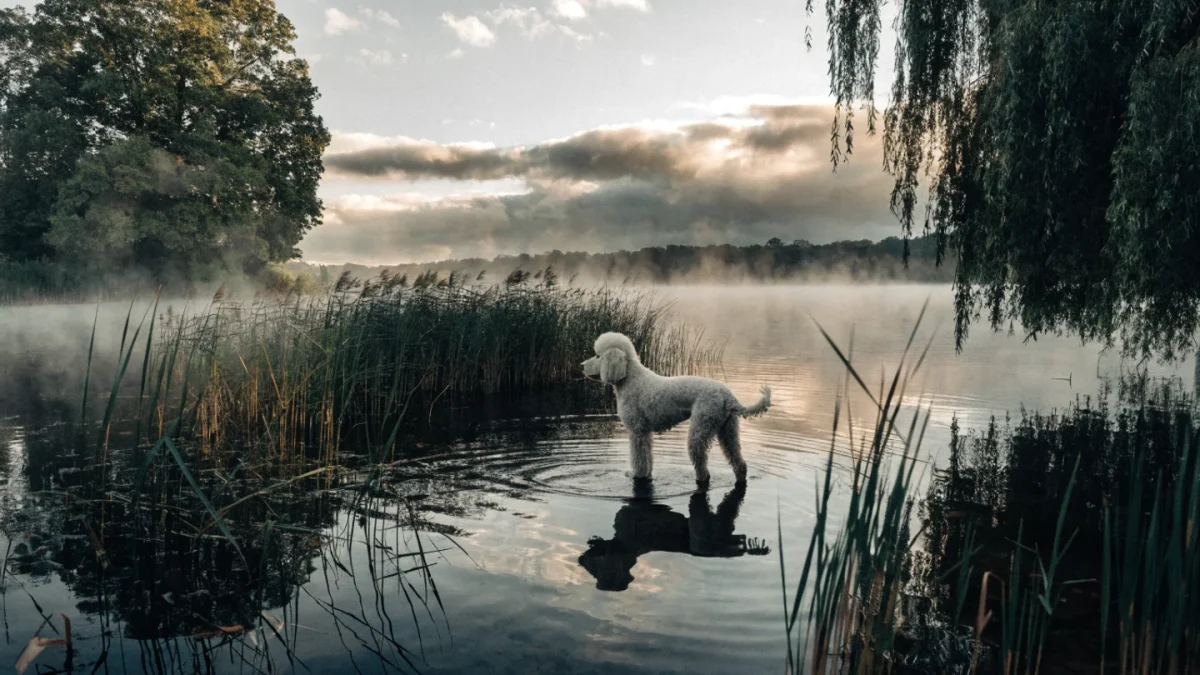
The most famous poodle painting in European art history isn't a portrait of a lapdog. It's a 1640s hunting scene by the Dutch artist Paulus Potter, showing a curly-coated water dog mid-retrieve, hauling a duck from a marsh with the kind of muscular purpose that would surprise anyone who associates the breed with show rings and salon grooming. The dog in that painting looks nothing like the modern continental clip. It looks like what poodles actually were for most of their history: working water retrievers built for cold rivers and long days in the field.
How a duck-hunting dog from central Europe became the national breed of France, then a circus performer, then a fashionable companion, and finally one of the most misunderstood breeds on earth is a story that spans roughly five centuries and at least three countries.
The German Water Dog
The poodle's origins trace to continental Europe, with the strongest evidence pointing to Germany. The name is the first clue — "Pudel" comes from the Low German "puddeln," meaning to splash in water. The breed's French name, "Caniche," derives from "cane," the French word for a female duck, reinforcing the waterfowl connection from a different linguistic angle.
German and Dutch artwork from the 15th and 16th centuries consistently depicts curly-coated dogs working alongside hunters in marshland. These dogs aren't ornamental. They're functional — muscular, medium to large, with dense waterproof coats trimmed for practical reasons. Albrecht Durer's 1500s sketches include dogs matching the poodle type, and similar dogs appear in German hunting manuscripts from the same period.
The Standard Poodle that emerged from this tradition was a serious working retriever. Standing 45 to 60 centimeters at the shoulder with a powerful build, the dog's job was straightforward: swim into cold water, retrieve shot waterfowl, deliver it undamaged to the hunter, repeat. The breed's intelligence — which would later make it famous for circus tricks and obedience competition — was originally selected for something more practical. A water retriever working in variable conditions needed to problem-solve independently, remember complex commands, and read its handler's signals across distance. Biddable and stupid wouldn't survive the working environment. The poodle had to be both cooperative and clever.
The Clip That Wasn't Fashion
The poodle's distinctive grooming — the pompoms, the shaved hindquarters, the topknot — reads as pure aesthetics today. In the original context, every element had a purpose.
Handlers shaved the rear legs and midsection to reduce drag in water. The coat was left full over the chest and rib cage for thermal insulation in cold rivers. Hair was kept on the joints — ankles, hips, and the area around the heart — to protect against cold-water injury and rheumatism. The topknot kept hair out of the dog's eyes while working. The tail pompom, sometimes dyed bright colors, served as a visual marker so hunters could track the dog's location in dense reeds and marsh grass.
That functional trim was later stylized into what became the Continental Clip and the English Saddle Clip — the two show ring styles recognized today. The functional logic disappeared; the aesthetic remained. The disconnect between the trim's origin and its modern perception is, in many ways, a summary of the entire poodle story.
France Adopts a German Dog
Exactly when and how the poodle crossed from Germany to France is poorly documented, but by the late 1500s, the breed was firmly established in French sporting culture. France eventually claimed the poodle as its national breed — a designation that sticks today despite the German origins.
The French didn't just adopt the poodle. They transformed its role. While the Standard continued as a water retriever and hunting companion in some circles, French aristocracy and bourgeoisie began valuing the breed's intelligence and trainability for entertainment and companionship. By the 17th century, poodles were performing in traveling shows and circuses across France, executing complex trick routines that audiences found astonishing. The circus tradition would persist for over two centuries.
This shift from field dog to performer wasn't a downgrade in the breed's capabilities. The cognitive demands of circus performance — learning long sequences of behaviors, performing reliably in chaotic environments, responding to subtle handler cues in front of crowds — actually reinforced the same intelligence traits that made the breed a superior retriever. The poodle temperament that modern owners experience — the quick learning, the sensitivity to human cues, the operational intelligence — was being refined through both working and performance contexts simultaneously.
The Miniature: A Working Dog Gets Smaller
By the 1700s, smaller poodles were being selectively bred in France, and their purpose was utilitarian. The Miniature Poodle — standing 28 to 38 centimeters at the shoulder — emerged as a truffle hunter.
Truffle hunting required a specific kind of dog. The animal needed an exceptional nose, obviously, but also a body compact enough to navigate dense forest underbrush, a drive to search persistently, and a temperament calm enough to indicate the find without destroying the truffle by digging too aggressively. Miniature Poodles fit the requirements precisely. Their size let them work through vegetation that would have tangled a Standard, while their intelligence made training for the subtle indication work relatively straightforward.
The truffle hunting tradition in France was significant enough economically that breeding smaller poodles with strong scenting ability was a genuine commercial enterprise, not a hobby. Miniatures earned their keep. The transition to primarily companion roles happened gradually through the 19th century as truffle cultivation techniques changed and the market for smaller companion dogs expanded among the growing European middle class.
The Toy: When Companionship Becomes the Job
The Toy Poodle — under 28 centimeters at the shoulder — appeared during the 18th century, bred explicitly as a companion for European aristocracy. French court records from the reign of Louis XV (1715-1774) document tiny poodles as fashionable companions among the nobility, carried in sleeves, seated on laps during court functions, and groomed to match their owners' aesthetic sensibilities.
The Toy lost the working function that defined its larger relatives. What it retained was the poodle coat genetics, the intelligence, and the intense bonding drive that made the breed so successful in its other roles. A Toy Poodle is temperamentally the same animal as a Standard — it just can't retrieve a duck from a river.
The miniaturization process introduced challenges. Breeding for increasingly small size without corresponding attention to structural proportion led to health problems in some lines — fragile bone structure, dental crowding from compressed jaw size, and patellar luxation from altered joint geometry. Responsible breeders worked to maintain correct proportion at smaller scales, but the pressure to produce ever-tinier dogs has been a persistent issue in the variety.
The Critical Distinction: One Breed, Three Sizes
Standard, Miniature, and Toy Poodles are not separate breeds. They are varieties of a single breed, evaluated against the same breed standard in every respect except height. This is a distinction that matters for understanding the breed's genetics and temperament. A Toy Poodle didn't descend from a separate lineage — it was selectively bred down from the same stock as the Standard, carrying the same cognitive and temperamental traits in a smaller body.
Recognition and Modern Development
Poodles were among the earliest breeds registered with major kennel organizations. The breed appeared in early studbooks across Europe in the mid-to-late 1800s, and formal breed clubs were established in France, Germany, and England in the late 1800s and early 1900s, with exact founding dates varying by national club.
The 20th century saw the poodle's popularity cycle dramatically. The breed reached peak popularity in the United States during the 1960s and 1970s, holding the number-one registration spot for 22 consecutive years — a record no other breed has matched. That popularity surge brought the typical consequences: overbreeding, puppy mills prioritizing volume over health, and a dilution of working temperament in some pet lines.
The late 20th and early 21st century brought a partial correction, with serious breeders refocusing on health testing, structural soundness, and temperament. The working poodle also made a modest comeback — Standard Poodles now compete in hunt tests, dock diving, and field trials alongside the traditional obedience and agility circuits. The breed, five centuries after those German marsh paintings, is still retrieving.
Frequently Asked Questions
Are poodles German or French?
The breed originated in Germany as a water retriever, with the name deriving from the German "puddeln" (to splash). France adopted the poodle and eventually claimed it as the national breed. Both countries contributed significantly to the breed's development — Germany for the working foundation, France for refinement, miniaturization, and cultural adoption. The debate continues, but the evidence favors a German origin with French development.
Why do poodles have those haircuts?
The iconic poodle clips originated as functional trims for water retrieval work. Handlers shaved the rear and midsection to reduce drag while swimming, left coat over the chest for insulation, kept hair on joints for protection from cold, and used the topknot to keep hair out of the dog's eyes. The tail pompom served as a visual tracking marker in dense reeds. The modern show clips preserved the aesthetic while losing the practical context.
When did Miniature and Toy Poodles first appear?
Miniature Poodles were selectively bred in France beginning around the 1700s, primarily for truffle hunting. Toy Poodles emerged during the 18th century as companions for European aristocracy, with French court records from the Louis XV era documenting their presence. Both varieties descend from the Standard Poodle through selective breeding for smaller size.