

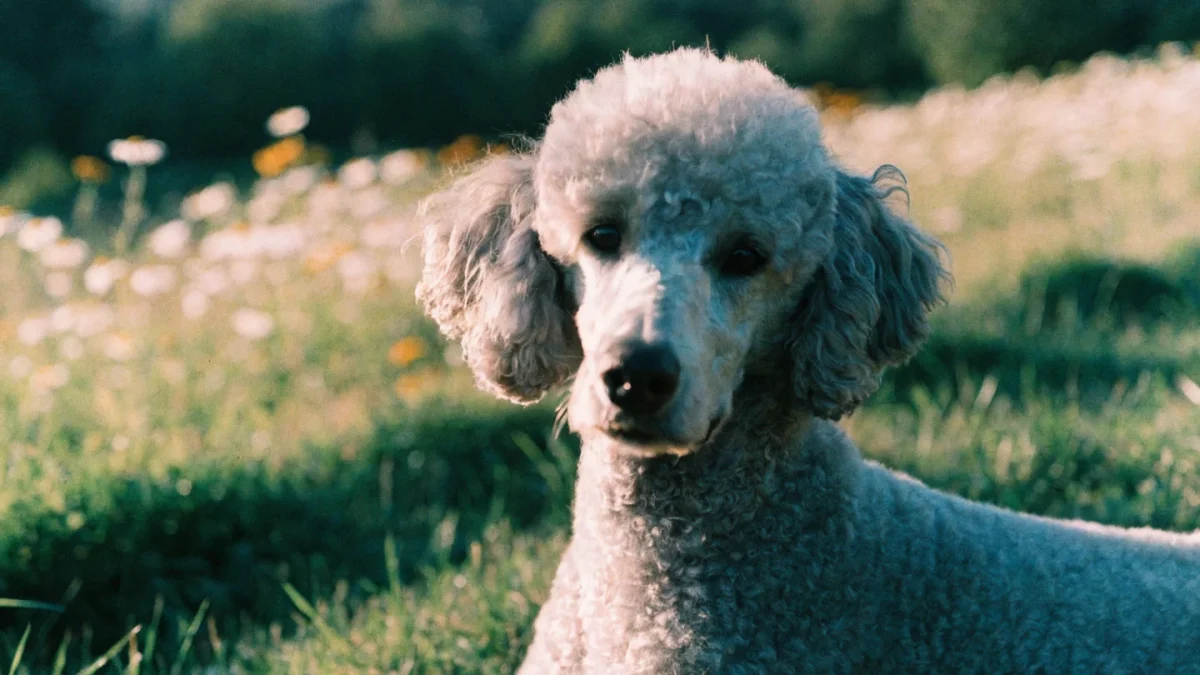
No breed suffers from its show appearance more than the Poodle. The continental clip — shaved hindquarters, pompons on the joints, the topknot tied with a ribbon — has done decades of damage to how people understand this dog. It reads as decorative, fussy, bred-for-aesthetics in a way that suggests the Poodle is a breed for people who want a dog that matches their furniture. That perception is almost exactly backwards.
Strip the show clip — put the coat in a sporting trim or let it grow out naturally — and what you have is one of the most capable working dogs ever produced. Water retrievers. Duck hunters. Dogs that were bred to swim into cold water, locate shot birds, and return them to hand. The intelligence, the drive, the willingness to work: none of that is incidental. It's the whole point of the breed, and the pom-poms were practical originally — they protected the joints in cold water. The circus-dog aesthetic came later and stuck in the wrong direction.
I've been making this argument to people at shows for years, and the Poodle handlers I respect all say the same thing: the owners who struggle with this breed are almost always the ones who bought it for how it looks. The poodle temperament rewards people who want a working partner. It taxes people who just wanted something elegant and low-maintenance.
Intelligence That Demands a Job
Stanley Coren's 1994 canine intelligence ranking placed the poodle second overall, behind only the Border Collie. That ranking measured obedience intelligence specifically — the speed of learning new commands and the reliability of executing them. Poodles learned new commands in fewer than five repetitions and obeyed first commands 95 percent of the time.
Those numbers sound like a selling point, and they are — until you realize that a dog smart enough to learn "sit" in three tries is also smart enough to open childproof cabinet latches, figure out which drawer holds the treats, and train the household cat to knock food off the counter for sharing. Poodle intelligence isn't passive. It's operational. The dog is always processing, always testing, always looking for the next problem to solve.
When that intelligence has a structured outlet — obedience, agility, nose work, trick training — the result is a dog that's almost eerily responsive. When it doesn't, the result is a dog that invents its own curriculum, and the courses it designs for itself tend to involve your furniture, your garbage, and your peace of mind.
This holds across all three sizes. Toy Poodle owners frequently underestimate this because the dog weighs three kilograms. But a bored Toy Poodle will bark compulsively, shred cushions, develop obsessive behaviors, and generally make itself and everyone around it miserable with the same efficiency as a bored Standard — just on a smaller scale.
Emotional Depth Most Owners Don't Expect
Poodles read human emotional states with a precision that surprises first-time owners. They register shifts in household mood, respond to tone of voice with visible behavioral changes, and adjust their own energy to match their person's state. This is part of why they excel as therapy and assistance dogs — the poodle's working origins selected for close human partnership over centuries, and that wiring runs deep.
The flip side of emotional intelligence is emotional vulnerability. Poodles are genuinely affected by raised voices, household conflict, erratic schedules, and inconsistent handling. A poodle in a chaotic home doesn't just tolerate the stress — it absorbs it. Anxiety manifests differently by size: Standards tend toward restless pacing and vigilance, Miniatures often develop stress-related barking, and Toys are prone to trembling, clinginess, and refusal to eat.
Separation anxiety is a real concern across all three sizes, though the severity varies. Standards, with their slightly more independent working heritage, typically handle moderate alone time better than the smaller varieties. Miniatures and Toys — bred more heavily for companionship over the last two centuries — can struggle with even brief separations if not gradually conditioned from puppyhood.
How Temperament Varies by Size
The core personality — intelligent, sensitive, bonding-oriented — is consistent across all three varieties. The differences are matters of degree, not kind.
Standard Poodles retain the most working drive. They're the variety most likely to be aloof with strangers initially, assessing before engaging. They carry a confidence that smaller varieties sometimes lack — a Standard in a new environment surveys it systematically rather than reacting to it. Their energy is sustained, not frenetic. A Standard wants to run for an hour, not sprint for five minutes and collapse.
Miniature Poodles are often described as the most "balanced" variety in temperament, though that oversimplifies things. What Miniatures tend to exhibit is a slightly higher social eagerness combined with the Standard's trainability. They adapt to varied living situations more readily than Standards and recover from novelty faster than Toys. In competitive obedience and agility, Miniatures punch well above their weight class.
Toy Poodles bond with particular intensity — often attaching most strongly to one person. They can be sharper in their reactions to unexpected stimuli (a doorbell, a dropped pan) than their larger relatives. This isn't nervousness in a well-bred Toy; it's heightened alertness compressed into a very small body. Poorly bred Toys, however, can tip from alert into genuinely anxious, which is a temperament problem distinct from the breed's normal range.
What Most People Get Wrong
The single most damaging misconception about poodle temperament is the "prissy" label. It survives because show grooming looks extravagant, and people conflate the haircut with the dog. A Standard Poodle will retrieve a duck from freezing water, hike for hours through rough terrain, and body-slam a flirt pole with the same enthusiasm as any sporting breed. The continental clip that looks decorative was designed for function — insulation over joints and chest, reduced drag in water. The dog underneath that grooming is an athlete, not an accessory.
The second misconception is that poodles are yappy. Poodles are alert barkers — they'll announce a visitor or an unusual sound — but well-exercised, mentally stimulated poodles are not nuisance barkers. The yapping reputation comes from understimulated dogs, often Toys and Miniatures that receive inadequate mental engagement because their owners equated small body with small needs.
For a deeper look at these and other persistent myths, the piece on common misconceptions about poodles addresses the full list.
The Right Owner for This Temperament
Poodles thrive with people who enjoy a thinking dog — someone who finds it satisfying rather than exhausting that their dog watches, learns, and responds to subtle cues. The ideal poodle owner values the relationship as a two-way exchange: the dog gives extraordinary loyalty and intelligence, and the owner gives structure, stimulation, and emotional consistency in return.
People who want a dog that's content to be left alone, that doesn't notice when the household is tense, or that requires only physical exercise without mental engagement — those people will find poodles demanding in ways they didn't sign up for. The poodle gives you exactly as much as you put in. The dog that gets daily training, varied enrichment, and a stable emotional environment is a different animal entirely from one that gets walks and nothing else.
Frequently Asked Questions
Are poodles good with children?
Standard Poodles are generally excellent with children of all ages — sturdy enough for active play and patient enough for the noise and unpredictability of family life. Miniatures do well with children who understand gentle handling. Toy Poodles are physically fragile and pair better with older children, roughly eight years and above. All sizes benefit from supervised introductions and clear boundaries set by adults.
Do poodles get along with other dogs?
With proper socialization, most poodles coexist well with other dogs. Standards may be initially reserved in new canine encounters but warm up reliably. Miniatures and Toys tend to be more immediately social. Resource guarding can develop in any size if not addressed early. Multi-dog households generally work well with poodles, provided each dog's exercise and mental stimulation needs are met independently.
How much attention do poodles need daily?
Beyond physical exercise (which varies by size from 30 to 90 minutes daily), poodles need active mental engagement — training sessions, puzzle toys, scent games, or learning new skills. A rough guideline: at least 15 to 20 minutes of focused interactive time beyond exercise, daily. Poodles that receive only physical activity without mental challenge often develop the anxiety and destructive behaviors associated with understimulation.