

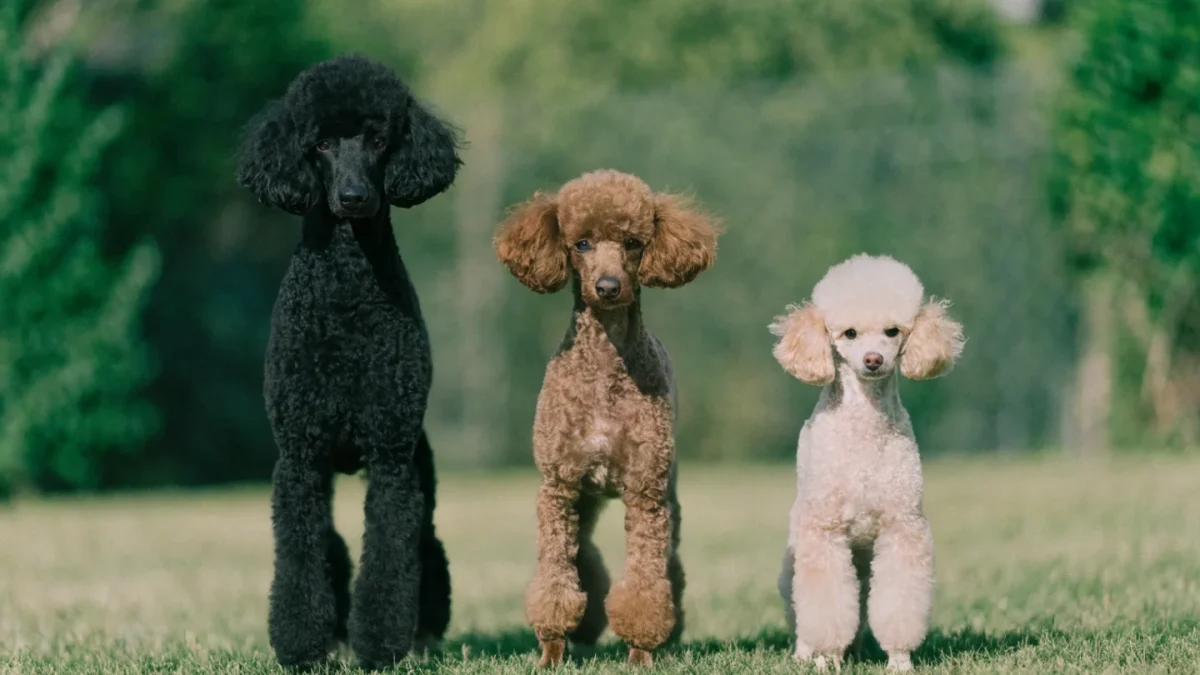
When someone says "I want a poodle," they're actually facing three very different dogs packaged under one breed name. Standard, Miniature, and Toy Poodles share the same breed standard in every respect except height — same coat, same intelligence ranking, same temperament blueprint. But the practical differences in daily life with each variety are significant enough that choosing the wrong size is the single most common mistake poodle buyers make.
The complete poodle breed guide covers the breed comprehensively. This piece focuses specifically on what changes between sizes and what stays the same — because understanding that distinction is what leads to the right decision.
What Stays the Same Across All Three
Before the differences, the constants. Every poodle owner deals with these regardless of size:
Coat maintenance. All three varieties have the same continuously growing, single-layer, curly coat. All three need professional grooming every four to six weeks. All three mat aggressively without regular brushing. The cost per session scales with the size of the dog, but the time commitment and frequency are identical.
Intelligence. Coren's obedience intelligence ranking applies to the breed, not the variety. A Toy Poodle is as cognitively capable as a Standard. The difference is only in what that intelligence can physically accomplish.
Emotional sensitivity. Poodles across all three sizes bond deeply, read human emotions with unusual accuracy, and are susceptible to stress from household instability. The poodle temperament operates on the same wiring regardless of body size.
Grooming the hypoallergenic myth. All three shed minimally. None are truly hypoallergenic. The reduced dander distribution helps allergy sufferers, but it's a spectrum, not a guarantee.
Where the Sizes Diverge
Physical Dimensions
| Measurement | Standard | Miniature | Toy |
|---|---|---|---|
| Height | Over 38 cm (typically 45-60 cm) | 28-38 cm | Under 28 cm |
| Weight | 20-32 kg | 5-9 kg | 2-4 kg |
| Build | Square, deep-chested, athletic | Scaled-down Standard proportions | Compact, fine-boned |
The weight range matters more than people think. A 32 kg male Standard is a substantial dog — comparable in mass to a Labrador Retriever. A 2 kg Toy can be carried in one hand. This isn't just an aesthetic difference. It determines housing requirements, travel logistics, physical handling, and even the practicality of basic activities like leash walking in different environments.
Exercise Requirements
Standards need 60 to 90 minutes of structured activity daily. Swimming, running, agility, fetch — these are athletes that require real physical output. A Standard without adequate exercise becomes destructive, anxious, or both.
Miniatures need 45 to 60 minutes. They're energetic enough for hiking and active play but adaptable enough for apartment living if the exercise happens consistently. Miniatures are arguably the most versatile variety for varied lifestyles.
Toys need 30 to 45 minutes. Their bodies fatigue faster, but their brains don't — mental enrichment compensates for the lower physical threshold. Puzzle toys, training sessions, and interactive play are non-negotiable supplements.
Health Predispositions by Size
This is where the choice gets consequential. The three varieties don't just differ in what they look like — they differ in what's likely to go wrong medically.
Standard-specific risks: Gastric dilatation-volvulus (bloat), hip dysplasia, Addison's disease at elevated rates, idiopathic epilepsy, sebaceous adenitis. Deep-chested body structure and larger joint surfaces create vulnerabilities that smaller varieties largely avoid.
Miniature-specific risks: Patellar luxation, Legg-Calve-Perthes disease, progressive retinal atrophy at well-documented rates. The mid-range size avoids the extremes but carries its own orthopedic profile.
Toy-specific risks: Patellar luxation (higher incidence than Miniatures), tracheal collapse, hypoglycemia in puppies, dental crowding from compressed jaw structure. Extreme miniaturization has consequences.
Lifespan
The inverse relationship between size and lifespan holds clearly: Standards average 10 to 13 years, Miniatures 12 to 15 years, Toys 14 to 18 years. A Toy Poodle from health-tested lines can reasonably be a companion for nearly two decades. A Standard, even from excellent breeding, is a shorter commitment.
Living Situation Fit
Standards need space to move indoors and reliable access to outdoor exercise areas. They can adapt to apartments, but it requires disciplined daily routines — a Standard in a small apartment without consistent exercise is a recipe for behavioral problems.
Miniatures are the pragmatist's choice for mixed environments. Apartments work. Houses work. They travel more easily than Standards but are robust enough for active outdoor life.
Toys excel in smaller living spaces and travel easily — they fit under an airline seat. The trade-off is physical fragility. Toys in homes with small children or large dogs require careful management to prevent accidental injury.
The Decision Framework
Choose a Standard if you want an athletic partner, have space, can budget for larger-dog grooming and veterinary costs, and can commit to serious daily exercise. Standards reward active, engaged owners with a depth of partnership that's hard to match.
Choose a Miniature if you want the full poodle experience in a more manageable size. Robust enough for outdoor activities, compact enough for flexible living. The Miniature is the variety that works in the most situations.
Choose a Toy if close companionship is the priority, you live in a smaller space, and your household can accommodate a physically delicate dog. Toys give the same intelligence and bonding in the most portable package — but they demand the same mental engagement as their larger relatives.
The wrong choice isn't about getting a bad dog. It's about getting a mismatch between your life and the dog's needs. Match correctly, and any of the three varieties delivers on the poodle promise.