

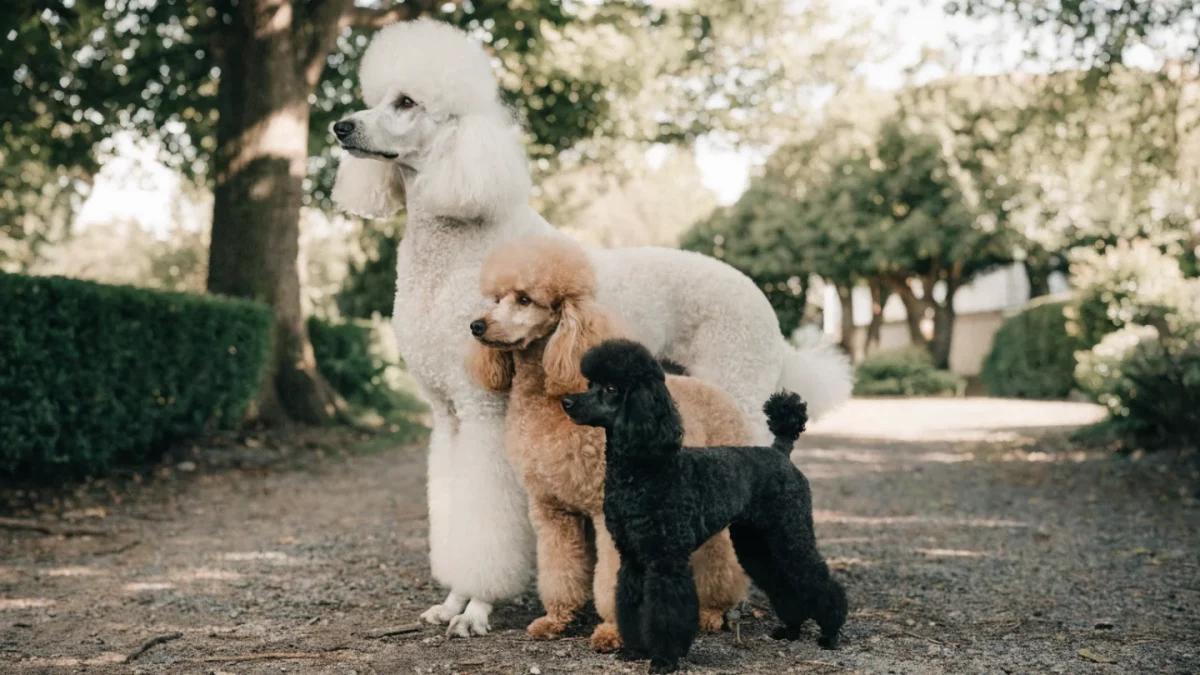
The poodle started out as a duck dog. That fact surprises most people who picture the breed in a continental clip at a show ring, but the name itself gives it away — "Pudel" comes from the Low German word "puddeln," meaning to splash in water. Before the elaborate grooming, before the miniaturization, before the centuries of association with French aristocracy, poodles were working retrievers hauling waterfowl out of cold European rivers and marshes.
Poodles come in three recognized sizes — Standard, Miniature, and Toy — and all three share the same breed standard aside from height. Originally bred as water retrievers in continental Europe, they rank among the most intelligent and trainable breeds, with a continuously growing coat that needs professional grooming roughly every four to six weeks. Whether you're researching the athletic Standard, the versatile Miniature, or the compact Toy, this poodle breed guide covering Standard, Miniature, and Toy varieties breaks down what actually differentiates the three sizes and what they share.
And they share more than most people realize. The biggest misconception about poodles? That they're fussy, delicate, or ornamental. That reputation has done real damage to the breed's image. Poodles are athletes. They're problem-solvers. They can be stubborn, goofy, and fiercely loyal in ways that catch first-time owners off guard. The show ring aesthetic is a fraction of what this breed actually is.
Origins and History
The Water Retriever Nobody Expects
Tracing the poodle's exact origin is complicated because Germany, France, and Russia all claim credit. The strongest evidence points to a Central European origin with significant development in both Germany and France. German artwork from the 15th and 16th centuries depicts curly-coated water dogs that closely resemble modern poodles. France eventually adopted the poodle (Caniche, from "cane" meaning duck) as its national breed.
The Standard Poodle is the oldest of the three sizes — muscular enough to swim in rough water, intelligent enough to work independently, athletic enough to spend full days in the field. The iconic poodle clip, which looks purely decorative today, originated as a functional trim. Handlers shaved the body to reduce drag in water while leaving hair on joints and chest for insulation. The pompoms weren't fashion. They were protection from cold.
Miniaturization and Diversification
By the 1700s, smaller poodles were being selectively bred in France for truffle hunting and companionship. The Miniature Poodle emerged as a distinct working size — small enough to navigate dense underbrush in truffle forests, but still sturdy and driven. These weren't lapdogs. They had jobs.
Toy Poodles appeared by the 18th century, bred primarily as companions for European aristocracy. French court records from the Louis XV era (1715–1774) show tiny poodles as fashionable companions. The Toy variety lost the working function but retained the intelligence and temperament of its larger relatives.
The key point: Standard, Miniature, and Toy are not separate breeds — they are varieties of a single breed, evaluated against the same standard except for height.
Physical Characteristics: Three Sizes, One Breed
Standard Poodle
The Standard is the largest and most athletic variety. Height: over 38 cm at the shoulder, with most Standards standing between 45 and 60 cm. Weight ranges from 20 to 32 kg, though this varies significantly between males and females. Males tend toward the upper end; females are typically lighter and slightly shorter.
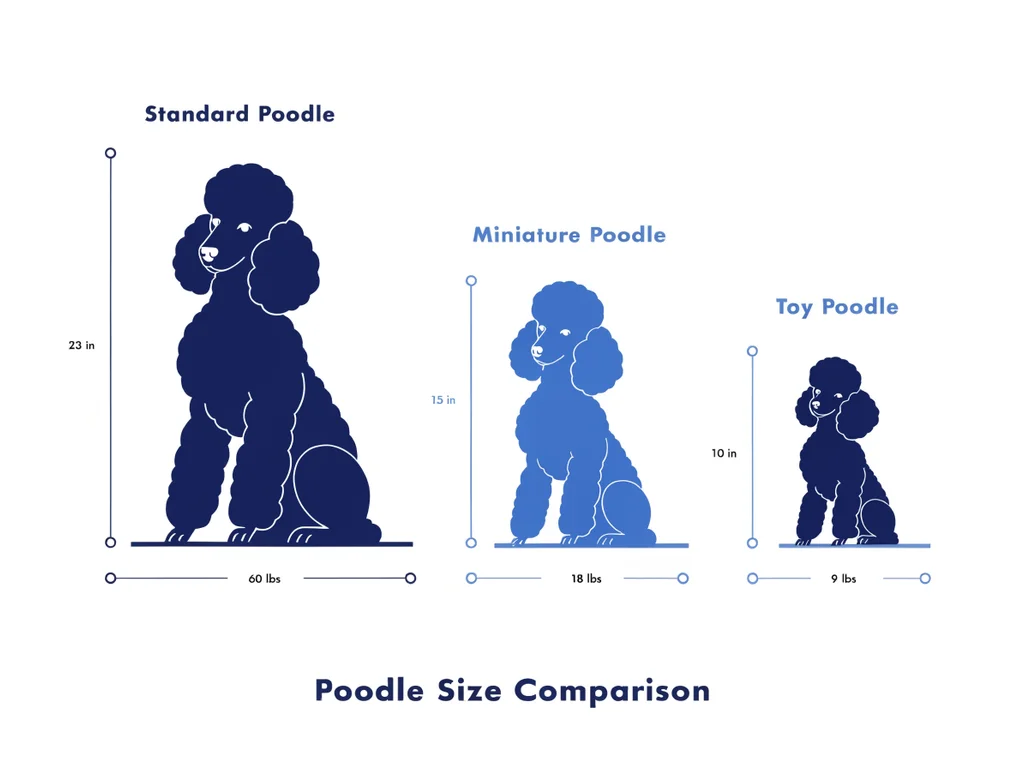
Build is square — body length from breastbone to buttocks roughly equals height at the shoulder. The chest is deep, reaching to the elbow. Legs are straight and well-muscled. There's nothing fragile about a well-bred Standard Poodle. If a Labrador is the pickup truck of the retriever world, the Standard Poodle is the sports car — same engine category, different chassis.
Miniature Poodle
The Miniature stands between 28 and 38 cm at the shoulder and typically weighs 5 to 9 kg. Proportionally, Miniatures should be exact scaled-down versions of the Standard — same square build, same angulation, same carriage. In practice, some breeding lines have drifted toward a slightly more compact, cobby build, which deviates from the breed standard.
Miniatures occupy a sweet spot: small enough for apartment living, large enough to be robust play partners. They're the variety most commonly seen in competitive obedience and agility relative to their numbers, partly because their size-to-trainability ratio is hard to beat.
Toy Poodle
Toys stand under 28 cm at the shoulder and weigh between 2 and 4 kg. Despite the tiny stature, the breed standard calls for the same proportions, movement, and expression as the larger varieties. A Toy Poodle should look like a miniature athlete, not a fragile ornament.
Extreme miniaturization has introduced structural challenges in some lines. Toys from poorly managed breeding programs can have disproportionately large heads, overly fine bone, and dental crowding. Responsible breeders prioritize correct proportion even at the smallest sizes, but buyers should evaluate structure carefully.
Size Comparison at a Glance
| Trait | Standard | Miniature | Toy |
|---|---|---|---|
| Height | Over 38 cm (typically 45–60 cm) | 28–38 cm | Under 28 cm |
| Weight | 20–32 kg | 5–9 kg | 2–4 kg |
| Original purpose | Water retrieval | Truffle hunting, companionship | Companionship |
| Life expectancy | 10–13 years | 12–15 years | 14–18 years |
| Exercise needs | High | Moderate-High | Moderate |
Coat and Color
All three sizes share the same coat type: dense, curly, and continuously growing. Poodles have a single-layer coat rather than a double coat, which is why they shed minimally compared to most breeds. The hair grows, it doesn't cycle through a shed-and-regrow pattern the way double-coated breeds operate. This means less hair on your furniture — but it also means the coat mats rapidly without regular maintenance.
Accepted coat colors include black, white, brown, silver, blue, gray, cream, apricot, red, and cafe au lait. Patterns like parti-color and phantom exist but aren't accepted for showing in all registries. Color should never be a primary selection criterion over health and structure, but it often is — and that drives certain health issues in color-chasing breeding programs.
Texture matters too. A correct poodle coat is dense and springy. Some poodles carry softer, cottony coats that mat faster and are harder to maintain. The adult coat won't fully develop until around two years of age, so puppy coat isn't a reliable predictor.
Temperament and Behavior
Intelligence That Cuts Both Ways
Poodles consistently rank among the top two or three breeds in trainability and problem-solving assessments. That intelligence is real and measurable — according to Stanley Coren's landmark canine intelligence assessment, published in The Intelligence of Dogs (1994) and based on evaluations from 208 obedience judges, poodles ranked second overall — learning new commands in fewer than five exposures and obeying first commands 95 percent of the time or better.
But high intelligence in dogs isn't the unqualified advantage people assume. A poodle that isn't mentally stimulated will find its own entertainment, and you won't like its choices. They open cabinet doors, figure out latch mechanisms, and manipulate other pets to get what they want. A bored poodle is a creative poodle, and creative poodles redecorate.
This applies to all three sizes. Toy Poodle owners sometimes underestimate the mental needs because the dog is small — that mistake leads to nuisance barking, destructive chewing, and anxiety-driven behaviors.
Emotional Sensitivity and Social Behavior
Poodles bond deeply and read human emotions with unusual accuracy, making them outstanding therapy and assistance dogs. The flip side is that poodles are genuinely affected by household stress, raised voices, or inconsistent handling. Separation anxiety is a legitimate concern across all three sizes, though Standards cope slightly better with alone time than Miniatures and Toys.
With proper socialization, poodles are typically good with other dogs, cats, and children. Standards tend to be the calmest around small children, partly because their size makes them less vulnerable to rough handling. Toy Poodles and very young children can be risky — not because Toys are aggressive, but because a two-kilogram dog is physically fragile around toddlers.
All sizes tend toward reserved wariness with strangers rather than the indiscriminate friendliness of, say, a Golden Retriever. They warm up, but they assess first. Standards especially make excellent alert dogs — they'll let you know someone is at the door without frenzied barking.
What Most People Get Wrong About Poodle Temperament
The "prissy" stereotype. Poodles are routinely portrayed as high-maintenance divas, and it's genuinely unfair. A Standard Poodle will happily dive into a muddy lake, retrieve a dummy in freezing conditions, and then roll in something unidentifiable on the walk back. Miniatures were truffle dogs — rooting through forest floors isn't exactly delicate work.
The stereotype stems from show grooming and the breed's association with French luxury culture. It tells you nothing about the actual dog underneath that continental clip. Poodles are goofy, playful, and have a distinctive sense of humor. They clown around. They play pranks. They're nothing like their public image.
Health Considerations
Shared Health Concerns (All Sizes)
Some conditions appear across all three poodle varieties:
Progressive Retinal Atrophy (PRA): A genetic eye condition causing gradual vision loss. DNA testing is available, and responsible breeding programs screen for it. Carriers should not be bred to carriers.
Sebaceous Adenitis: An inflammatory skin condition that destroys the sebaceous glands, leading to scaling, hair loss, and secondary infections. More common in Standards but documented in Miniatures and Toys. Diagnosis requires skin punch biopsy.
Addison's Disease (Hypoadrenocorticism): An endocrine disorder where the adrenal glands don't produce sufficient hormones. Symptoms are vague — lethargy, vomiting, intermittent appetite loss — which makes it easy to miss. Standards have a significantly higher incidence than the general dog population — a 2021 UK primary veterinary care study published in the Journal of Small Animal Practice found that 2.26 percent of Standard Poodles were affected, giving them 51 times the odds of developing the condition compared to crossbreeds.
Dental disease: Particularly in Miniatures and Toys, where crowding in smaller jaws accelerates plaque and tartar buildup. Regular dental care isn't optional with poodles — it's a baseline requirement.
Standard Poodle Health
Standards are prone to several conditions that Miniatures and Toys experience at lower rates:
- Gastric dilatation-volvulus (bloat): A life-threatening emergency where the stomach twists on its axis. Deep-chested breeds are at highest risk, and the Standard Poodle qualifies. Feeding practices (multiple small meals rather than one large meal, avoiding exercise immediately after eating) can reduce risk but not eliminate it.
- Hip dysplasia: Abnormal hip joint development causing lameness and arthritis. Screening via radiographic evaluation is standard practice in breeding programs.
- Idiopathic epilepsy: The International Veterinary Epilepsy Task Force's 2015 review in BMC Veterinary Research identifies Standard Poodles as a breed with suspected genetic epilepsy, with a reported median age of onset around 2.4 to 3.7 years depending on the study population. Focal seizures evolving into generalized seizures are the most common presentation.
Miniature Poodle Health
- Patellar luxation: The kneecap slides out of its normal groove. Grading runs from I (mild, self-correcting) to IV (permanent displacement requiring surgery). Miniatures are affected more frequently than Standards.
- Legg-Calve-Perthes disease: Deterioration of the femoral head due to interrupted blood supply. Primarily a concern in smaller breeds, including Miniature Poodles. Usually presents before one year of age.
- PRA: While present in all sizes, Miniatures have particularly well-documented incidence rates.
Toy Poodle Health
- Patellar luxation: Even more common in Toys than Miniatures due to smaller joint structures.
- Tracheal collapse: The tracheal rings weaken and flatten, causing a distinctive honking cough. More frequent in toy and miniature breeds broadly, including Toy Poodles.
- Hypoglycemia: Toy Poodle puppies especially are susceptible to dangerous drops in blood sugar due to their small body mass and limited glycogen reserves. Frequent small meals are essential during the first year.
Lifespan Expectations
A general pattern holds: smaller poodles live longer. Toy Poodles routinely reach 14 to 18 years, with the American Kennel Club listing a 10-to-18-year range that accounts for the full spectrum. Miniatures average 12 to 15 years. Standards average 10 to 13 years. These are averages — individual dogs from health-tested lines in appropriate body condition can exceed these ranges.
Grooming: The Defining Commitment
If there's one thing every prospective poodle owner needs to understand before committing, it's the grooming. The poodle coat doesn't shed like other breeds, but it grows continuously and mats aggressively. Left ungroomed, a poodle's coat will felt into tight mats that pull on the skin, trap moisture, and create breeding grounds for skin infections.
Professional Grooming Schedule
Plan for professional grooming every four to six weeks. This is not optional. Every four to six weeks, for the lifetime of the dog. A full groom includes bathing, blow-drying (poodle coats must be dried straight or they mat during drying), scissoring or clipping to style, and attention to ears, nails, and sanitary areas.
The cost varies by region and size — Standards cost more simply because there's more dog to groom. Budget grooming as a fixed recurring expense before you get a poodle. If the grooming budget isn't there, this isn't the breed for you.
Between-Groom Maintenance
Daily brushing is the standard recommendation, and it's realistic for Toys. For Miniatures and Standards, brushing every two to three days is the minimum to prevent mats from setting. Use a slicker brush and a metal comb, and work in sections — brush a section, then comb through it to check for mats you missed.
Ears require special attention. Poodle ear canals grow hair that can trap moisture and debris, leading to chronic ear infections. Many groomers pluck this hair, though veterinary dermatologists have increasingly moved away from routine plucking — the consensus is that plucking healthy ear canals can cause micro-trauma and inflammation that actually increases infection risk, while trimming with blunt-tipped scissors achieves the same airflow without the tissue damage. Plucking still has a place when an active ear infection needs medication access through dense canal hair, but as a default grooming practice, trimming is the safer call. Either way, regular ear cleaning is necessary.
Clip Styles
The continental and English saddle clips seen in show rings are not how most pet poodles live. Common pet clips include:
- Puppy clip: Even length all over, easy to maintain, looks neat.
- Sporting clip: Short body with slightly longer legs, ears, and topknot. Practical for active dogs.
- Lamb clip: Even length everywhere, longer than a puppy clip. Soft, approachable look.
- Summer clip: Very short all over. Minimal maintenance. Some owners go this route in warm climates.
The clip you choose affects maintenance between grooms. Longer clips mat faster. Shorter clips need more frequent grooming to stay sharp. There's no free lunch.
A Note on "Hypoallergenic"
Poodles are frequently marketed as hypoallergenic. This needs qualifying. No dog breed is truly hypoallergenic. Poodles shed less dander-carrying hair into the environment than double-coated breeds, which reduces (but does not eliminate) allergen exposure. People with mild dog allergies often tolerate poodles better than heavy-shedding breeds. People with severe allergies may still react. Always spend extended time with the specific variety before committing if allergies are a factor.
Exercise and Mental Stimulation
Standard Poodle
Standards are athletes that need serious exercise — a minimum of 60 to 90 minutes daily, combining physical activity with mental challenges. Swimming is ideal for the breed (they are water retrievers, after all). Running, hiking, fetch, and structured play all work. Without adequate exercise, Standards channel their energy into destructive behaviors.
Dog sports are where Standards truly shine. Agility, obedience, dock diving, rally, and nose work all suit the breed's intelligence and physical capability. A Standard Poodle doing agility at full speed looks nothing like the stereotype.
Miniature Poodle
Miniatures need 45 to 60 minutes of daily exercise. They adapt well to apartment living provided they get that outlet, plus mental enrichment. Puzzle toys, training sessions, and interactive play matter as much as physical exercise for this size.
Toy Poodle
Toys need 30 to 45 minutes of daily activity. Their exercise requirements are lower, but their mental stimulation needs are identical to their larger relatives. Short training sessions throughout the day, food puzzle toys, and interactive play compensate for the lower physical exercise threshold.
Mental Enrichment (All Sizes)
Poodles need to think. Rotating puzzle toys, scent work games, and learning new tricks regularly all help. The breed excels at complex trick sequences — they were circus performers for centuries for good reason. A poodle that learns one new skill per week is happier than one that runs the same fetch routine daily.
Training
Poodles are among the easiest breeds to train — food-motivated, toy-motivated, and praise-motivated, which gives you multiple reward currencies to work with. Positive reinforcement works exceptionally well.
Harsh corrections backfire badly. Poodles are sensitive enough to shut down under heavy-handed training, and smart enough to learn avoidance behaviors instead of the desired response. If a poodle is "stubborn," the problem is almost always the handler's approach, not the dog's willingness.
Size-Specific Training Notes
Standards: Their size makes early leash manners and impulse control critical. A 30 kg Standard pulling on a leash is a serious management problem. Start recall, loose-leash walking, and settle commands early.
Miniatures: Prone to what trainers call "small dog syndrome" — not a real syndrome, but a pattern where owners skip training because the dog is manageable at small size. An untrained Miniature Poodle is still an obnoxious housemate. Train them with the same expectations you'd have for a large dog.
Toys: Housetraining takes longer because their small bladders need more frequent access to elimination areas. Patience and a consistent schedule matter more than any single method. Avoid carrying Toys everywhere — they need to walk, explore, and develop confidence independently.
Living Arrangements
Space Requirements
Standards need access to exercise areas and enough indoor room to move comfortably. They can adapt to apartment living if exercise needs are met religiously. Miniatures and Toys are genuinely adaptable to apartments — their size makes indoor management straightforward, and Miniatures are arguably the most versatile size for varied living situations.
Climate and Multi-Pet Considerations
The poodle's single-layer coat provides less insulation than a double coat. In cold climates, Standards doing outdoor winter activities may benefit from a fitted coat. Toys and Miniatures are particularly vulnerable to cold due to their small body mass. In hot climates, poodles handle heat better than many breeds because they lack the dense undercoat that traps warmth.
Poodles generally coexist well with other dogs and cats when introduced properly. Standards can have high prey drive toward small animals — their retriever heritage includes flushing instincts. Homes with rabbits, guinea pigs, or birds should supervise interactions carefully. Miniatures and Toys have lower prey drive on average, but individual variation exists.
Choosing the Right Size
This is the decision that defines the poodle ownership experience. The three sizes share intelligence, trainability, coat type, and core temperament, but they differ in practical ways that matter daily.
Choose a Standard if: you want an athletic partner for outdoor activities, dog sports, or active family life. You have space, budget for grooming a large dog, and can commit to serious daily exercise. Standards are the closest to the breed's working origins.
Choose a Miniature if: you want the full poodle personality in a more manageable package. Robust enough for active outings, compact enough for apartments. Miniatures are the pragmatist's poodle.
Choose a Toy if: you want a close companion that travels easily. Small doesn't mean low-maintenance — Toys need grooming, mental stimulation, and socialization just as much as their larger relatives. Ideal for individuals or couples who can provide attentive, consistent care.
The Right Owner for Any Poodle
Regardless of size, poodles thrive with owners who meet three non-negotiable requirements. First, grooming: if professional grooming every four to six weeks plus regular brushing sounds exhausting, choose a different breed. Second, mental engagement: poodles need more than walks — they need to learn, solve problems, and interact meaningfully with their people. Third, emotional presence: these are bonding-oriented dogs that don't do well as afterthoughts.
People who meet those three requirements consistently describe poodles as the best dogs they've ever owned. People who don't describe them as neurotic and difficult. The dog is the same. The experience diverges based on what the human brings to the relationship.
Frequently Asked Questions
Are poodles really hypoallergenic?
Not entirely. Poodles shed far less hair and dander into the environment than double-coated breeds, which reduces allergen exposure for many people with mild allergies. However, no breed is truly hypoallergenic. The allergen most people react to (Can f 1) is produced in saliva and skin secretions, not just hair. People with severe dog allergies may still react to poodles. Extended exposure to the specific dog before committing is the only reliable test.
What is the difference between a Miniature Poodle and a Toy Poodle?
Size is the primary distinction. Miniatures stand 28 to 38 cm at the shoulder (5–9 kg); Toys stand under 28 cm (2–4 kg). Beyond size, Miniatures tend to be slightly more robust, while Toys are more prone to structural issues from extreme miniaturization. Temperament and intelligence are essentially identical — personality differences between individuals within each size are greater than average differences between the two sizes.
Do poodles bark a lot?
Poodles are alert dogs that will bark to notify you of visitors, unusual sounds, or changes in their environment. They are not typically excessive barkers when properly exercised and mentally stimulated. However, understimulated poodles — especially Miniatures and Toys — can develop habitual barking as a self-soothing or attention-seeking behavior. Consistent training and adequate enrichment prevent most barking issues.
How often do poodles need grooming?
Professional grooming every four to six weeks is the baseline for all three sizes. Between professional sessions, home brushing every one to three days prevents matting. Ears need weekly cleaning, and nails should be trimmed every two to three weeks. The total grooming time commitment — including home maintenance and professional appointments — is higher than almost any other breed. This is the single biggest lifestyle adjustment for new poodle owners.
Can Standard Poodles live in apartments?
Yes, with caveats. Standards can adapt to apartment living if they receive 60 to 90 minutes of daily exercise and consistent outdoor access. They're calm indoors when properly exercised. The challenge is that meeting a Standard's needs from an apartment requires deliberate planning: daily park trips, swimming sessions, or structured activities. If that routine can be maintained reliably, apartment living works.
Are poodles good with children?
Standards are generally excellent family dogs — sturdy enough for play with children of all ages, patient and playful. Miniatures do well with children who have learned gentle handling. Toys are physically fragile and best suited to households with older children (roughly eight years and above). Supervision is always necessary with any breed and young children.