

Research has documented a peculiar feature of chihuahua skulls: a fontanelle — an opening where the cranial bones hadn't fully fused — present in a significant proportion of adult dogs. A 2021 study in the Journal of Veterinary Internal Medicine found persistent fontanelles in the majority of chihuahuas examined by CT scan. In humans, fontanelles are a birth feature that closes within the first two years. In chihuahuas, they're a breed characteristic that persists into adulthood in many individuals. That single anatomical quirk tells you something fundamental about chihuahua genetics: this breed carries genetic traits that, in other contexts, would be considered pathological but in chihuahuas are so deeply embedded that breed standards acknowledge them as normal.
The chihuahua's genetic profile encompasses more than the molera. Coat type, color inheritance, and the ongoing controversy surrounding the merle pattern all have genetic mechanisms that matter for breeders, buyers, and owners trying to understand what their dog is and why.
The Molera: A Fontanelle by Another Name
The molera is a soft spot on the top of the chihuahua's skull, located where the frontal and parietal bones meet. Most chihuahua puppies are born with one, and the chihuahua breed guide notes it as a distinguishing breed feature. In most individuals, the molera reduces significantly in size during the first six months and may close entirely by adulthood. In a meaningful number of chihuahuas, however, it persists as a permanent opening.
The genetics behind the molera are linked to the breed's apple-dome skull conformation. The rounded skull shape requires the cranial bones to accommodate a relatively large brain-to-skull-size ratio, and the molera appears where the bony plates don't fully converge. In breeds with flatter, more elongated skulls, this closure happens completely during development. The chihuahua's extreme skull curvature makes incomplete closure more likely.
A small molera in an otherwise healthy adult chihuahua is considered within breed norms. A large, persistent molera in combination with a domed, enlarged skull can indicate hydrocephalus — a condition where cerebrospinal fluid accumulates in the brain, causing neurological symptoms. The distinction between a normal breed trait and a pathological condition is a matter of degree, and veterinary evaluation is warranted when the molera is pronounced or the skull shape appears abnormally distended.
The deer-head chihuahua, with its flatter skull and longer muzzle, tends to have smaller or absent moleras compared to the apple-head type. This anatomical difference is one reason deer-head chihuahuas — while not conforming to breed-standard skull shape — may carry lower risk for the cranial issues associated with extreme dome curvature.
Coat Type Genetics
The chihuahua comes in two coat varieties — smooth and long — and the genetic mechanism is straightforward. Coat length in dogs is controlled primarily by the FGF5 gene (fibroblast growth factor 5). The wild-type allele produces short hair (smooth coat). Recessive mutations in FGF5 produce long hair when present in two copies — at least five such variants have been identified across dog breeds, with the most common being the p.Cys95Phe variant.
Smooth coat is dominant. A smooth-coat chihuahua can carry one copy of the long-coat allele (genotype L/l) without showing it. Two smooth-coat carriers bred together will produce, on average, 25% long-coat puppies (l/l), 50% smooth-coat carriers (L/l), and 25% smooth-coat non-carriers (L/L). This is why long-coat puppies appear in litters from two smooth-coat parents — it surprises first-time breeders but follows basic Mendelian genetics.
The two coat types are not separate breeds or varieties in most registries — they're interbreedable, and mixed-coat litters are routine. The practical difference for owners is grooming maintenance: long-coat chihuahuas require regular brushing to prevent matting, while smooth-coat chihuahuas shed more visibly because loose hair falls freely rather than being caught in longer fur.
The coat texture and density of the smooth-coat variety varies considerably between individuals. Some smooth-coat chihuahuas have a very fine, sparse coat that provides minimal insulation — these dogs are the most cold-sensitive individuals in the breed. Others have a denser, slightly plusher smooth coat. This variation is polygenic and not fully mapped to specific loci.
Color Genetics
Chihuahuas display one of the widest color ranges of any breed. Fawn, black, white, chocolate, cream, blue, red, sable, brindle, and combinations thereof are all common. The genetic architecture behind this diversity involves the same loci that control color in other breeds, but the breadth of allowable colors in the chihuahua standard means that few color-restricting selection pressures have narrowed the palette.
The A (agouti) locus controls pattern distribution — sable, tan points, and solid patterns. The E (extension) locus determines whether black/brown pigment can be expressed at all; the recessive e/e genotype blocks eumelanin production and produces a red or cream dog regardless of what the A locus specifies. The B locus switches black eumelanin to brown (chocolate), and the D locus dilutes black to blue or brown to lilac.
Blue chihuahuas carry the homozygous d/d genotype at the dilution locus. The blue coloring is visually distinctive, but it can be associated with color dilution alopecia (CDA) — a condition where diluted hair shafts are structurally fragile and prone to breakage, resulting in patchy hair loss. CDA has been documented in chihuahuas and multiple other breeds carrying the d/d genotype. Not all blue chihuahuas develop this condition, but the association is well-documented across dilute-colored dogs of multiple breeds.
The Merle Controversy
No genetic topic in chihuahua breeding generates more heated debate than the merle pattern.
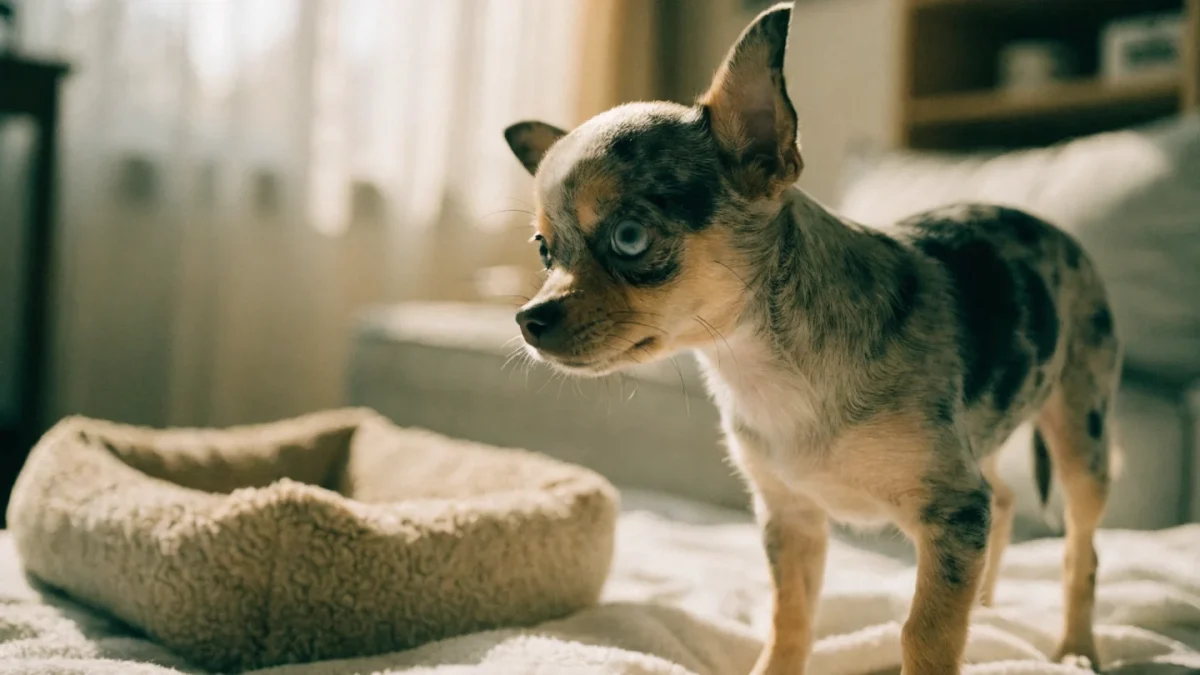
Merle is produced by the M locus — specifically, a SINE insertion in the PMEL17 gene that disrupts melanocyte function during development. A single copy of the merle allele (M/m) produces the distinctive mottled pattern: patches of diluted color against a background of full-pigment color, often with striking blue or heterochromatic eyes. The visual effect is undeniably eye-catching.
The controversy isn't about how merle looks. It's about where it came from in chihuahuas and what happens when two merle dogs are bred together.
Origins of Merle in Chihuahuas
The chihuahua's history traces the breed to Mesoamerican Techichi dogs, and no historical or archaeological evidence suggests that merle was present in those ancestral populations. Merle is common in herding and working breeds — Australian Shepherds, Border Collies, Dachshunds — that have entirely separate lineage histories.
The most widely accepted explanation is that the merle gene entered chihuahua populations through crossbreeding with merle-carrying breeds at some point during the 20th century. The exact cross is debated — Dachshunds have been most commonly suggested as a likely source — but the timeline is relatively recent in breed-history terms, with no records of merle chihuahuas before the 1940s.
This matters because it raises a question of breed purity that some registries and breeders take very seriously. If merle was introduced through crossbreeding, then merle chihuahuas carry non-chihuahua DNA within recent generations. Several breed registries have responded by refusing to register merle chihuahuas or by requiring DNA testing to confirm breed purity.
The Double Merle Problem
The more urgent issue is medical, not philosophical. When two merle-patterned dogs are bred together (M/m x M/m), approximately 25% of the offspring will be homozygous merle (M/M) — commonly called "double merle" or "lethal white."
Double-merle puppies are predominantly white with minimal pigment. They carry a high risk of congenital deafness (due to the absence of melanocytes in the inner ear), ocular defects ranging from microphthalmia (abnormally small eyes) to complete blindness, and neurological abnormalities. Some double-merle puppies are born with conditions severe enough to require euthanasia.
This outcome is entirely preventable. If merle chihuahuas are bred only to non-merle partners, no double-merle puppies are produced. The genetic math is simple, the testing is inexpensive, and responsible breeders who work with merle dogs know the protocol. The double-merle problem persists because some breeders prioritize producing more merle-patterned puppies (which command higher prices) over the welfare of the offspring.
What the Genetics Tell Us
The chihuahua's genome carries the signatures of its unusual history — ancient Mesoamerican origins compressed through centuries of European contact and twentieth-century miniaturization. The molera reflects the extreme skull shape. The coat-type genetics are elegantly simple. The color diversity preserves an unusually broad genetic palette. And the merle controversy illuminates the tension between aesthetic preferences and animal welfare that runs through purebred dog breeding globally.
Understanding these genetic fundamentals helps owners and prospective buyers make informed decisions — about which traits are breed norms versus health risks, about which color patterns carry hidden genetic costs, and about which breeding practices prioritize the dogs over the product.