

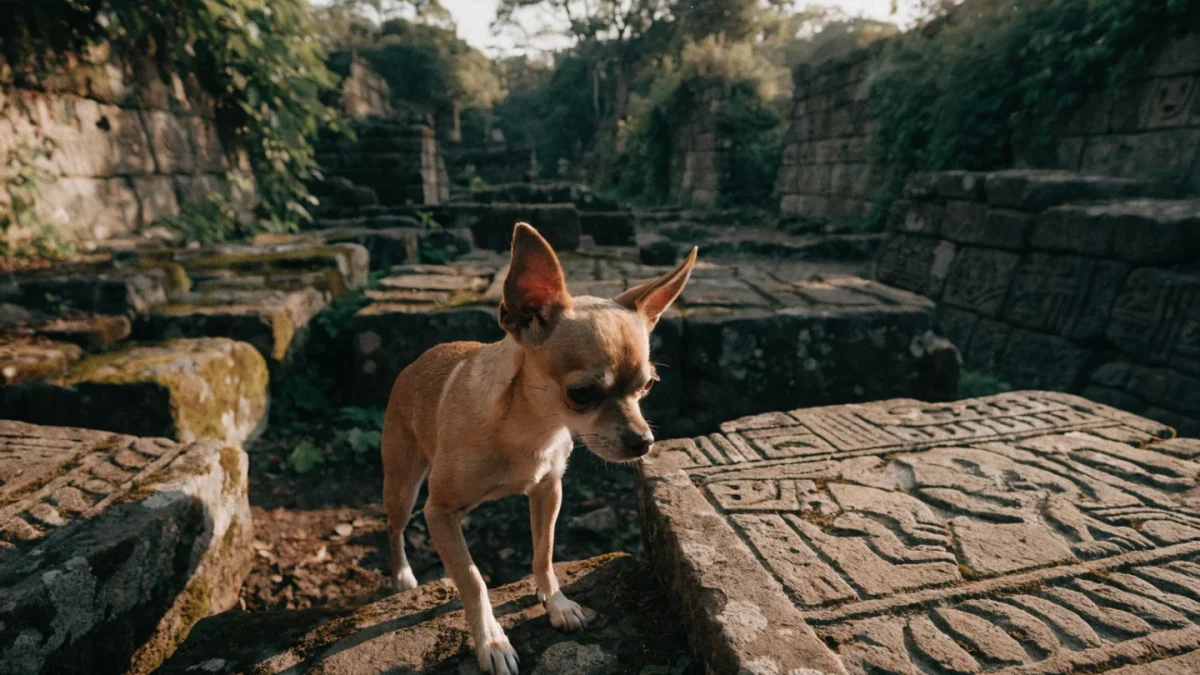
The oldest physical evidence of the chihuahua's ancestors was found not in a home or a kennel, but in a grave. At Colima, in western Mexico, ceramic burial vessels shaped like small dogs with large ears, rounded skulls, and bulging eyes have been dated to approximately 300 BC. These aren't crude figurines — they're detailed enough to identify the physical type. The dogs depicted have proportionally large heads, erect ears, and compact bodies that any modern chihuahua owner would recognize immediately.
The chihuahua history origins aztec techichi connection is not a romantic creation myth. It's an archaeological and historical record that spans more than two thousand years, crosses multiple civilizations, survives a European conquest that destroyed most of Mesoamerican culture, and ends with American tourists buying small dogs from Mexican vendors in the 1850s. The trail is incomplete — there are gaps, contested interpretations, and genuine mysteries — but the broad strokes are supported by physical evidence, Spanish colonial records, and genetic analysis.
The Techichi: A Dog Before the Breed
The Techichi was a small, mute or near-mute companion dog kept by the Toltec civilization, which dominated central Mexico from roughly the 10th to 12th centuries AD. Toltec stone carvings at the archaeological site of Tula, north of modern Mexico City, depict small dogs that match descriptions of the Techichi — compact, smooth-coated, with erect ears and a slightly curved tail.
The Techichi was larger than today's chihuahua — likely 4.5 to 9 kg (10 to 20 pounds), roughly double the modern breed's weight range. It was apparently not a barker, which distinguishes it sharply from its modern descendant. Colonial-era Spanish accounts describe the Techichi as quiet and docile, used as a companion and, less palatably to modern sensibilities, as a food source.
Whether the Techichi is the chihuahua's direct ancestor or merely a close relative in the same lineage is debated. The weight difference is substantial. Some researchers propose that the modern chihuahua resulted from the Techichi crossing with a smaller, possibly wild dog — perhaps a type of small canid native to the Chihuahuan Desert region. Others argue that selective breeding alone accounts for the size reduction over several centuries. Genetic studies have confirmed that some modern chihuahuas retain pre-contact Mesoamerican maternal DNA — a 2024 study in Proceedings of the Royal Society B traced a specific mitochondrial haplotype found exclusively in ancient Mexican dog samples and modern chihuahuas, supporting a Mesoamerican origin rather than a Spanish import.
Aztec Spiritual Companions
When the Aztec empire absorbed Toltec territories in the 12th and 13th centuries, they inherited the Techichi along with much of Toltec culture. Under Aztec society, these small dogs took on roles that went far beyond companionship.
The Aztecs believed that small dogs, particularly those with red or reddish-brown coats, could guide the souls of the dead through the nine levels of Mictlan — the underworld. This belief was not metaphorical. Dogs were sacrificed and buried with their owners to serve as literal guides in the afterlife. Archaeological sites across central Mexico have yielded dog remains in human burial contexts dating throughout the Aztec period, roughly 1300 to 1521 AD.
The spiritual role created a complicated relationship. These dogs were valued, bred, and cared for — but their value was partly defined by their utility in death. Red-coated dogs were most prized for burial purposes, which likely created selective pressure toward red and fawn coat colors that persist in the breed today.
Beyond the burial rites, Techichi-type dogs served as living hot-water bottles. Their small, warm bodies were placed against sick or injured people, and the Aztecs attributed healing properties to the dog's warmth. This practice is documented in multiple historical accounts and persisted in rural Mexico well into the 19th century.
The Aztecs also kept the dogs as household companions, particularly among the nobility. Descriptions from early Spanish colonial observers indicate that the dogs were bathed regularly, fed carefully, and treated with what would be recognizable as pet-owner affection. The relationship wasn't purely utilitarian — there was genuine emotional attachment.
The Spanish Conquest and Near-Disappearance
Hernan Cortes and the Spanish conquistadors arrived in 1519, and over the following decades, Aztec civilization was systematically dismantled. The Techichi's spiritual role was directly targeted — Spanish missionaries viewed the burial practices and underworld beliefs as pagan, and they actively suppressed the rituals that had given these dogs cultural significance.
The dogs themselves didn't disappear. They lost their cultural status, their breeding programs, and their protected position in society, but they persisted in rural and semi-wild populations across central and northern Mexico. Spanish colonial records from the 16th through 18th centuries occasionally mention small dogs in Mexican households, but the references are sparse — the dogs had gone from cultural icons to unremarkable household animals.
This three-hundred-year gap in the breed's documented history is the most contested period among breed historians. Some maintain that the chihuahua descends in an unbroken line from the Techichi through this rural survival period. Others suggest that the dogs in the Chihuahuan Desert by the 1800s were heavily crossed with small European breeds brought by Spanish settlers — possibly including the Maltese or small terrier types. The truth is probably somewhere between the two positions: a core population of indigenous small dogs that absorbed some European genetic input over three centuries of contact.
Rediscovery in the Desert
The modern breed history begins in the mid-1800s in the Mexican state of Chihuahua — the largest state in Mexico, covering a vast stretch of northern desert and mountain terrain. American travelers crossing the border reported finding small dogs living in semi-feral communities around the ruins of ancient buildings and in rural villages.
These dogs were variable in appearance — some smooth-coated, some long-coated, ranging in size from very small to moderately sized — but they shared the basic physical type: large ears, a rounded skull, and a compact body with expressive, prominent eyes. Local Mexican families kept them as companions and vermin control, and American visitors began purchasing them and bringing them north.
The dogs acquired their breed name from the state where most were acquired, not from any specific town or breeding program. "Chihuahua" was simply a geographic identifier that stuck. Early American owners also called them "Texas dogs," "Arizona dogs," and "Mexican dogs" before the Chihuahua name became standard.
American Standardization
The chihuahua's formalization as a breed happened primarily in the United States. The American Kennel Club registered its first chihuahua in 1904, and the Chihuahua Club of America was founded in 1923, drafting the original breed standard that same year. Early show chihuahuas were exclusively smooth-coated — the long-coat variety wasn't formally recognized until later, though long-coated individuals had been documented in Mexican populations for decades.
The breed's early American development is poorly documented compared to European breeds that were standardized during the Victorian dog-show boom. No single founding kennel or breeder shaped the chihuahua the way Reverend Honeywood shaped the beagle or Dudley Marjoribanks shaped the golden retriever. Instead, the breed coalesced gradually from imported Mexican stock refined by multiple American breeders working somewhat independently.
The chihuahua breed guide covers the physical standard in detail. From a historical perspective, the key development during this standardization period was the emphasis on smaller size. Mexican chihuahuas were more variable — some dogs exceeded 4.5 kg. American breeders consistently selected for smaller individuals, pushing the breed toward the 1.8-to-2.7 kg range specified in today's standard.
This size selection had consequences. The apple-dome skull shape, the molera (open fontanelle), and the dental crowding that plagues modern chihuahuas are all correlated with the extreme miniaturization that occurred primarily during the 20th century. The ancient Techichi, at roughly twice the modern chihuahua's weight, almost certainly had fewer of these structural issues.
Cultural Waves
The chihuahua's American popularity came in identifiable surges. Xavier Cugat, the Spanish-born bandleader who was a fixture of American entertainment from the 1930s through the 1960s, was rarely photographed without a chihuahua — his trademark was conducting his orchestra while cradling his chihuahua Pepito in one arm — and is widely credited with popularizing the breed among American audiences. The breed's association with Latin culture and Hollywood glamour established an image that persists today.
A second surge came in the early 2000s, driven largely by the breed's appearance in popular media. The Taco Bell advertising campaign of the late 1990s featuring a talking chihuahua made the breed a cultural phenomenon, and subsequent appearances in films and celebrity media sustained the interest.
Each popularity spike brought increased breeding volume, and not all of that breeding was thoughtful. The demand for ever-smaller chihuahuas intensified, producing the "teacup" and "micro" marketing categories that carry significant health risks. The breed's current health profile — particularly the prevalence of hydrocephalus, patellar luxation, and dental disease — reflects the cumulative effect of decades of size-focused selection pressure with insufficient attention to structural soundness.
What the History Tells Us
The chihuahua's temperament — its intense loyalty, its wariness of strangers, its one-person devotion, its alert vigilance — makes more sense when you understand what the breed was selected for across two millennia. This was never a hunting dog, a herding dog, or a working dog in the European sense. It was a companion animal with spiritual significance — a dog bred to be close to one person, to be attuned to that person's emotional state, and to serve as a watchful presence in the household.
The Techichi that was buried alongside its owner to guide a soul through the underworld was, in the simplest terms, a dog that never left its person's side. The modern chihuahua that follows its owner from room to room, sleeps touching its owner's body, and views separation as a genuine crisis is behaving in a way that two thousand years of selective pressure encoded into its DNA.
That's the weight of history in a two-kilogram dog. It's considerably more than most people expect when they pick one up for the first time.