

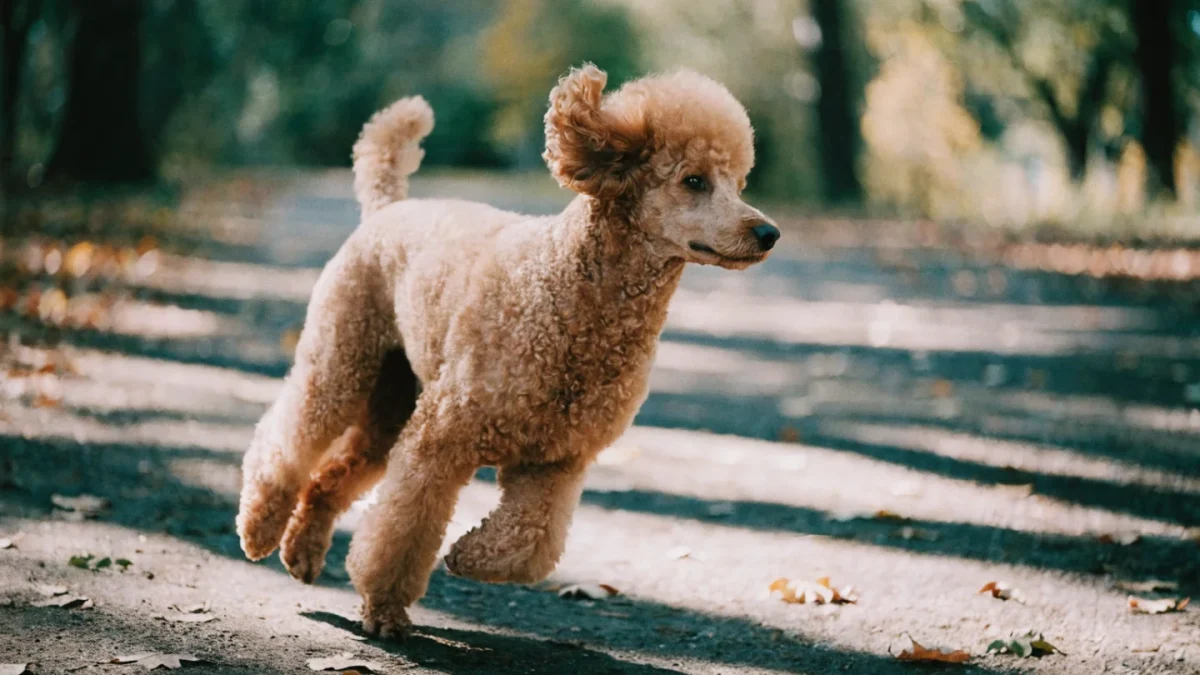
Every dog breed sheds. Including poodles. That statement contradicts what most people believe about the breed, so it's worth starting there: poodles do shed hair. What they don't do is deposit that hair all over your home in the way a Labrador or German Shepherd does. The mechanism behind this difference is genetic, well-documented, and more nuanced than the "hypoallergenic" marketing label suggests.
Understanding poodle coat genetics explains three things that matter to owners: why the coat behaves the way it does, why grooming is non-negotiable, and why color inheritance in poodles is both more complex and more commercially exploited than in most breeds.
The Single-Layer Coat: What Makes Poodles Different
Most dog breeds carry a double coat — a coarser outer layer (guard hairs) and a dense, insulating undercoat. The undercoat grows in cycles: active growth (anagen), regression (catagen), and resting/shedding (telogen). When the telogen phase hits, the undercoat releases en masse. That's the "blowing coat" phenomenon that double-coated breed owners dread twice a year.
Poodles lack this undercoat. They carry a single layer of dense, curly hair that grows continuously — more like human hair than typical dog fur. The hair follicles spend a prolonged period in the anagen (growth) phase before cycling, which means individual hairs grow longer before they're released.
When poodle hairs do reach the end of their growth cycle and detach from the follicle, they don't fall freely to the floor. The tight curl pattern traps shed hairs within the coat itself. This is why poodles don't leave hair on furniture and clothes the way double-coated breeds do — the shed hair is mechanically captured in the surrounding curls.
It's also why matting is such a persistent problem. Those trapped shed hairs tangle with the living coat, forming mats that tighten over time. Without regular brushing to remove the trapped dead hair, the mats compress against the skin and create the conditions for irritation and infection. The same genetic trait that makes poodles low-shedding is the trait that makes their grooming demands among the highest of any breed.
The Genetics of the Curl
The poodle's characteristic curl is primarily controlled by the KRT71 gene, which encodes a keratin protein involved in hair follicle shape. A variant in this gene — identified in research published by Cadieu et al. in 2009 in Nature Genetics — produces the tightly curled coat that defines the breed. Additional modifier genes likely influence curl tightness and texture, though the specific loci beyond KRT71 have not been fully characterized in poodles.
The FGF5 gene, often called the "long hair gene," also plays a role. Variants in FGF5 extend the anagen growth phase, producing the continuously growing hair that characterizes poodles. Dogs with two copies of the long-hair variant at FGF5 grow hair rather than fur — a distinction that matters because hair-growth patterns don't include the cyclical mass shedding that fur-growth patterns do.
The combination of KRT71 (curl) and FGF5 (continuous growth) is what produces the poodle's distinctive coat. This genetic pairing is also why poodle crosses — the various "doodle" mixes — have unpredictable coats. Without two copies of both relevant variants, the offspring may shed significantly more than a purebred poodle.
Color Genetics: Ten Accepted Shades and Their Inheritance
Poodle coat color is among the most diverse in any single breed. Accepted colors include black, white, brown, silver, blue, gray, cream, apricot, red, and cafe au lait. Understanding how these colors are inherited requires a brief look at canine color genetics.
The E locus (MC1R gene) determines whether a dog can produce eumelanin (black/brown pigment) in the coat. Poodles that are homozygous recessive (e/e) at this locus express phaeomelanin instead, producing the cream, apricot, and red shades.
The B locus (TYRP1 gene) controls whether eumelanin appears as black or brown (chocolate/liver). A poodle that is bb at the B locus will have brown pigmentation instead of black — affecting coat, nose leather, eye rims, and paw pads.
The D locus (MLPH gene) controls pigment dilution. A dd genotype dilutes black to blue and brown to cafe au lait or silver beige. Blue poodles aren't a different base color — they're genetically black dogs with dilution.
Progressive graying is a distinctive feature in poodles. Dogs born black may gradually lighten to silver or blue over their first two to three years. Dogs born brown may lighten to cafe au lait or silver beige. This progressive clearing is believed to be controlled by a separate gene — sometimes called the G locus — that gradually reduces pigment density in the hair shaft as the dog matures. A black poodle puppy that develops silver coloring by age three is expressing progressive graying, not a coat color change in the conventional sense.
The A locus (ASIP gene) contributes to the phantom pattern — tan points on a darker base, similar to the pattern seen in Dobermanns and Rottweilers. Phantom poodles carry the at/at genotype at the A locus combined with a dominant E allele. The pattern is striking but isn't accepted for showing by all registries.
Color-Driven Breeding: A Welfare Concern
The diversity of poodle colors has created a market dynamic that undermines breed welfare. Breeders charging significant premiums for "rare" colors — deep red, true silver, phantom, parti-color — create financial incentives that can displace health testing, structural evaluation, and temperament assessment as breeding priorities.
A red poodle isn't healthier or more intelligent than a black one. The genes that produce coat color are independent of the genes that influence hip conformation, eye health, or temperament stability. When a buyer selects primarily on color and a breeder selects primarily for color demand, the result is breeding programs optimized for aesthetics at the expense of everything else.
This doesn't mean color preference is inherently problematic. It means color should never be the primary criterion — for buyer or breeder. The breed's historical development shows that working function, temperament, and structural soundness drove selection for centuries. Color was incidental. Reversing those priorities has consequences.
The "Hypoallergenic" Question, Genetically
The low-shedding coat reduces the amount of dander-carrying hair deposited in the environment. This is the basis for calling poodles hypoallergenic, and the mechanism is real. Less shed hair means less airborne dander.
But the primary canine allergen — Can f 1 — is a protein produced in saliva, urine, and skin secretions. It isn't confined to shed hair. Can f 1 is present on the dog's skin, transferred through licking, and distributed through direct contact regardless of coat type. A poodle produces Can f 1 at rates comparable to high-shedding breeds; the difference is in how much of it becomes airborne.
For mild allergies, the poodle's coat type makes a meaningful difference. For moderate to severe allergies, the distinction may not be sufficient. The poodle breed guide recommends extended exposure testing before committing — spend multiple sessions with the specific variety, not just a brief meeting.
Frequently Asked Questions
Do poodles have hair or fur?
Technically, hair and fur are chemically identical — both are composed of keratin. The distinction is functional: "hair" describes a continuously growing coat with a prolonged anagen phase, while "fur" describes a coat that cycles through growth and shedding phases more rapidly. Poodles have hair by this functional definition — their coat grows continuously rather than cycling through seasonal sheds, which is why it must be cut rather than allowed to shed naturally.
Why do some poodle puppies change color as they age?
Progressive graying, controlled by what's informally called the G locus, causes many poodles to lighten substantially during their first one to three years. Black puppies may clear to silver or blue. Brown puppies may lighten to cafe au lait or silver beige. The adult coat color often looks dramatically different from the puppy coat. This is a normal genetic process in the breed, not a defect or health concern.
Are "doodle" mixes as low-shedding as purebred poodles?
Not reliably. The low-shedding trait requires specific combinations of KRT71 and FGF5 gene variants. First-generation crosses between a poodle and a shedding breed produce puppies with variable coat genetics — some may shed very little, others may shed substantially. Without genetic testing of individual puppies, coat type in crosses is unpredictable. Multi-generation "doodle" breeding can increase consistency, but purebred poodles remain the most reliable option for low-shedding requirements.