

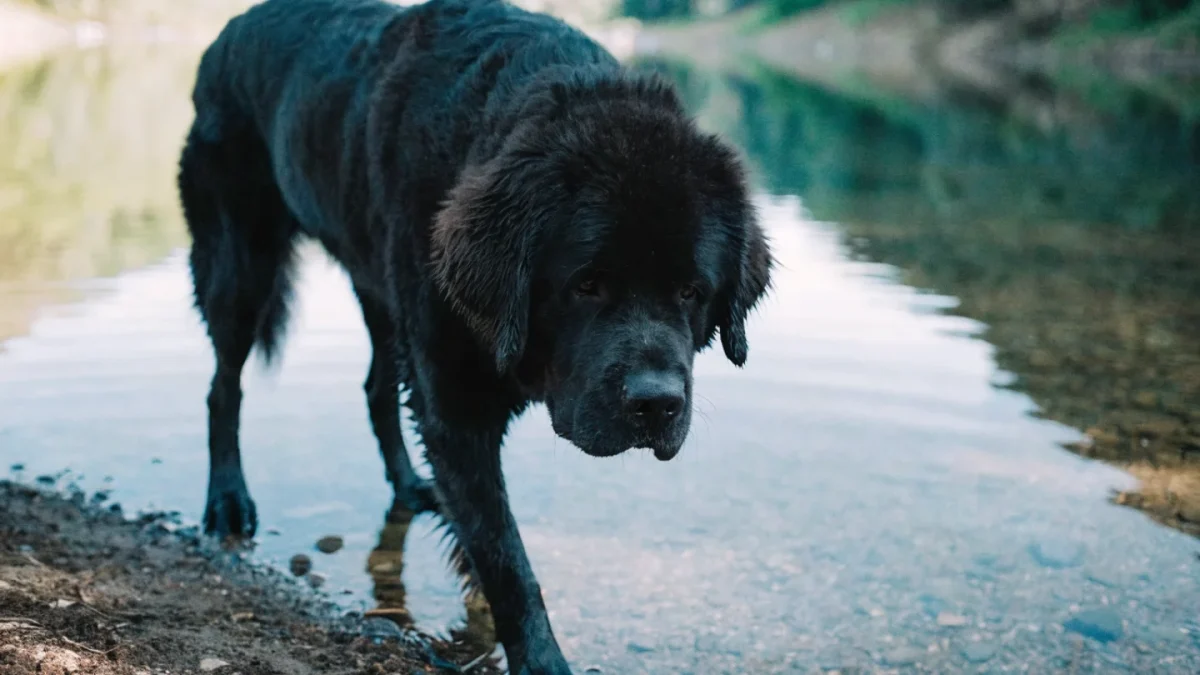
The first written descriptions of Newfoundland dogs in the late 1700s noted two distinct color patterns — solid black and black-and-white. By the time formal breed standards were established in the mid-1800s, brown Newfoundlands had joined the registry, and the black-and-white "Landseer" pattern had become famous enough to carry its own name, borrowed from the painter Sir Edwin Landseer, who featured the pattern in works throughout the 1830s and 1840s. What those early breed historians couldn't have known was that the genetic mechanisms behind those colors would eventually help explain some of the breed's most consequential health conditions.
Newfoundland genetics involve more than coat color. Two conditions — subvalvular aortic stenosis and cystinuria — carry significant implications for breeding decisions and puppy-buyer due diligence. Understanding the genetic basis of each is essential for anyone involved with the breed.
Coat Color Genetics
The Black Foundation
Black is the ancestral and most common Newfoundland color. Genetically, it requires dominant alleles at the K locus (which overrides agouti patterning to produce solid eumelanin) and the B locus (which determines whether eumelanin expresses as black or brown). A black Newfoundland is typically KB/KB or KB/ky at the K locus and B/B or B/b at the B locus.
Brown (Chocolate)
Brown Newfoundlands carry two copies of the recessive b allele at the B locus (genotype b/b), which shifts eumelanin production from black to brown. The coat ranges from deep chocolate to a lighter bronze. Nose leather, paw pads, and eye rims are brown rather than black, and eye color tends to be lighter amber. Brown Newfoundlands are accepted in most breed standards, though some registries historically treated them as less typical.
Gray
Gray Newfoundlands carry the dilution gene at the D locus — two copies of the recessive d allele (genotype d/d) modify black eumelanin to a steel gray. Gray is accepted in some breed standards and not others. As with other dilute-colored dogs across breeds, there are anecdotal associations between the dilute genotype and coat-quality issues, though systematic data specific to gray Newfoundlands is limited, and color dilution alopecia has been documented primarily through case reports rather than large-scale breed studies.
The Landseer Pattern
The black-and-white pattern known as "Landseer" is controlled by white-spotting alleles at the S locus. Landseer Newfoundlands carry extreme white-spotting genetics that produce a predominantly white base coat with black patches, typically concentrated on the head and saddle area. The pattern's striking appearance made it a favorite of Victorian artists and helped establish the Newfoundland as a recognizable breed in popular culture.
In some countries, the Landseer pattern is registered as a separate breed — the Landseer European Continental Type (ECT) — which has been bred as a distinct population with slightly different physical proportions. The Newfoundland breed history traces how this split developed. In other registries, Landseer-patterned dogs are simply a color variant of the Newfoundland.
Subvalvular Aortic Stenosis
SAS is the most consequential genetic health condition in the breed. It's a congenital narrowing below the aortic valve that restricts blood flow from the left ventricle. Severity ranges widely: mild cases may never cause clinical signs, while severe cases lead to exercise intolerance, fainting, sudden death, or heart failure.
Inheritance Pattern
The genetics of SAS in Newfoundlands have been studied since the 1970s, and the inheritance pattern is not simple. Early research proposed an autosomal dominant model with variable penetrance, but subsequent work has suggested polygenic inheritance — multiple genes contributing to disease severity, with environmental factors potentially influencing expression. No single-gene DNA test for SAS exists. Screening relies on physical examination by a veterinary cardiologist, specifically Doppler echocardiography to measure blood flow velocity across the aortic valve.
Screening Protocol
A single normal echocardiogram does not guarantee a dog is free of SAS-producing genes — it confirms only that the individual dog does not show hemodynamic evidence of stenosis at the time of examination. Because mild SAS can be difficult to detect, and because the polygenic nature means carriers may be clinically normal, breeding programs use repeated evaluations and pedigree analysis to reduce prevalence rather than eliminate it outright.
The Newfoundland breed guide covers SAS from the owner's perspective. From a genetics standpoint, the key takeaway is that SAS is the primary reason cardiac screening is nonnegotiable in Newfoundland breeding programs. Any breeder who does not screen for SAS is gambling with the lives of the puppies they produce.
Cystinuria
Cystinuria is a metabolic disorder in which the kidneys fail to properly reabsorb the amino acid cystine, leading to the formation of cystine crystals and stones in the urinary tract. In Newfoundlands, a breed-specific mutation has been identified and classified as Type I cystinuria.
Inheritance and Testing
The Type I form in Newfoundlands follows an autosomal recessive inheritance pattern. A dog must inherit two copies of the mutant allele — one from each parent — to be affected. Dogs with one copy (carriers) are clinically normal but can produce affected offspring if bred with another carrier.
A DNA test for the Newfoundland-specific cystinuria mutation has been available since the early 2000s. The test is definitive: it identifies affected dogs (two copies), carriers (one copy), and clear dogs (no copies). Responsible breeding programs use this test to ensure that two carriers are never mated, which prevents the production of affected puppies without removing carriers from the gene pool entirely — important in a breed with a limited genetic base.
Clinical Significance
Affected male dogs are at significantly higher risk than affected females. Cystine stones in male dogs can cause urinary obstruction, which is a veterinary emergency. In females, the wider urethra means stones are more likely to pass without obstruction, though they still form and can cause chronic urinary issues.
Management of affected dogs involves dietary modification and increased water intake, but the condition requires lifelong monitoring. Prevention through responsible breeding and DNA testing is far more effective than treatment.
What the Genetics Tell Us
The Newfoundland's genetic landscape reflects its history — a breed developed from a relatively small founding population on an island, with intense selection for working traits (size, swimming ability, coat density, temperament) and less historical attention to the health conditions that accompanied those traits. The limited genetic base concentrates both desirable and undesirable alleles.
Modern genetic tools give breeders the ability to reduce disease prevalence without further narrowing the gene pool. DNA testing for cystinuria is straightforward. Cardiac screening for SAS, while imperfect, meaningfully reduces incidence when applied consistently. For prospective owners, the actionable takeaway is specific: ask for the cardiac evaluation, ask for the cystinuria test, and understand that responsible breeding in Newfoundlands requires more than pairing two good-looking dogs. The Newfoundland puppy buying guide walks through exactly what documentation to request and what to look for when visiting a litter.