

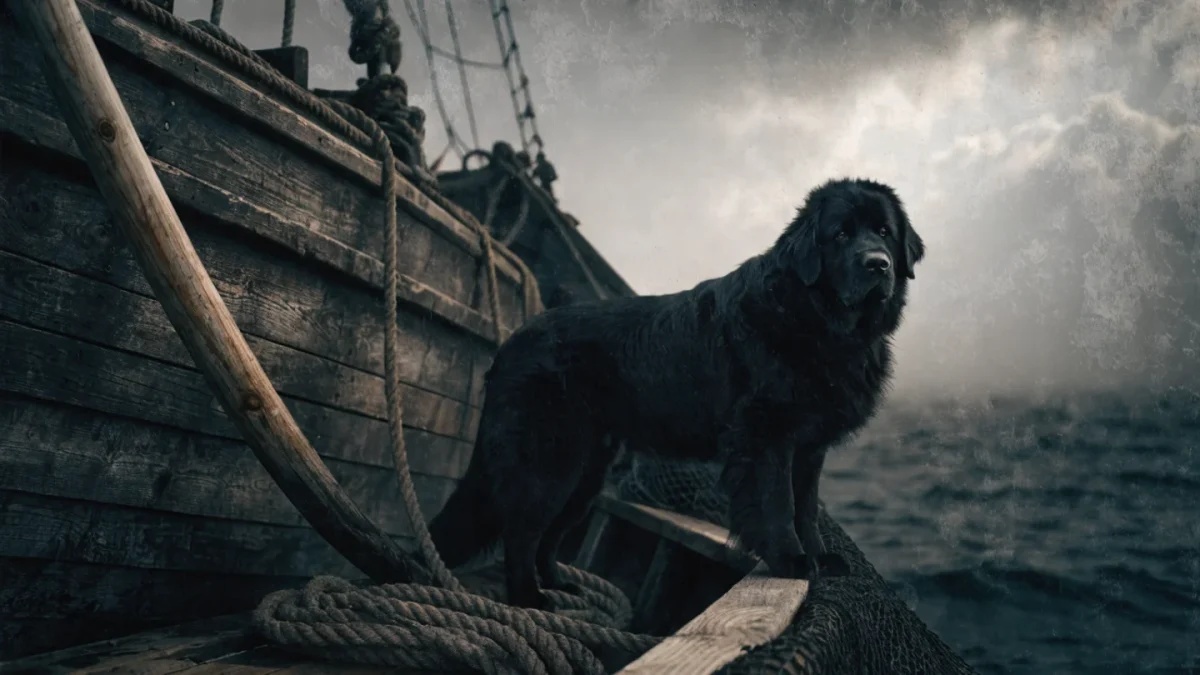
How does a dog end up this way — this large, this calm, this specifically capable in cold water? What combination of pressures, over what span of time, produces an animal that can tow a drowning sailor through Atlantic surf and then lie quietly under a kitchen table with a toddler climbing on it?
Those aren't rhetorical questions. The Newfoundland's history actually answers them, and the answers are specific: a particular island, a particular set of people doing a particular kind of work, selecting over several centuries for exactly the traits that would help them survive it. This isn't a breed that was refined in aristocratic kennels or shaped by show standards. It was shaped by freezing water, heavy nets, and the blunt reality that a dog that couldn't do the work wasn't worth feeding through a Newfoundland winter. For a complete overview of the breed today, see the Newfoundland breed guide.
The Island and Its Dogs
The island of Newfoundland, lying off the eastern coast of Canada at roughly the same latitude as northern France, was one of the first points of contact between European fishermen and the North American coast. By the early 1500s, Basque, Portuguese, English, and French fishing fleets were working the Grand Banks — the extraordinarily productive fishing grounds southeast of the island — and establishing seasonal and eventually permanent settlements along the coast.
These settlers brought dogs. What kinds of dogs, exactly, is where the historical record gets murky. Mastiff-type dogs, Portuguese water dogs, and various working breeds from the British Isles have all been proposed as ancestors. The indigenous Beothuk and Mi'kmaq peoples also kept dogs, and crossbreeding between European imports and local dogs almost certainly occurred, though the exact ancestral contributions remain debated among historians.
What emerged by the 1600s was a distinct type: a large, heavy-boned dog with a thick, water-resistant coat, webbed feet, massive lung capacity, and an instinctive affinity for cold water. These weren't pets. They were working tools — as essential to the fishing operation as nets and boats.
The Working Years: 1600s-1800s
The Newfoundland's job description on the island was broad. They hauled fishing nets from the water — a task that involved swimming into the surf, grabbing the net's lead line, and dragging it back to shore. They retrieved anything that fell overboard. They pulled carts loaded with salted fish from the docks to the drying racks and from the racks to the warehouses. In winter, they were hitched to sleds.
The water work was what set them apart from other large working dogs. The combination of the waterproof coat, the webbed feet, the unusual breaststroke swimming motion, and the massive chest capacity gave them endurance in cold water that no other breed could match. A Newfoundland could work in water temperatures that would incapacitate a human in minutes.
By the mid-1700s, the breed's reputation had spread across the Atlantic. English merchants and naval officers returning from Newfoundland brought dogs with them, and the breed quickly gained popularity among the British upper classes — both as working water dogs and as status symbols. The dogs were expensive, difficult to transport, and impressively large. All three qualities appealed to the Georgian and Victorian gentry.
The Landseer Connection
The painter Sir Edwin Landseer, who dominated British animal art in the 1830s through 1860s, painted Newfoundlands repeatedly. His most famous depiction, A Distinguished Member of the Humane Society (1838), shows a black-and-white Newfoundland lying on a dock — dignified, massive, and calm. The painting became iconic, and the black-and-white color variety eventually adopted Landseer's name.
Landseer's paintings did more than document the breed. They shaped public perception. His Newfoundlands were noble, heroic, and gentle — qualities the breed genuinely possessed, but which Landseer elevated into a romantic ideal that drove demand. By the mid-1800s, Newfoundlands were among the most popular large dogs in Britain.
The relationship between the Newfoundland's temperament and its historical working role is direct — the calm, patient, people-oriented personality that makes the breed distinctive today was forged in the working boats and fishing settlements where reactivity and aggression would have been liabilities.
Famous Newfoundlands in History
Several individual Newfoundlands earned fame for specific acts, and their stories illustrate the breed's capabilities.
Seaman traveled with the Lewis and Clark Expedition from 1803 to 1806 — the entire 12,800 km journey from St. Louis to the Pacific Ocean and back. Captain Meriwether Lewis purchased him for $20 (a substantial sum at the time) and documented the dog's contributions in his journals, including hunting, guarding the camp, and on one occasion catching a squirrel that was swimming across a river. Seaman survived the entire expedition.
Tang, a Newfoundland aboard the SS Ethie, reportedly helped save 92 people when the ship ran aground off the coast of Newfoundland in 1919. According to the traditional account, the dog swam to shore through heavy surf carrying a line that the crew used to rig a breeches buoy — a story widely cited in breed histories, though the level of primary-source documentation varies.
Rigel was said to have survived the sinking of the RMS Titanic in 1912, swimming in the frigid North Atlantic for hours and barking to alert the rescue ship Carpathia to the presence of a lifeboat. The Rigel story has been widely circulated but its veracity has been questioned by Titanic historians, and primary source confirmation is limited — no contemporary crew or passenger accounts mention the dog by name, and the earliest published versions of the story appeared well after the event.
These accounts — whether fully verified or partly legendary — reflect a breed whose real capabilities made extraordinary stories plausible.
Breed Recognition and Standardization
The Newfoundland was among the earliest breeds to be formally recognized by kennel clubs. The breed appeared at early British dog shows in the 1860s and was among the first breeds recognized when The Kennel Club was established in Britain in 1873.
In North America, the breed was well established by the time formal registries emerged. The Newfoundland Club of America was founded in 1930 and has maintained the breed standard, health screening programs, and water rescue testing ever since.
Standardization introduced the cosmetic divisions that persist today. Show-line Newfoundlands tend to be heavier, with more exaggerated features — bigger heads, thicker coats, more massive bone — while working-line dogs retain more of the functional athletic build of the island ancestors. Neither is more "authentic," though the working dogs tend to be better swimmers and the show dogs tend to be more dramatically impressive standing still.
The Water Rescue Tradition Today
Organized water rescue testing for Newfoundlands began in the mid-20th century and continues as a formal competitive discipline. Dogs are trained and tested on retrieving objects from water, towing boats, delivering lifelines to "drowning" swimmers, and diving from boats to reach people in distress.
Several countries maintain active Newfoundland water rescue teams that work alongside coast guard and marine rescue services. In Italy, the Scuola Italiana Cani Salvataggio (Italian School of Rescue Dogs) has trained Newfoundlands and other water-capable breeds for operational water rescue since 1988, deploying them from helicopters and rescue boats along the Italian coastline. These are not demonstrations — the dogs assist in real rescues in open water.
The breed's utility in water rescue rests on the same physical and behavioral traits that made them invaluable to 17th-century fishermen: endurance in cold water, calm under pressure, powerful swimming ability, and a hardwired instinct to tow struggling humans to safety. Four centuries of selection for those traits have produced a dog whose rescue instinct is so reliable that formal training primarily involves channeling behavior the dog already wants to perform.
Population Decline and Recovery
The Newfoundland's numbers dropped sharply in the early 20th century, particularly in its homeland. Changes in the Newfoundland fishing industry reduced the need for working dogs, and two World Wars disrupted breeding programs across Europe and North America.
Dedicated breeders in England and North America maintained the breed through the lean years, and population recovery began in the 1950s and 1960s. Today, the breed is stable but never common — its size, grooming requirements, and health screening needs keep it out of mass-market popularity. That relative rarity has, in some ways, protected the breed from the over-breeding pressures that have damaged more popular giant breeds.
The genetic legacy of that population bottleneck, including the prevalence of conditions like subvalvular aortic stenosis and cystinuria, is explored in more detail in the Newfoundland genetics guide.
A Breed Shaped by the Sea
The Newfoundland's history isn't a linear story of aristocratic refinement. It's a story of a dog that was built by fishermen, tested by the North Atlantic, exported by merchants, romanticized by painters, and validated by centuries of documented rescues. Every trait that defines the modern breed — the size, the coat, the webbed feet, the calm temperament, the instinctive drive to pull people from water — has a functional origin in the working life of the island that gave the breed its name.
That's what separates the Newfoundland's history from most breed stories. It wasn't designed in a study or refined in a show ring. It was forged in one of the most demanding working environments a dog has ever faced, and it came out the other side as something extraordinary.