

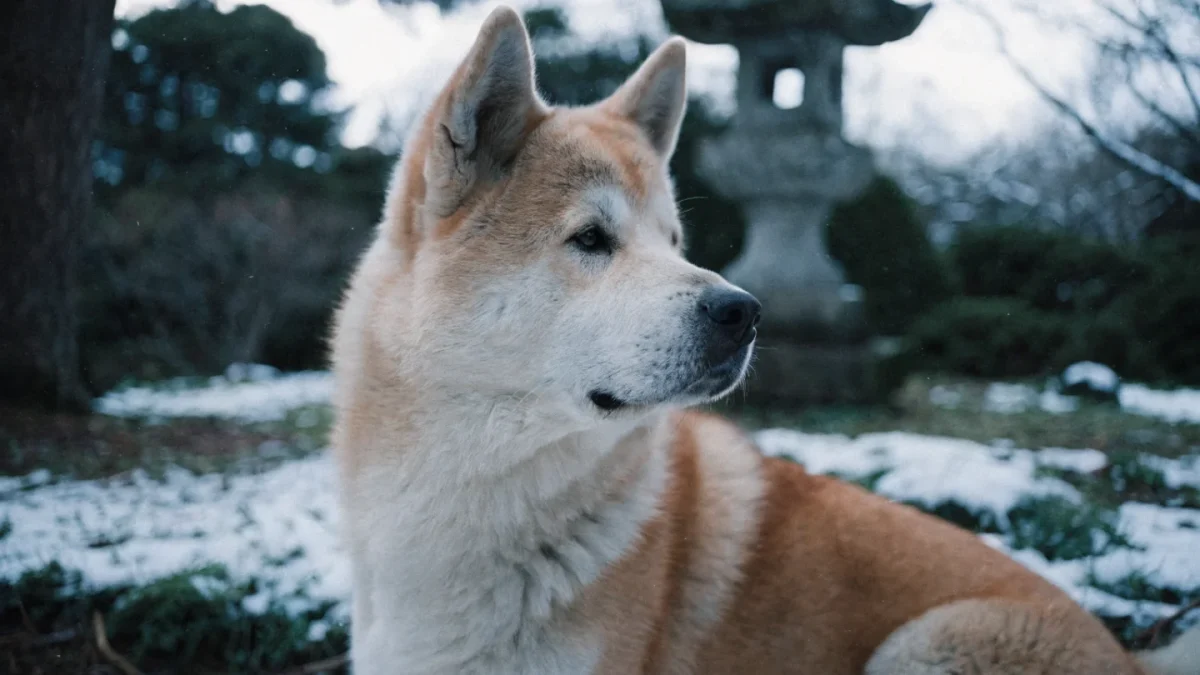
I met an Akita at a national specialty a few years back — a male, probably three years old, fawn and white, maybe 45 kilograms of completely settled dog. His handler was across the room talking to a judge. The dog was watching the door. Not anxiously. Not alertly in the way a sporting breed watches — head up, ears scanning, body poised for movement. He was watching the door the way you watch something you've already decided about. The deliberateness of it. The utter stillness in a room full of noisy, over-stimulated dogs. I've been around a lot of breeds at shows, and there are very few that carry that quality — that sense that the dog has already decided who matters in this room and is simply waiting for the world to catch up with its conclusions.
That dog was a perfect illustration of akita temperament personality in a single gesture. A dog that was never designed to be agreeable. It was designed to be devoted — and those are fundamentally different things. The gap between those two qualities is where most ownership struggles with this breed begin.
Loyalty Without Submission
The Akita's loyalty is not the eager, democratic affection of a golden retriever that loves everyone in the room. It's targeted, intense, and exclusive. An Akita bonds with its family unit — often one person above all others — and that bond becomes the organizing principle of the dog's behavior. Where the bonded person goes, the Akita's attention follows. Who the bonded person trusts, the Akita tolerates. Who the bonded person doesn't invite in, the Akita monitors.
This selectivity has practical consequences. Akitas don't transfer loyalty easily. Rehoming an adult Akita is one of the hardest transitions in the breed world because the dog doesn't simply adjust to new people the way a sociable breed might. It grieves. It withdraws. Rebuilding trust with a new owner takes weeks to months, and some Akitas never fully bond to a second family the way they did to the first.
The complete Akita breed guide covers the full ownership picture, but no section of that guide matters more than this one: if you get an Akita, plan to keep it for life. This breed takes the commitment literally.
Independence: Obedience on Their Terms
The most common frustration new Akita owners report isn't aggression or destructiveness. It's the blank stare.
You give a command. The Akita looks at you. It clearly understands. And then it decides whether to comply. That pause — that visible calculation — is the breed's independence in its purest form. Akitas were bred to make life-or-death decisions in the field without waiting for instructions. A dog holding a bear at bay in the mountains of northern Japan couldn't wait for a handler's cue. It assessed, decided, and acted. That autonomous decision-making is still running in every Akita alive today.
This doesn't mean Akitas are untrainable. They learn commands quickly — often faster than breeds with reputations for intelligence. What they lack is the desire to perform commands repeatedly for the sake of approval. A golden retriever performs a sit because making you happy is its primary motivation. An Akita performs a sit because it has evaluated the request and found it reasonable. Ask for the twentieth repetition in a training session, and the Akita will decide you've made your point and it has better things to do.
Experienced Akita owners learn to keep training sessions short, purposeful, and varied. The dog responds to a handler who earns respect through consistency and calm authority. It does not respond to repetitive drilling, harsh corrections, or any approach that treats obedience as the dog's obligation rather than a negotiated agreement.
The Guarding Instinct
Akitas guard. They don't need training for it, they don't need encouragement, and they don't need permission. The breed spent centuries protecting Japanese nobility, and that watchfulness is hardwired rather than taught.
A typical Akita in its home is always processing the environment. It tracks sounds at the door. It positions itself in sight lines between its family and entry points. It monitors guests with a calm vigilance that people unfamiliar with the breed sometimes mistake for tension. The dog isn't tense. It's working.
What distinguishes the Akita from breeds specifically developed for protection work — like the Belgian Malinois or the German Shepherd — is the absence of handler dependency in the guarding behavior. A Malinois waits for a command. An Akita makes its own assessment. This means the Akita will decide for itself what constitutes a threat and how to respond to it. For experienced owners who understand the breed, this is manageable through socialization and environmental control. For inexperienced owners, it can create situations that escalate faster than they know how to handle.
The practical rule: socialize relentlessly from puppyhood. An Akita that has been exposed to a wide range of people, environments, and situations during its critical developmental period will have a broader threshold for what it considers normal. An Akita that has been isolated develops a narrower threshold — and narrow thresholds mean more situations trigger the guarding response.
Same-Sex Dog Aggression
This is the trait that catches the most owners off guard, and the one I'm most direct about when someone asks me whether an Akita is right for their household.
Many Akitas — particularly intact males, but also some females — display pronounced intolerance toward dogs of the same sex. This isn't occasional selectivity. It's a consistent breed characteristic documented across decades by breed organizations and behavioral researchers. The roots are historical: Akitas were used in organized dog fighting in the Akita Prefecture during the 1800s, and the tolerance for same-sex competition was selectively bred out of many lines. That history left a behavioral legacy that no amount of modern socialization completely erases.
What this means in practice: an Akita household with two male dogs is a high-risk environment. Two female Akitas can also escalate into serious conflict. Opposite-sex pairings are generally safer but not guaranteed. Dog parks, off-leash areas, and any environment with uncontrolled access to unfamiliar dogs present real danger — not because the Akita will attack unprovoked, but because the Akita may not tolerate another dog's approach, posturing, or proximity.
Responsible Akita ownership means managing this reality rather than pretending it doesn't exist. Controlled introductions, leashed encounters, physical separation when needed, and the willingness to accept that your Akita may never be a dog-park dog are baseline requirements.
Stranger Wariness vs. Aggression
Here's what most people get wrong about Akita behavior toward unfamiliar people: they interpret reserve as hostility.
A well-socialized Akita meeting a stranger for the first time will typically ignore them, acknowledge them with a glance and move on, or observe them from a distance. The dog isn't being rude. It's being an Akita. The breed was not developed for social enthusiasm. It was developed for discernment — evaluating who belongs and who doesn't, and acting accordingly.
This reserve becomes a problem only when socialization has been insufficient. An Akita that hasn't been exposed to a variety of people during puppyhood may develop genuine wariness — stiffening when approached, growling at unfamiliar visitors, or refusing to allow strangers into its space. That's not breed temperament. That's a socialization failure, and it's preventable.
The distinction matters because breed-specific legislation and insurance restrictions often target Akitas based on the assumption that reserve equals danger. In reality, a properly socialized Akita is one of the most dignified, self-controlled dogs you'll encounter. It simply expresses that control through calm assessment rather than tail-wagging enthusiasm.
Quiet Communication
Akitas are not barkers. Unlike many guarding breeds that vocalize at every perceived disturbance, Akitas tend toward silence. When an Akita does bark, it generally means something — an unfamiliar presence, an unusual sound, a genuine change in the environment. Experienced owners learn to take that bark seriously precisely because it's rare.
What Akitas do instead of barking is more subtle. They communicate through body positioning, ear orientation, gaze direction, and a distinctive vocalization that owners describe as a mumbling or grumbling — a low, conversational rumble that sounds almost like the dog is talking. This is not aggression. It's the Akita's way of expressing opinion, and many owners come to recognize distinct patterns: the grumble that means the dog wants to go outside, the one that means dinner is overdue, the one that means a stranger is approaching the house.
The Right Temperament Match
Living with an Akita's temperament is profoundly rewarding for the right person and genuinely miserable for the wrong one. The breed's history helps explain why these traits exist, but temperament is what you live with every day.
The Akita suits someone who respects independence in a companion animal. Someone who doesn't need constant validation from their dog. Someone who finds the quiet, observant loyalty more meaningful than exuberant affection. Someone who can manage same-sex dog aggression through environmental control rather than wishful thinking.
The Akita does not suit someone who wants a dog that obeys reflexively, socializes indiscriminately, or fits seamlessly into a multi-dog household. These are not flaws in the breed. They are the breed — shaped by centuries of purpose, refined by specific function, and present in every Akita you'll ever meet.