

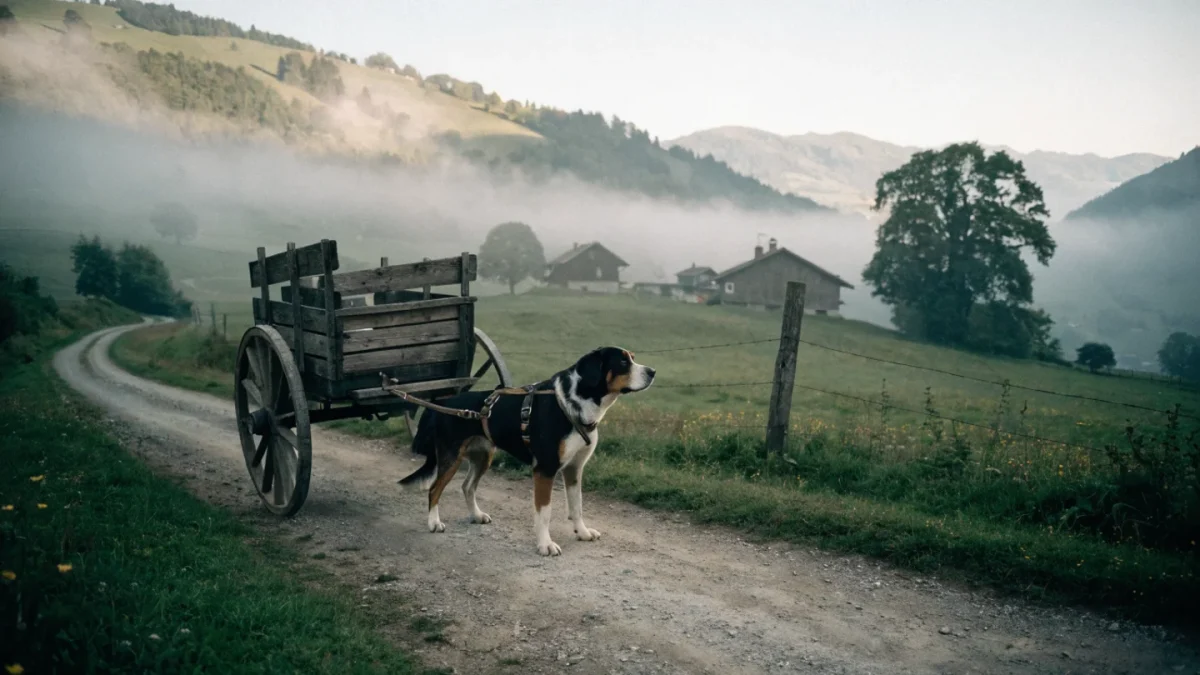
Before the Bernese mountain dog had a name, it had a job. For at least several centuries — the exact timeline is impossible to pin down because nobody was keeping pedigree records for working farm dogs — large tricolored dogs hauled milk carts through the valleys of the canton of Bern in central Switzerland. They drove cattle to alpine pastures in summer and back to the lowlands in autumn. They guarded farmsteads at night. And when their working life was over, they slept by the fire with the family they'd served.
These were not dogs bred for appearance or sport. They existed because Swiss dairy farmers needed a strong, willing, weather-resistant animal that could perform multiple tasks without specialized handling. The dogs that did the work survived. The ones that didn't were not kept. It was as simple and as brutal as that.
The Sennenhund Family
The Bernese mountain dog belongs to a group of four related Swiss breeds collectively called the Sennenhund, from the Swiss-German word "Senn" — a dairyman or alpine herdsman. All four share the same tricolor pattern (black, rust, and white). Where they came from before that is genuinely contested — the most-repeated theory has them descending from Molossian-type mastiffs that arrived with Roman legions crossing the Alps, but other accounts point to Phoenician trading routes or a mastiff type that was already sitting in the Alps before Rome ever showed up. Nobody's settled it, and I'm not going to pretend otherwise.
The four Sennenhund breeds, distinguished primarily by size and coat, are:
- Greater Swiss Mountain Dog (Grosser Schweizer Sennenhund): The largest and oldest. Short-coated. The probable ancestor of the other three.
- Bernese Mountain Dog (Berner Sennenhund): Long-coated. The most well-known internationally.
- Appenzeller Sennenhund: Medium-sized, short-coated, with a curled tail. The most energetic of the four.
- Entlebucher Sennenhund: The smallest. Short-coated, compact, and often used for herding.
All four nearly disappeared in the late 1800s. The Bernese came closest to the edge.
The Decline
Industrialization hit Swiss agriculture hard in the second half of the nineteenth century. Railroads replaced cart transport. Mechanized farming reduced the need for draft animals. The dogs that had been essential farm infrastructure for generations became, in economic terms, unnecessary. Without a formal breeding program or registry, the farm dogs of the Bern canton were crossed indiscriminately with whatever dogs were available, diluting the type that had been consistent for centuries.
At the same time, the St. Bernard was enjoying a wave of international fame — the heroic rescue dog of the Great St. Bernard Pass. Swiss dog culture was dominated by a single breed, and the other Swiss types languished in obscurity. Nobody was looking at the tricolored farm dogs of Bern and seeing a breed worth preserving. They were just farm dogs. Common. Replaceable.
By the 1890s, the tricolored dogs of the Dürrbächler type — the direct ancestors of today's Bernese mountain dog — were scattered across rural farms with no organized breeding, no standard, and no advocates.
Franz Schertenleib and the Search
Franz Schertenleib was a wine merchant and innkeeper from Burgdorf, in the canton of Bern. He remembered the impressive tricolored dogs from his youth — the ones that pulled cheese and milk carts to market — and set out to find them. In the late 1890s and early 1900s, he traveled through the farming regions around Dürrbach and Riggisberg, locating dogs that matched his memory of the type.
What he found was discouraging. The dogs were rare, often poorly maintained, and inconsistent in type. But enough of them existed — on scattered farms, in small numbers — that a recovery was possible. Schertenleib began acquiring dogs and promoting them at local shows.
Albert Heim and Formal Recognition
The figure who made the Bernese mountain dog's survival a certainty was Albert Heim, a professor of geology at the Swiss Federal Institute of Technology in Zurich. Heim was passionate about Swiss dog breeds and spent decades working to classify, standardize, and preserve all four Sennenhund types. His scientific training made him systematic where earlier fanciers had been sentimental.
Heim recognized that the Dürrbächler farm dogs were a distinct type — separate from the Greater Swiss Mountain Dog, which was short-coated and larger — and argued forcefully for their independent recognition. In 1904, several of these dogs were shown at a dog show in Bern. In 1907, the Swiss Kennel Club established the Schweizerische Dürrbach-Klub, and the first breed standard was written.
The name changed from Dürrbächler to Berner Sennenhund — Bernese Mountain Dog — at Heim's suggestion, to reflect the breed's broader regional identity rather than tying it to a single hamlet. It was a practical decision. A breed named after a tiny village nobody outside the canton had heard of wasn't going to attract a viable breeding population.
The Bottleneck Problem
Early 20th-century Bernese mountain dog breeding drew from a very small founder population. The exact number of founding dogs is debated, but the effective population was small enough that significant genetic diversity was lost before the breed had time to expand. This bottleneck created the genetic framework that still defines the breed today — including the cancer predisposition that is the breed's most serious health challenge. For a detailed look at how that narrow foundation affects today's dogs, see Bernese mountain dog genetics and cancer.
The problem was compounded by the breed's initial slow growth. For the first few decades after recognition, the Bernese mountain dog remained a regional breed. Breeding stock was limited. Popular sires were used repeatedly, further narrowing the gene pool. By the time the breed expanded internationally, the genetic damage was already embedded.
Crossing the Atlantic
Bernese mountain dogs arrived in North America in the late 1920s and 1930s, primarily through individual imports. The first documented import is credited to Isaac Schiess, a Kansas farmer who brought over a pair — Donna von der Rothöhe and Poincaré von Sumiswald — in January 1926. A decade later, Glen Shadow of Ruston, Louisiana imported his own pair, Felix and Fridy, and it's Shadow's dogs that get the credit for pushing the American Kennel Club toward formally recognizing the breed in 1937.
Growth was slow. The breed remained rare in North America through the 1950s and 1960s. Recognition by major kennel clubs helped build awareness — the breed was registered under its working group classifications during this period — but it was the 1970s and 1980s that brought genuine momentum. The breed's striking appearance and calm Bernese mountain dog temperament attracted families looking for a large, gentle companion, and breeding programs expanded to meet demand.
By the 1990s, the Bernese mountain dog was established as a moderately popular breed in North America, Europe, and parts of Asia. It has never reached the explosive popularity of breeds like the golden retriever or Labrador — which may be a mercy, given how overbreeding has devastated those breeds' health profiles.
The Modern Breed
Today's Bernese mountain dog is recognizably the same animal that pulled milk carts through the Emmental valley a century ago. The tricolor coat, the heavy bone, the calm watchfulness — these traits have survived the transition from working farm dog to family companion largely intact.
What has changed is purpose. Fewer than a handful of Berners in the world still work as draft dogs in any commercial sense. The breed's function has shifted entirely to companionship, with carting and drafting preserved as a recreational activity and competitive sport rather than daily labor.
The breed's health profile has also shifted — and not for the better. The genetic bottleneck of the early 1900s, combined with popular-sire effects and the expansion of breeding programs without sufficient emphasis on health testing, has produced a breed with a cancer rate and a shortened lifespan that would have been unrecognizable to the farmers who developed it. That tension — between a temperament people adore and a body that fails too soon — is the central story of the modern Bernese mountain dog.
The Bernese mountain dog breed guide covers what living with one looks like today. This article is about how we got here — and why understanding the history matters for anyone who cares about the breed's future.
Frequently Asked Questions
Are Bernese mountain dogs related to Saint Bernards?
Not directly, despite both being large Swiss breeds. They developed in different regions for different purposes. The Saint Bernard traces to the Great St. Bernard Hospice and was bred for mountain rescue, while the Bernese developed as a multipurpose farm dog in the canton of Bern. Both likely share ancient Roman mastiff-type ancestry, but their breeding lines diverged centuries ago.
Why are Bernese mountain dogs tricolored?
The tricolor pattern — black, rust, and white — is consistent across all four Sennenhund breeds and appears to be a very old trait fixed in the population before any formal breeding programs existed. The genetics behind the pattern involve interactions between the agouti, extension, and spotting loci that produce the specific distribution of black, tan, and white. The consistency of the pattern suggests strong selection pressure, possibly because the markings made the dogs easily identifiable at a distance on the farm.
How close did the Bernese mountain dog come to extinction?
Very close. By the 1890s, no organized breeding program existed, and the remaining dogs were scattered across rural farms with no registry or standard. Without the intervention of Franz Schertenleib and Albert Heim in the early 1900s, the breed almost certainly would have been absorbed through crossbreeding or simply died out as farming practices changed. The population recovered from an extremely small founder base, which is why genetic diversity remains a concern today.