

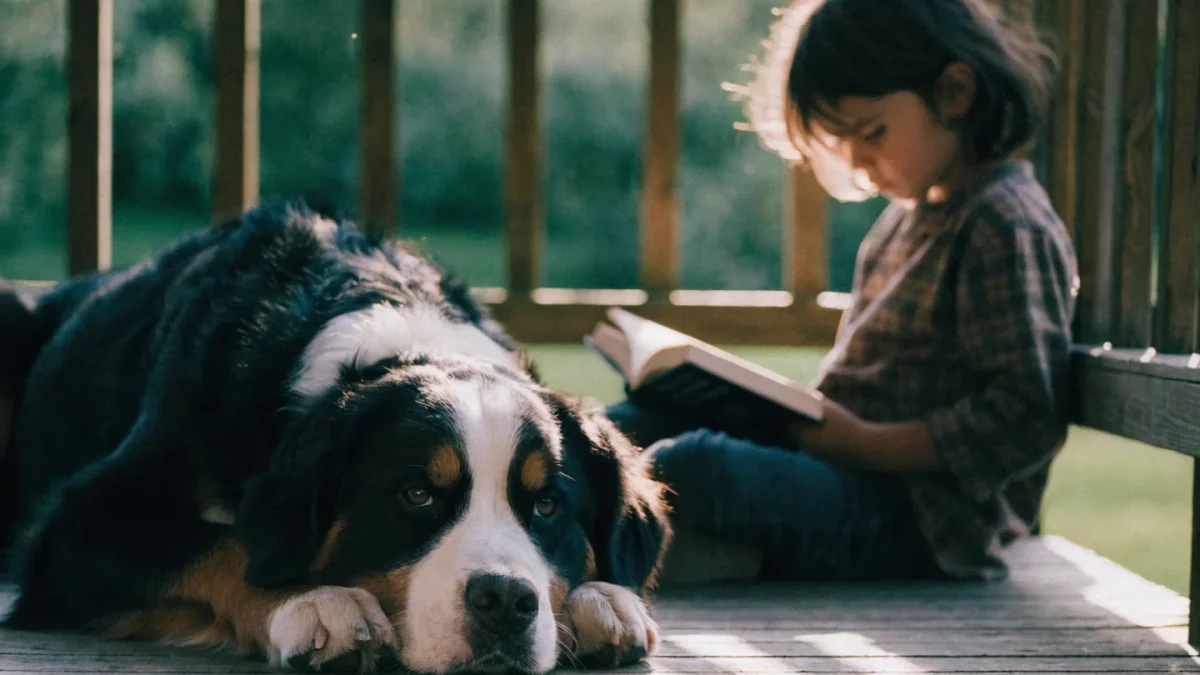
Swiss farmers didn't choose their dogs for personality tests. For several hundred years, the dogs that became the Bernese mountain dog were selected for one compound trait: the willingness to work hard all day and then lie quietly at the family's feet all night. The dogs that pulled carts reliably, watched over livestock without wandering, and tolerated the chaos of a busy farmyard — those were the dogs that got to stay. That selection pressure produced a temperament profile unlike anything else in the working group.
The Bernese mountain dog temperament sits in a space that very few breeds occupy. These dogs are calm without being lethargic, loyal without being possessive, and affectionate without being demanding. They're not golden retrievers in a larger body. They're something different — quieter, more observant, more deliberate in how they engage with the world.
The Bond: What It Actually Looks Like
Bernese mountain dogs attach to their families with an intensity that surprises people who associate devotion with more demonstrative breeds. A Berner doesn't jump all over you when you walk through the door. It gets up, walks to you, leans its full weight against your leg, and stays there. That lean — Berner owners talk about it constantly — is the breed's signature expression of affection. Forty-five kilograms of dog pressing against you because proximity is the point.
This attachment runs deep. Berners track their people through the house, positioning themselves wherever you are. They don't follow you with anxious energy the way some velcro breeds do. They simply relocate. Working in the kitchen? The Berner is lying by the refrigerator. Moving to the living room? The Berner is now lying by the couch. Going outside? The Berner is at the door before you reach it.
Where this gets complicated is separation. Bernese mountain dogs were bred to work alongside humans, not independently. Extended isolation — and "extended" can mean as few as four or five hours for some individuals — creates genuine distress. This isn't mere boredom. It's a dog whose entire temperament is built around partnership being forced into solitude. Destructive behavior, vocalizing, and house-soiling in an otherwise-trained Berner are almost always separation-related.
The Reserve: Not Every Dog Is for Everyone
One of the things that distinguishes the Bernese temperament from the retrievers and spaniels is a measured response to unfamiliar people. Most Berners don't rush to greet strangers. There's an evaluation period — the dog watches, assesses, and then decides how much engagement to offer. Some warm up quickly. Others maintain a polite distance permanently.
This isn't shyness, and it isn't aggression. It's the temperament of a farm guardian. Bernese mountain dogs were expected to be discerning about who belonged on the property and who didn't. The history of the Bernese mountain dog as a multipurpose farm dog — drafter, drover, and watchdog combined — explains why they approach new situations with more caution than breeds developed strictly for human collaboration.
For families who want a dog that loves them deeply but doesn't try to become best friends with every person at the park, this reserve is a feature. For people who want a universally social dog, it can be disappointing.
The Stubborn Streak Everyone Warns You About
"Stubborn" is the word Berner owners reach for most. I think it's the wrong word. What the Bernese mountain dog actually has is working-dog discernment — the habit of evaluating a command before executing it.
A golden retriever hears "sit" and sits because cooperation is the default. A Bernese mountain dog hears "sit" and considers the request in context. Is there a reason to sit? Does this seem important? Am I comfortable? The delay between command and response isn't defiance. It's processing. But if you've been trained by biddable breeds to expect instant compliance, that half-second pause feels like mutiny.
This trait responds to patient, consistent handling. Berners learn quickly — they're not unintelligent dogs by any measure. They simply reserve the right to think about it first. Harsh corrections backfire dramatically. A Berner that's been corrected harshly doesn't become more obedient — it becomes withdrawn and less willing to engage. The breed is emotionally sensitive in a way that doesn't match its physical size.
Short, varied sessions work better than long, repetitive drilling. Keep things interesting. These dogs get bored with repetition faster than they get tired of working.
With Children: The Good and the Realistic
Bernese mountain dogs have a well-earned reputation for being gentle with children, and in my experience this is accurate for the vast majority of the breed. Their calm energy and high tolerance for handling make them natural family dogs. Many Berners seem to instinctively moderate their behavior around small children — moving more slowly, lying down rather than standing, allowing climbing and grabbing that they wouldn't tolerate from an adult stranger.
The caution is mechanical, not behavioral. A Bernese mountain dog's tail alone weighs enough to send a toddler staggering. An excited Berner turning in a tight space can sweep a small child off their feet without registering it happened. Supervision matters here — not because the dog might bite, but because the physics of a 40-plus kg animal in close quarters with a 12 kg child aren't optional.
The other thing worth mentioning: Berners absorb the emotional temperature of their household. If there's shouting, tension, or conflict among the humans, the dog feels it. Stress in the home creates stress in a Bernese mountain dog. It's one of those common misconceptions about Bernese mountain dogs that their calm exterior means they're unaffected by household dynamics. They're not.
With Other Animals
Berners coexist well with other dogs in most cases. They're not typically competitive or resource-guardy, and their moderate play style means they're less likely to overwhelm smaller dogs than some high-energy breeds. Male-to-male tension can occur, particularly with unfamiliar dogs, but escalation to actual aggression is rare.
Cats and small animals are generally safe with a well-socialized Bernese. The breed doesn't have strong prey drive — they were herding and drafting dogs, not hunters. Early socialization makes the transition smoother, but even adult Berners introduced to cats tend to adapt within a few weeks.
The Emotional Depth
The aspect of Bernese temperament that gets discussed least — and matters most — is their emotional sensitivity. These dogs read human emotion with startling accuracy. They notice when you're upset before you've said a word. They respond to grief, illness, and distress by positioning themselves close and staying quiet. It's not trained behavior. It's who they are.
This sensitivity is a double-edged trait. It makes the Bernese mountain dog an extraordinary companion in difficult times. It also means they internalize stress. A Berner in a chronically tense household will develop anxiety-related behaviors — pacing, excessive grooming, reluctance to eat — that reflect the environment rather than the dog.
The breed gives enormous emotional returns. But it asks for emotional stability in return. A Bernese mountain dog thrives in a household that is calm, consistent, and present. In the complete Bernese mountain dog breed guide, I cover the practical side — grooming, exercise, health. Here, the message is simpler: this breed will mirror the emotional life you give it.
Frequently Asked Questions
Do Bernese mountain dogs have separation anxiety?
Bernese mountain dogs are prone to separation distress — a strong preference for human company that becomes problematic when left alone for extended periods. Not every Berner develops clinical separation anxiety, but the breed is predisposed to it. Gradual desensitization to alone time, avoiding dramatic departures and arrivals, and providing enrichment during absences all help. Dogs left alone routinely for eight or more hours are at high risk.
Are Bernese mountain dogs aggressive?
Aggression is not part of the standard Bernese temperament. These dogs are calm, tolerant, and non-confrontational by nature. Individual dogs with poor socialization, traumatic histories, or pain-related behavior changes may show aggression, as can any breed, but it's far outside the norm. The reserve they show with strangers is caution, not hostility.
How do Bernese mountain dogs compare to Saint Bernards in temperament?
Both are calm, large Swiss breeds, but they differ in key ways. Bernese mountain dogs tend to be more active, more socially discerning, and more emotionally attuned to their specific family. Saint Bernards are generally more placid and uniformly friendly with everyone. Berners retain more working-dog alertness, while Saints are further removed from their working origins in daily temperament. Both bond deeply, but the Berner's bond feels more exclusive.