

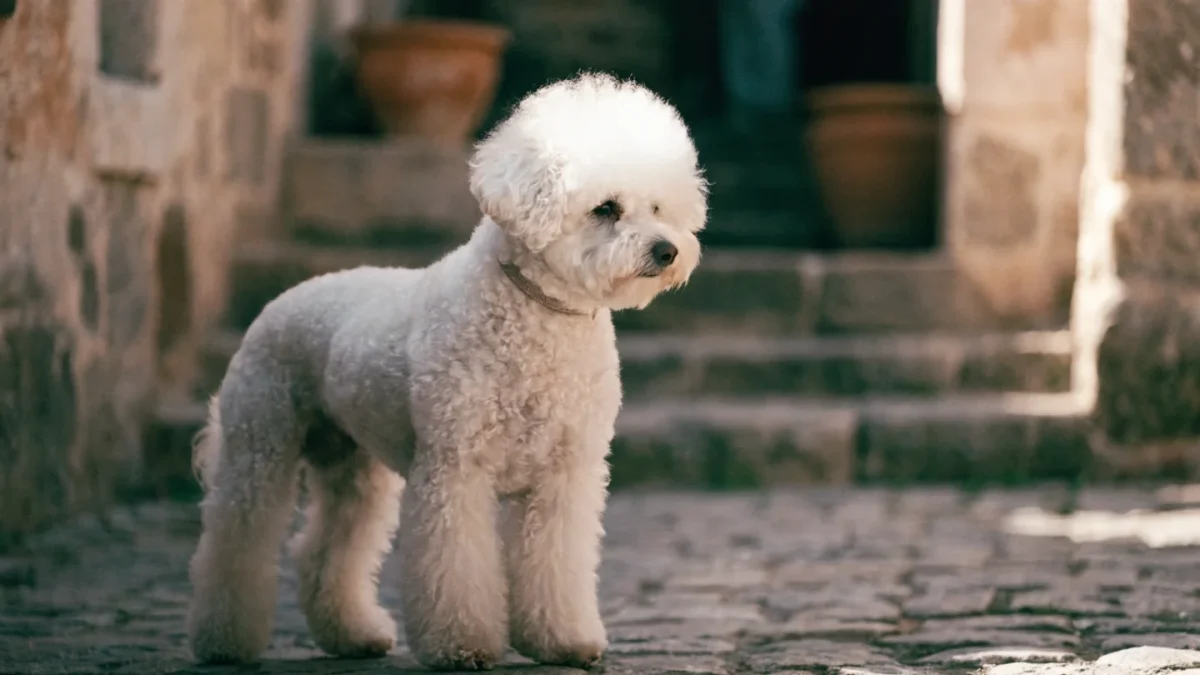
Almost every breed that survives into the modern era was built for work. Herding, hunting, guarding, hauling — the dogs we have today are the descendants of animals that earned their keep. The Bichon Frise is the rare exception. This breed was never bred for work. It was bred for company. For centuries, its entire purpose was to be pleasant to be around — and that turns out to be surprisingly hard to breed for, and extraordinarily durable once you've got it.
The Bichon's history is not a story of heroic utility or ancient function repurposed for modern pet life. It's a straight line from companionship to companionship, with a few near-disasters along the way. Court favorite, street dog, circus performer — the Bichon survived because people kept finding it impossible to ignore. Understanding that history explains why the breed is what it is today: adaptable, socially attuned, and built for human proximity in a way that most breeds aren't.
The Barbichon Family: Shared Mediterranean Roots
The Bichon Frise belongs to a group of small, white, curly-coated breeds known collectively as the Barbichon (or Bichon) family. The name derives from "barbichon," a diminutive of "barbet" — the French water spaniel that likely contributed to the group's ancestry. The family includes five recognized breeds that share common origins but diverged through centuries of geographic isolation:
- Bichon Frise — developed primarily in France and Belgium
- Bolognese — associated with Bologna, Italy, from at least the 11th century
- Havanese — Cuba's national breed, brought by Spanish settlers (see Havanese history and Cuban origins for the parallel story of how Bichon-type dogs traveled with colonists to the Americas)
- Maltese — likely the oldest member, with documentation dating to classical antiquity
- Coton de Tulear — developed in Madagascar, probably from Bichon-type dogs on trade ships
The common ancestor of all five breeds appears to have been small, white, water-comfortable dogs that accompanied traders and sailors throughout the Mediterranean basin during the medieval period. These dogs were practical shipboard companions — small enough to live in cramped quarters, sociable enough to maintain morale, and useful enough as ratters and barter goods to justify their presence.
The Canary Islands Connection
The breed's early name — Bichon Tenerife — points to the Canary Islands as a critical waypoint in its development. Spanish and Italian sailors active in the Canary Islands trade during the 13th and 14th centuries almost certainly brought Bichon-type dogs to the islands, where the breed established a local population. Precise archaeological evidence for the date of Bichon-type dogs' arrival on Tenerife is lacking, though breed historians generally place their introduction by Spanish and Italian sailors during the 13th to 14th centuries, coinciding with the European colonization of the Canary Islands.
The Canary Islands served as a crossroads for Atlantic and Mediterranean trade routes. Dogs bred or maintained there would have traveled with sailors heading to ports across southern Europe, North Africa, and eventually the New World. The Bichon Tenerife was likely reintroduced to mainland Europe through this commercial network rather than through a single introduction event.
By the late 1400s, the breed had caught the attention of Italian aristocrats. The Bichon appeared in Italian court circles during the Renaissance period, and Italian traders may have facilitated its spread to France and other European courts.
Royal Courts: The Golden Age
The Bichon's peak social status lasted roughly from the early 1500s through the late 1700s. During this period, the breed became a fixture of European aristocratic life.
In France, the breed gained particular prominence. Henry III's devotion in the 1570s made the Bichon fashionable among the French nobility. The dogs were pampered, perfumed, and decorated with ribbons — a treatment that reflected their owners' status as much as any genuine affection for the animals. The French verb "bichonner," meaning to pamper or fuss over, is derived from the breed's name.
Spanish painters captured the breed during this era. Francisco de Goya included small white dogs consistent with the Bichon type in several paintings during the late 1700s. Earlier, Titian's works from the mid-1500s featured similar dogs in aristocratic portrait settings. These artistic records, while not precise breed documentation, confirm the breed's presence in wealthy European households across several centuries.
The court era was formative for the breed's temperament. Dogs that were selected for life in royal chambers — small, calm indoors, tolerant of handling, responsive to human attention, and appealing to look at — passed those traits forward. The Bichon's people-centered temperament traces directly to centuries of selection for exactly this role.
Fall From Grace: Revolution to Circus Ring
The French Revolution of 1789 ended the Bichon's aristocratic patronage virtually overnight. The breed that had been a symbol of court luxury became a liability — associated with the very class that was being dismantled. Bichons were abandoned, released, or simply left behind as noble households collapsed.
What happened next is the part of the breed's history that impresses me most. Rather than disappearing — as many purpose-bred aristocratic dogs did when their patrons vanished — the Bichon adapted. The breed survived on the streets and eventually found a second career that exploited exactly the traits that had made it a court favorite: trainability, showmanship, and an eagerness to perform.
By the mid-1800s, Bichons had become circus and street-performer dogs. Their intelligence, compact size, willingness to learn routines, and natural charm made them effective performers. Organ grinders, traveling circus troupes, and fairground entertainers across Europe used Bichons in their acts. The dogs walked on hind legs, jumped through hoops, and performed tricks that drew crowds and coins.
This circus period was not glamorous for the dogs. Working conditions were often poor, and performer dogs were tools rather than companions. But the period accomplished something critical: it kept the breed alive. A century after losing royal support, the Bichon Frise still existed — scattered, unregistered, and unrecognized, but genetically intact.
The 1933 Revival
The breed's formal rescue began in France after World War I. A small group of French and Belgian fanciers began collecting Bichon-type dogs — sourcing from circus performers, street dogs, and scattered household pets — with the goal of establishing a standardized breed.
On March 5, 1933, the Societe Centrale Canine (France's national kennel club) officially adopted a breed standard written by Madame Abadie of Steren Vor Kennels and the president of the FCI's breed standards committee. The breed was registered under the name "Bichon a Poil Frise" — literally "curly-haired small dog." The FCI recognized the breed the following year, listing France and Belgium as co-countries of origin.
The timing was precarious. World War II began just six years after formal recognition, and European dog breeding programs were devastated by the war. The Bichon survived the war years through the efforts of a small number of dedicated breeders who maintained their lines despite extreme difficulty. The exact number of breeding Bichons that survived World War II in France and Belgium is not recorded, but the breed's survival depended on a small number of dedicated fanciers who maintained their lines despite extreme difficulty — the breed had only been formally standardized six years before the war began.
Post-War Expansion
The Bichon Frise reached the United States in 1956, when a French family — the Picaults — emigrated to the Midwest with several Bichons. Initial interest was modest. The breed gained formal recognition from the American Kennel Club in 1972, which accelerated its visibility in North America.
In the United Kingdom, the Bichon arrived somewhat later and was recognized by The Kennel Club in 1976. The breed's popularity in Britain grew steadily through the 1980s and 1990s.
The post-war decades saw the Bichon transition from an obscure European breed to an internationally recognized companion dog. Show ring success — including multiple Best in Show wins at major competitions — raised the breed's profile, and its reputation as a low-shedding, apartment-friendly companion fueled demand.
What the History Tells Us About the Breed Today
Every era of the Bichon's history selected for the same core traits: social adaptability, human attachment, compact size, and resilience. The dogs that survived Mediterranean voyages, court intrigue, revolutionary upheaval, circus life, and two world wars were, by definition, the ones that could handle anything — as long as people were involved.
This is why the modern Bichon is simultaneously tough and emotionally dependent. The resilience is genuine — Bichons are physically hardy for their size, adaptable to new environments, and remarkably long-lived. The emotional dependency is equally genuine — remove the human element, and the dog's entire behavioral framework collapses into anxiety.
The Bichon Frise breed guide covers the practical implications of this temperament in detail. But the history matters because it explains why the breed is the way it is. The Bichon Frise wasn't designed in a breeding program with a specific working goal. It was shaped by centuries of survival, and the survival strategy was always the same: be indispensable to the nearest human.
Frequently Asked Questions
Is the Bichon Frise related to the Poodle?
The Bichon Frise and the Poodle share distant ancestry through the Barbet (French water dog), which contributed to both lineages. They are not closely related in the way that, say, the Golden Retriever and Labrador Retriever share recent common origins. The similarity in coat type — curly, low-shedding, requiring professional grooming — reflects convergent selection for similar traits rather than a close genetic relationship. The Bichon's closest relatives are the other Barbichon breeds: the Bolognese, Havanese, Maltese, and Coton de Tulear.
Why is the breed called "Frise"?
"Frise" (or "Frise" in the French original) means curly. The full name "Bichon a Poil Frise" translates roughly to "curly-haired small dog." The name was formally adopted in 1933 when the breed standard was written, replacing the earlier regional names like "Bichon Tenerife" that had been used informally for centuries.
Were Bichon Frises really circus dogs?
Yes. After losing aristocratic patronage following the French Revolution, Bichons became working performers in circus troupes and street acts across Europe during the 1800s. Their compact size, trainability, and natural showmanship made them effective performers. This circus era, while not romantic in its working conditions, preserved the breed through a period when it had no other institutional support. The same intelligence and eagerness to engage that made them court favorites made them capable performers — a versatility that arguably saved the breed from extinction.