

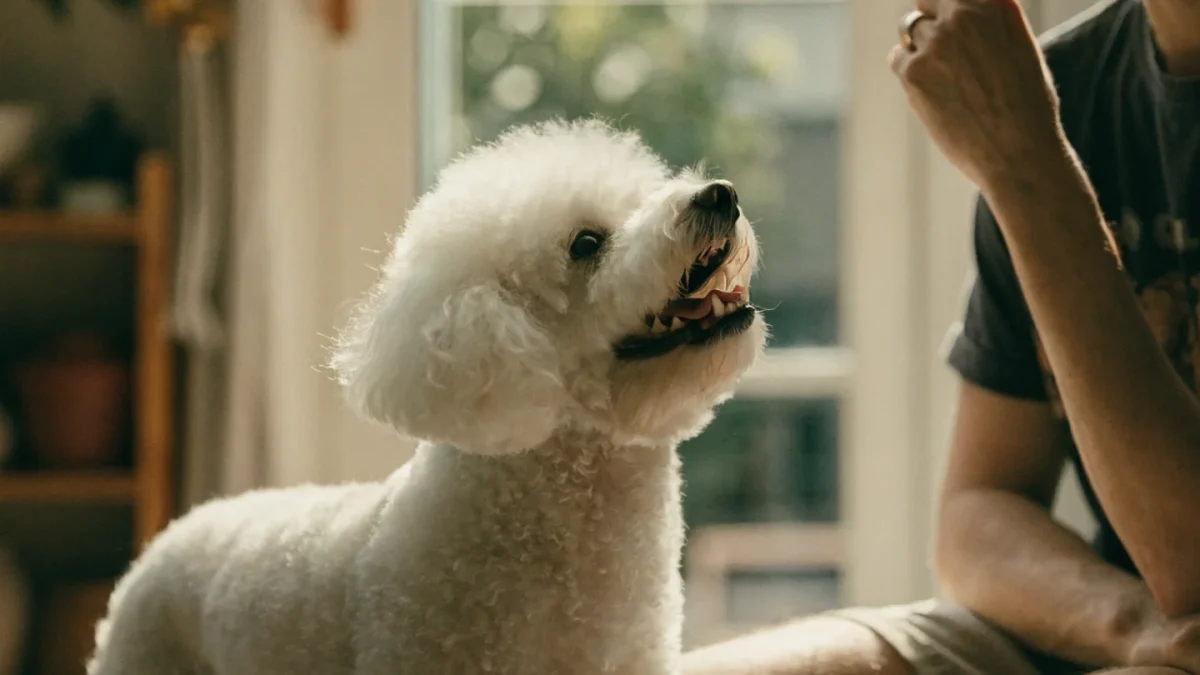
The Bichon Frise is one of the few breeds that has never had a job other than being someone's favorite creature in the room. While most breeds trace their temperament to working origins — retrievers retrieve, herders herd, terriers dig and hunt — the Bichon was bred for the specific purpose of human companionship. That selection pressure, applied consistently for roughly five centuries, produced a dog whose entire emotional architecture is organized around the presence of people.
Understanding the Bichon Frise temperament and personality means understanding a breed that isn't just friendly by preference — it's friendly by design. And that design has consequences, both wonderful and genuinely challenging, that prospective owners need to see clearly.
The Core Temperament: Built to Bond
Bichons attach deeply and broadly. They bond to their primary person but rarely become one-person dogs in the way some toy breeds do. A healthy Bichon welcomes visitors, warms to strangers, gets along with other dogs, and generally approaches the world as though it contains no threats — only friends it hasn't met yet.
This social confidence isn't random. The breed's centuries as a human companion — from Mediterranean trade vessels to aristocratic courts to circus stages — selected for dogs that could adapt to new people, new environments, and new social groups without anxiety. The Bichons that thrived in those settings passed that adaptability forward.
Their energy level sits in a comfortable middle range. Bichons are playful — genuinely playful, not just tolerant of interaction — but they don't have the relentless drive of a sporting breed. A Bichon will happily chase a toy for twenty minutes, then settle on the couch next to you for an hour. That oscillation between activity and calm is one of the breed's most appealing traits.
Emotional Sensitivity
Bichons are mood-readers. Owners consistently report that the dog's behavior shifts in response to human emotional states — becoming quieter and more physically close when the person is sad, more animated when the person is cheerful, and sometimes agitated when household tension is high. Whether this represents genuine emotional perception or learned association with behavioral cues, the practical effect is the same: the Bichon adjusts.
This sensitivity is a double-edged trait. It makes the Bichon an intuitive, responsive companion. It also means the dog absorbs household stress. Bichons in chaotic, unpredictable environments — frequent yelling, inconsistent schedules, ongoing interpersonal conflict — tend to develop anxiety-driven behaviors: excessive barking, house-training regression, and compulsive licking.
The breed responds best to calm, consistent handling. Raised voices and harsh corrections don't produce compliance; they produce a dog that shuts down, hides, or stress-signals through lip licking, yawning, and whale eye. If you've never seen a Bichon flatten itself against the floor and refuse to move, you haven't yet overcorrected one. It only takes once to understand why positive reinforcement isn't just recommended for this breed — it's practically mandatory.
Separation Anxiety: The Breed's Central Challenge
This cannot be buried in a subsection. Separation anxiety is the single most significant behavioral issue in the Bichon Frise, and it isn't a defect — it's the logical consequence of what the breed was designed to do.
A dog selected for five centuries to be near people will struggle when people leave. The science is straightforward: the same attachment system that makes the Bichon such a devoted companion becomes a source of distress when the attachment figure is absent. Moderate cases produce whining, restlessness, and minor destructive behavior. Severe cases produce panic — self-injury, escape attempts, continuous vocalization, and complete house-training collapse.
What makes this especially relevant is that the Bichon doesn't typically grow out of separation anxiety the way some puppies grow out of crate resistance. In breeds with independent working heritage — hounds, terriers, livestock guardians — time alone is tolerable because the dog's temperament includes self-sufficiency. The Bichon's temperament includes no such provision. Time alone isn't just unfamiliar to the breed — it's contrary to its fundamental wiring.
Managing separation anxiety in Bichons requires deliberate conditioning: gradual desensitization to departures, mental enrichment during absences, and realistic expectations about duration. A Bichon conditioned carefully can handle four to five hours alone. A Bichon expected to tolerate eight to ten hours from the start will deteriorate.
Social Behavior With Other Dogs
Bichons are generally sociable with other dogs. They lack the terrier combativeness and the guardian breed's wariness toward unfamiliar dogs. In multi-dog households, Bichons tend to integrate well, particularly with breeds of similar size and energy level.
The breed can hold its own socially but is physically small enough to be vulnerable during rough play with larger dogs. Supervised introductions and size-appropriate play groups reduce the risk of accidental injury. A well-socialized Bichon rarely starts conflicts — but it's also not equipped to finish them.
Having a second dog in the household can significantly reduce separation anxiety. The companionship of another animal — even a cat — doesn't fully replace human attachment, but it takes enough of the edge off that many Bichons cope better with alone time when they're not actually alone.
With Children
Bichons can be good family dogs, but the match works best with older children who understand how to handle a small dog. The breed is playful and affectionate with kids, and its pain tolerance is moderate. The risk isn't aggression — it's fragility. A Bichon dropped by a toddler or stepped on during rough play can sustain serious injury. A 4 kg dog and a 20 kg five-year-old are a physics mismatch that supervision alone doesn't fully resolve.
Teaching children to sit on the floor to interact with the dog, to avoid picking the dog up, and to recognize when the dog wants to leave the interaction makes the relationship work. Bichons that feel safe around children are genuinely delightful with them — animated, patient, and playful. Bichons that feel threatened become avoidant, which is the breed's way of handling conflict: retreat, not confrontation.
The "Bichon Buzz"
Long-time Bichon owners know exactly what this is. The Bichon buzz — sometimes called the Bichon blitz — is a sudden burst of high-speed running, often in tight circles or figure-eights, accompanied by a low-slung posture and what can only be described as a look of deranged joy. It lasts two to five minutes, happens most often in the evening or after a bath, and ends as abruptly as it began.
This is normal. It's a form of what behaviorists call frenetic random activity periods (FRAPs), common in many breeds but particularly pronounced in Bichons. It's not a sign of anxiety or a problem to solve — it's a harmless discharge of accumulated energy, and frankly, it's one of the most entertaining things the breed does.
What Most People Get Wrong
The misconception I hear most: "Bichons are just lap dogs."
They can be lap dogs. They enjoy it. But reducing the breed's temperament to "sits in your lap and looks cute" misses the intelligence, the emotional complexity, the social needs, and the genuine behavioral challenges that come with a breed this deeply attached to its people.
A Bichon that's treated as a decorative object rather than a sentient companion — carried everywhere, never trained, never socialized, never given agency — becomes neurotic, snappy, and difficult. The cheerful temperament the breed is known for requires investment: consistent routines, positive training, social exposure, and genuine engagement. The Bichon gives a lot. It asks for a lot in return.
The Bichon Frise breed guide covers the full picture of ownership — health, grooming, exercise, and lifestyle fit — and every section connects back to temperament. The Bichon's character isn't separate from the rest of the breed profile. It is the breed profile.
Frequently Asked Questions
Do Bichon Frises bark a lot?
Bichons can be vocal. They tend to bark at doorbells, unexpected noises, visitors, and sometimes at things only they can perceive. The barking is typically alert-based rather than aggressive — the dog is announcing something, not threatening it. Training and adequate mental stimulation reduce nuisance barking, but expecting a completely silent Bichon is unrealistic. The breed communicates, and barking is part of the vocabulary.
Are Bichon Frises aggressive?
Aggression is uncommon in well-socialized Bichons. The breed was not selected for guarding, hunting, or territorial defense, and its default response to perceived threats is avoidance rather than confrontation. When aggression does appear in Bichons, it's almost always fear-based — the product of poor socialization, rough handling, or chronic stress. Addressing the underlying fear, rather than punishing the behavior, resolves most cases.
Can two Bichon Frises live together successfully?
Yes, and the pairing often works well. Two Bichons provide each other with the companionship the breed craves, reducing separation anxiety and creating a social dynamic that keeps both dogs engaged. The main consideration is ensuring each dog receives individual attention and training — two untrained Bichons can reinforce each other's bad habits as effectively as their good ones.