

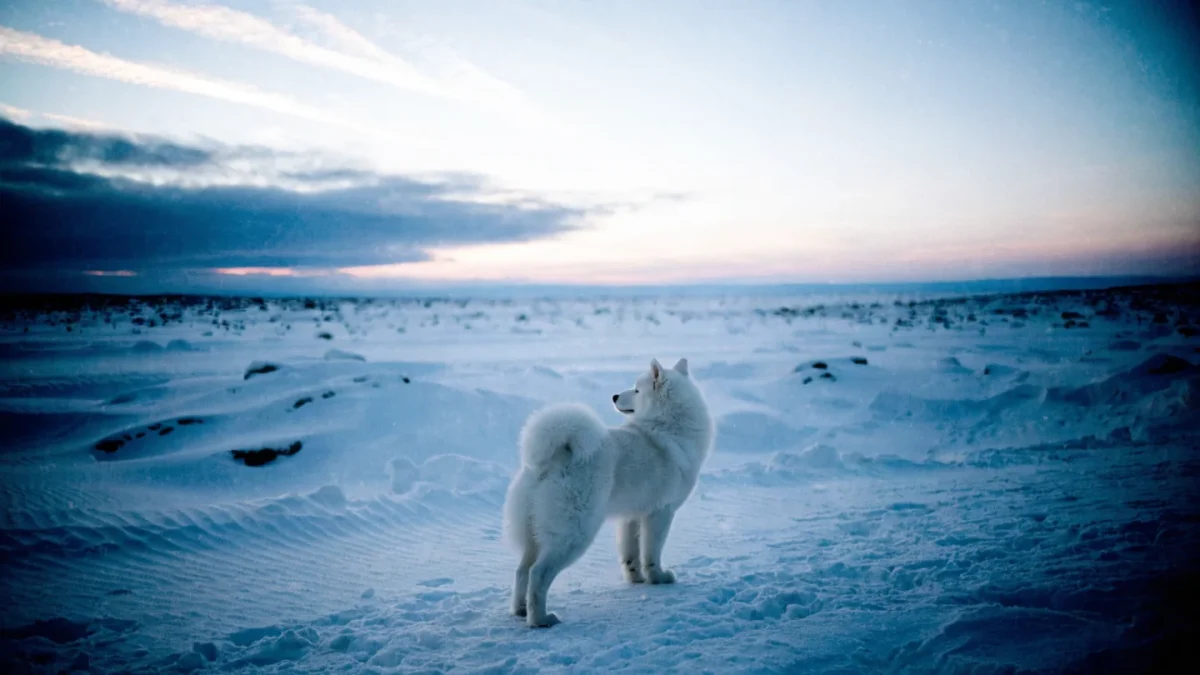
There's a moment, when you first see a Samoyed in a yard on a cold morning, when the dog doesn't quite look real. The coat is white — not cream, not off-white, genuinely white — and it catches the winter light in a way that seems almost luminescent. The outer guard hairs carry a faint silver gloss. The undercoat beneath is dense enough that the whole dog seems to float slightly above its own body, a cloud that has been taught to trot. And then it turns to look at you, and there's the smile — that upturned corner of the mouth that isn't actually a smile but has always been called one, the expression that breeders say prevents the dog's drool from freezing to its face in Arctic conditions. Functional, not sentimental. The breed has always been like that: beautiful for reasons that began as practical.
That dog standing in your yard on a winter morning is essentially unchanged from the animal that the Samoyede people — now called the Nenets — built over thousands of years on the Siberian tundra. Not a refinement of that dog. Not a modernized version. The same dog, give or take a kennel club and a show career. Understanding what it is now means understanding what it was built for, and that means starting at the beginning, which is considerably further back than most breed histories admit.
The Samoyede People
The dogs are named after the people who created them. The Samoyede — now more commonly called the Nenets — are a nomadic people indigenous to northwestern Siberia and the Russian Arctic. For centuries, they lived a semi-nomadic life centered on reindeer herding across the tundra and taiga regions stretching from the White Sea to the Yenisei River.
Their dogs were not pets. They were survival infrastructure. The Samoyede used their dogs for three primary purposes: herding reindeer, pulling sleds loaded with camp equipment during migrations, and providing warmth inside the family tent — the chum — during winter nights when temperatures plummeted well below minus thirty degrees Celsius.
That third function is the one that shaped the breed's temperament more than anything else. Dogs that slept inside the family tent, alongside children and adults, generation after generation for thousands of years, were selected for human sociability, gentle disposition, and tolerance of close physical contact. Aggressive dogs didn't sleep in the tent. Dogs that didn't sleep in the tent didn't survive the winter as reliably.
The result is a breed whose defining behavioral characteristic — extreme sociability and proximity-seeking — is not a trained behavior or a modern development. It's a survival adaptation baked into thousands of years of genetic selection. The Samoyed temperament profile is, quite literally, a product of shared body heat.
Into the West: Polar Exploration
Western awareness of the breed arrived through the Age of Polar Exploration. The late nineteenth and early twentieth centuries saw a series of expeditions to the Arctic and Antarctic that relied on dog teams, and Samoyed-type dogs featured prominently.
Fridtjof Nansen (1893-1896). Nansen's Fram expedition acquired dogs from the Nenets people for the attempt to drift across the Arctic Ocean. After Nansen and Hjalmar Johansen left the ship for their dash toward the North Pole, the remaining dogs helped sustain the expedition. Several of these dogs eventually made it back to Norway.
Roald Amundsen (1910-1912). Amundsen's successful South Pole expedition primarily used Greenland Dogs, but his planning was informed by the performance of Samoyed-type dogs on earlier expeditions. The breed's reputation as reliable polar working dogs was well established by this point.
Ernest Shackleton (1907-1909). The Nimrod expedition to Antarctica included Samoyed-type dogs among its sled teams. The dogs' performance on the ice contributed to the breed's reputation, though the expeditions took a devastating toll — many dogs did not survive the journeys.
Robert Scott (1910-1912). Scott's ill-fated Terra Nova expedition also used dogs, including Samoyed-type animals. The expedition's failure and the deaths of Scott's polar party overshadowed the dogs' contribution, but surviving expedition dogs became important in early Western breeding programs.
Foundation of the Western Breed
The transition from polar working dog to recognized breed happened primarily in England. Ernest Kilburn-Scott and his wife Clara are credited with establishing the breed in the West. Ernest brought a dog named Sabarka from Archangel, Russia, in the 1890s and subsequently acquired additional dogs including some with expedition backgrounds.
The Kilburn-Scotts bred their dogs systematically and promoted the breed in British dog fancy circles. Clara Kilburn-Scott drafted the first breed standard. The Kennel Club in Britain recognized the breed in 1909 under the name "Samoyed."
The early Western breeding population was small. Most foundation dogs traced to a handful of imports from Russia and expedition survivors. This narrow genetic base is a recurring theme in the breed's history and has consequences for modern health — the complete breed guide addresses the hereditary conditions that trace to this bottleneck.
The Breed Standard Takes Shape
By the 1920s, the Samoyed had established itself in both Britain and North America. The breed attracted owners drawn to the striking white coat, the distinctive facial expression, and the sociable temperament. The transition from working dog to companion and show dog was relatively smooth because the traits that made the Samoyed useful in Siberia — the dense weatherproof coat, the athletic build, the people-oriented disposition — also made it appealing as a household companion.
The breed standard emphasized the qualities inherited from the working dogs: a strong, compact body capable of sustained effort; a profuse double coat with harsh outer guard hairs and a soft, dense undercoat; a wedge-shaped head with the characteristic upturned mouth corners; and dark, intelligent eyes set in a face that conveyed alertness and good humor.
What the standard preserved, intentionally or not, was also the breed's functional nature. Modern Samoyeds retain the stamina, the coat, the cold tolerance, and the mental independence of their working ancestors. Show breeding has altered some proportions and coat density, but the core animal — the tent dog, the sled puller, the reindeer herder — is still recognizable.
From Siberia to Everywhere
The Samoyed's path from the Siberian tundra to global popularity tracks a pattern common to many working breeds: discovered by outsiders, romanticized for its appearance, adopted as a companion, and gradually separated from the work it was designed to do.
But the breed hasn't forgotten what it is. The dog that curls up on your couch and demands to be included in every household activity is doing exactly what its ancestors did in the chum. The dog that barks at everything and insists on being the center of attention is exhibiting the alert, communicative behavior that served the Nenets people on the tundra. The dog that destroys your furniture when left alone too long is a tent dog without a tent — a social animal whose deepest programming says isolation means danger. Readers interested in how a related but distinct northern breed navigated its own path from Siberian working dog to Western companion will find the history of the Siberian Husky a useful parallel account.
Understanding the Samoyed's history doesn't make the breed easier to live with. But it explains why the dog is what it is, and that understanding is the foundation of realistic ownership.