

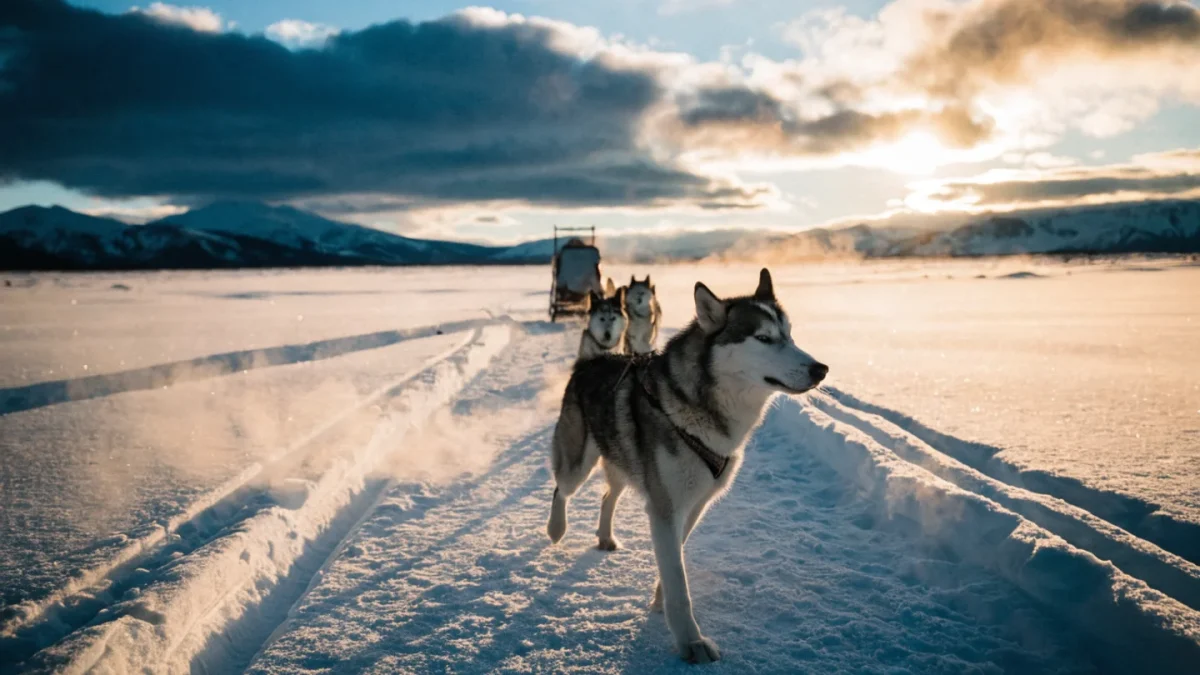
In January 1925, two children in Nome, Alaska died from what the town's sole physician, Dr. Curtis Welch, confirmed as diphtheria. The nearest supply of antitoxin serum was in Anchorage — roughly 1,600 km away by the only winter route available. The harbor was frozen, planes couldn't fly in the extreme cold, and the railroad only reached as far as Nenana, still 1,085 km from Nome. What happened next would turn a breed that most Americans had never heard of into a permanent fixture of popular culture.
But the siberian husky history stretches back thousands of years before that famous relay. The 1925 serum run was an introduction, not an origin.
The Chukchi Foundation: 3,000 Years of Purposeful Breeding
The Siberian Husky's roots trace to the Chukchi people, a semi-nomadic indigenous group inhabiting the coastline and interior of the Chukchi Peninsula in northeastern Siberia. Archaeological evidence and genetic analysis of sled dog lineages place the development of purpose-bred sled dogs in this region back thousands of years — a 2020 genomic study published in Science found evidence of Arctic-adapted sled dogs on Zhokhov Island in northeastern Siberia dating to roughly 9,500 years ago, making the broader sled dog tradition one of the oldest sustained breed development efforts in the history of domesticated dogs.
The Chukchi bred their dogs for a specific combination of traits that reflected their survival needs. The dogs had to pull moderate loads over enormous distances — not sprinting, but sustained, efficient trotting across hundreds of kilometers. They had to do this in temperatures that regularly dropped below -40C, consuming as little food as possible. Efficiency wasn't a preference. In a subsistence economy where food was scarce, a dog that ate more than it earned wasn't kept.
This produced an animal quite different from the larger, heavier freight dogs developed by other Arctic peoples. The Chukchi sled dog was medium-sized, lean, and metabolically efficient. European explorers and traders who encountered the Chukchi often noted that their dogs were smaller than expected for sled work — a remark that would echo decades later when the breed first appeared in Alaska.
The Chukchi also selected deliberately for temperament. Dogs lived inside family dwellings, slept with children for warmth during the coldest months, and needed to cooperate reliably with other dogs in large teams. Aggression toward people or persistent dog-to-dog fighting meant removal from the breeding population. The modern breed's characteristic gentleness with humans and cooperative pack behavior traces directly to this selection.
For a detailed breakdown of how this Chukchi heritage shapes the breed's behavior today, see Siberian Husky temperament: the independence bred in over millennia.
Arrival in Alaska: The All Alaska Sweepstakes
The breed's westward journey from Siberia to Alaska began in the early 1900s through fur traders and explorers operating across the Bering Strait. The pivotal figure was a Russian fur trader named William Goosak, who entered a team of Siberian dogs in the 1909 All Alaska Sweepstakes — a roughly 408-mile (657 km) sled dog race from Nome to Candle and back.
Goosak's small, light dogs drew ridicule from the Alaskan mushing community, which favored large mixed-breed freight dogs and Malamute-type teams. The Siberians were dismissed as "Siberian rats" — too small to be competitive. Goosak's team finished third. The ridicule stopped.
The following year, 1910, a musher named John "Iron Man" Johnson drove a team of Siberian imports to victory, finishing the 653 km course in a record time of 74 hours and 14 minutes. Two other Siberian teams also placed in the top four. The performance was so dominant that it triggered immediate demand for Siberian dogs among serious racing mushers.
A Norwegian musher named Leonhard Seppala became the breed's most influential early champion in North America. Seppala acquired Siberian dogs around 1914 and over the next decade built what many consider the finest sled dog team ever assembled. He won the All Alaska Sweepstakes three consecutive years — 1915, 1916, and 1917 — before the race was discontinued due to World War I. His lead dog, Togo, would later become central to the event that made the breed internationally famous. For more, see Samoyed.
The 1925 Serum Run to Nome
By January 1925, the diphtheria situation in Nome was escalating. Dr. Welch had confirmed the disease, the town's antitoxin supply had expired, and the nearest replacement was 1,085 km away in Nenana, where it could arrive by rail from Anchorage. The decision was made to relay the serum by dog sled — the only viable transport across the frozen interior in winter.
Twenty mushers and approximately 150 sled dogs participated in what became known as the "Great Race of Mercy." The serum was passed hand to hand in a continuous relay, running day and night through blizzard conditions, with temperatures dropping to approximately -40C with wind chill.
Leonhard Seppala and his lead dog Togo ran what was widely considered the most dangerous and longest single leg — approximately 146 km across the treacherous frozen Norton Sound, where open water and unstable ice made the crossing life-threatening. Seppala deliberately chose the shorter but far more dangerous route across the open ice rather than the safer coastal trail, gambling that speed was more important than safety given the mounting death toll in Nome.
Togo was twelve years old at the time. He navigated the team through a ground blizzard with near-zero visibility, across ice that was shifting and cracking, and delivered the serum to the next relay point. The physical and navigational demands of that leg remain one of the most remarkable documented performances by any sled dog.
The final leg — approximately 85 km from Bluff to Nome — was run by a musher named Gunnar Kaasen with a lead dog named Balto. Kaasen and Balto arrived in Nome on February 2, 1925, five and a half days after the relay began. The town was saved. And the world's press, hungry for a dramatic narrative, found its hero.
Balto, Togo, and the Credit Controversy
Here's where the history gets complicated — and where what most people know about the serum run is incomplete.
Balto received the overwhelming majority of public recognition. A bronze statue was erected in Central Park in New York City in December 1925, less than a year after the run. Balto became a celebrity. Books, film newsreels, and eventually an animated movie carried his name into household familiarity for generations.
Seppala and many other mushers were frustrated by this outcome. Togo had run the longest, most dangerous leg. He had navigated conditions that would have stopped most dogs. He was the veteran leader who made the critical crossing. Balto ran the final, shorter, and by most accounts less treacherous leg — but he was the one who arrived in Nome, and arrival makes for a better photograph than a mid-route handoff.
Seppala publicly advocated for Togo's recognition for years. Togo was eventually acknowledged more widely — a bronze statue by sculptor Shelley Smith Curtis was installed in Seward Park on Manhattan's Lower East Side in 2001, and a 2019 film told his story — but the popular imagination still defaults to Balto. The credit disparity is a useful reminder that historical fame often tracks with narrative simplicity rather than proportional contribution.
From Working Dog to Recognized Breed
The serum run transformed the Siberian Husky from a regional working dog into an internationally recognized breed. Demand surged. Seppala toured the continental United States with his dogs in 1926 and 1927, staging demonstrations and races that introduced the breed to audiences far from Alaska.
Formal breed recognition followed relatively quickly. The American Kennel Club recognized the breed in 1930, with the first breed standard published in the AKC Gazette in April 1932, based heavily on the working dogs that Seppala and other mushers had imported from Siberia.
The breed standard reflected the dogs' working heritage — the emphasis was on medium size, efficient movement, endurance, and the dense double coat necessary for Arctic survival. Early standards explicitly warned against excessive size or heavy bone, distinguishing the Siberian Husky from the larger Alaskan Malamute and preserving the breed's identity as a distance runner rather than a freight hauler.
World War II and Diversification
During World War II, Siberian Huskies served in the United States military's Arctic Search and Rescue Unit, further demonstrating the breed's endurance and cold-weather capability under demanding conditions.
After the war, the breed's population expanded beyond working sled dog kennels. Pet ownership of Huskies increased steadily through the 1950s and 1960s, and the breed began appearing in the conformation show ring more frequently. This split between working lines and show lines — a pattern common to many breeds — began to produce visible divergence. Show-bred Huskies trended toward heavier coats, slightly heavier bone, and more uniform markings. Working-line dogs remained leaner, lighter, and selected primarily for performance.
Both lineages still exist today, and the conversation about which better represents the breed's heritage is one that Husky enthusiasts engage in passionately. The genetic diversity within the breed remains relatively broad compared to some popular breeds — a legacy of the Chukchi's large breeding populations and the continued infusion of working bloodlines. For more on how genetics shape the breed's distinctive appearance, see Siberian Husky genetics: eye color, coat patterns, and heterochromia.
The Breed Today
The Siberian Husky is now one of the most recognized dog breeds worldwide. Its striking appearance — the piercing eyes, the wolf-like silhouette, the dramatic markings — has made it a fixture of popular culture, social media, and public fascination.
That visibility is a double-edged sword. The breed's photogenic qualities drive impulse acquisitions by people unprepared for the reality of living with a high-energy, independent, escape-prone, prey-driven, heavily shedding working dog. Return-to-rescue rates for the breed are consistently among the highest of any popular breed, a statistic that traces directly to the gap between the breed's image and its actual demands.
The irony is hard to miss. The Chukchi bred these dogs for substance — for endurance, efficiency, and survival under the hardest conditions on earth. The breed's modern popularity is driven largely by appearance. The most meaningful thing a prospective owner can do is study the breed's history, understand what these dogs were built for, and ask honestly whether they can meet those needs in a modern context. The complete Siberian Husky breed guide covers the full picture.