

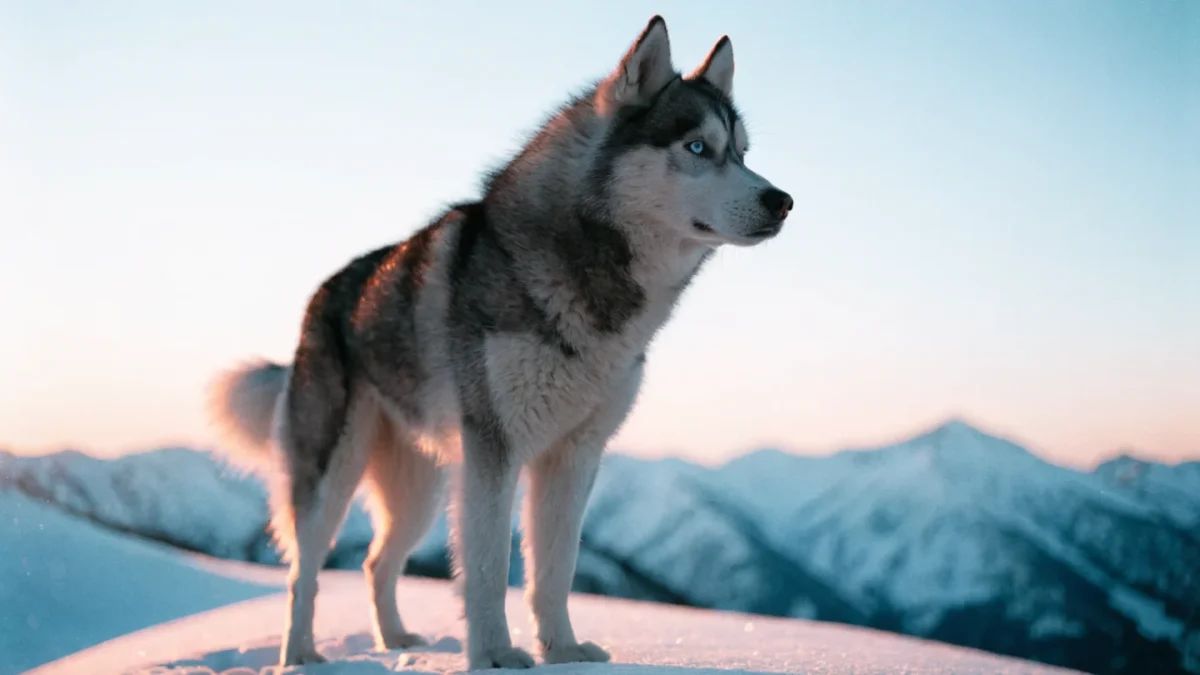
The 1925 serum run to Nome is the single worst reason to get a Siberian Husky. I know that's a harsh opening, but it's the truth. Balto is a statue in Central Park. The breed it represents is an independent, escape-prone, high-endurance working dog that will destroy a couch, scale a fence, and run into traffic if you give it the chance. What that relay team accomplished — covering 1,085 km of frozen Alaskan wilderness in five and a half days in whiteout conditions — is genuinely extraordinary. It is also utterly irrelevant to what it's like to own a Husky in a suburban house.
The gap between the Husky of popular imagination and the Husky that actually arrives in your home is where most Husky problems begin. People come to this breed through a story of heroism and endurance and they end up with a dog that howls at 2am, defeats every containment solution they've tried, and requires 90-plus minutes of daily exercise minimum. That dog isn't a disappointment. It's exactly what the breed is. The disappointment is the mismatch between expectation and reality.
If you've come looking for a siberian husky breed guide that tells you what living with this dog actually involves — the demands, the rewards, and the genuine deal-breakers — this is it. The breed inspires obsessive devotion in people who understand it and bewildered frustration in people who don't. The difference almost always comes down to preparation.
Origins and the Chukchi Heritage
The Siberian Husky's history is inseparable from the Chukchi people, a semi-nomadic indigenous group living along the Arctic coastline of the Chukchi Peninsula. Archaeological and genetic evidence places the development of sled dog lineages in this region back at least 3,000 years, though some estimates extend further — a 2020 study published in Science analyzing ancient DNA from Zhokhov Island in Arctic Siberia found evidence of purpose-bred sled dogs dating back roughly 9,500 years. The Chukchi bred their dogs with a clarity of purpose that modern breeders would envy: the dogs needed to pull moderate loads across enormous distances in sub-zero temperatures while consuming as little food as possible.
That last requirement shaped the breed's metabolism in ways that still matter. Siberian Huskies are remarkably fuel-efficient for their work output. They can shift their metabolic pathways during sustained exercise — a physiological adaptation studied by exercise scientists that allows them to burn fat reserves without depleting glycogen stores the way most mammals do. Research documented during multi-day sled races found that within a few days of sustained running, sled dogs switch from glycogen-dependent metabolism to a glycogen-sparing mode, extracting fat directly from the bloodstream and even resynthesizing muscle glycogen overnight without additional food intake. This is why a 20 kg Husky can outwork a 35 kg dog on the trail and finish looking like it's ready for another shift.
The Chukchi valued temperament alongside physical ability. Dogs that lived inside family dwellings, slept with children for warmth, and cooperated with other dogs in harness were the ones selected for breeding. Aggression was not tolerated. This is the origin of the breed's generally non-aggressive, pack-oriented personality — it was bred in, deliberately, over millennia.
For a deeper look at how the breed went from Chukchi villages to the front pages of newspapers, see the full history of the Siberian Husky and the serum run.
Physical Characteristics
Size and Build
Males typically stand 53 to 60 cm at the shoulder and weigh 20 to 27 kg. Females range from 51 to 56 cm and 16 to 23 kg. This puts the Siberian Husky firmly in the medium category — smaller than most people expect. The breed's visual impact comes from its proportions and coat volume, not from raw mass.
The build is compact and athletic without being bulky. The chest is deep but not excessively broad — the body needs to cut through snow, not push through it. The back is straight and moderately long. Legs are well-boned but not heavy, built for efficient, tireless trotting. The overall impression should be of balanced, effortless power — a distance runner's frame, not a sprinter's.
Coat
The double coat is dense and medium-length. The undercoat is soft, thick, and insulating. The outer guard coat is straight and somewhat smooth-lying. Coat length should never be so long that it obscures the body's outline — excessive coat is considered a fault in the breed standard for good reason. A working dog dragging ice-laden fur across the tundra is a dog in trouble.
Coat color varies enormously. Black and white is the most recognized pattern, but the breed comes in every shade from pure white to jet black, including grey, agouti, red, sable, and copper. Facial markings are distinctive — most Huskies display some version of the characteristic face mask, though the patterns vary from bold symmetrical masks to open-faced configurations with minimal marking.
Eyes
The eyes deserve their own mention because they're often the first thing people notice. Eye color ranges from brown to blue, and heterochromia — one blue eye, one brown — occurs frequently enough in the breed to be considered normal rather than exceptional. Parti-colored eyes (two colors within the same iris) also appear. All eye colors are equally acceptable, and eye color has no correlation with vision quality or health status.
Distinguishing Features
The ears are medium-sized, triangular, set high and close together, and carried erect. The tail is fox-brush shaped and carried in a graceful sickle curve over the back when alert — but not curled tightly or lying flat against the back. At rest, the tail hangs down. In extreme cold, Huskies wrap the tail over the nose while sleeping, using it as a built-in face warmer.
Temperament and Behavior
If the Golden Retriever is the breed that lives to please its owner, the Siberian Husky is the breed that respects its owner — but reserves the right to make its own decisions. This distinction matters enormously, and misunderstanding it is the single biggest reason Huskies end up in rescue.
What Most People Get Wrong About This Breed
The misconception I hear most often: "Huskies are like wolves — they're aggressive and dangerous."
They're not. Siberian Huskies are one of the least human-aggressive breeds recognized by any major registry. The Chukchi bred out human aggression over thousands of years because the dogs lived and slept with families, including small children. A dog that bit a child didn't get bred again. The result is a breed that is remarkably gentle with people — often to the point of being useless as a watchdog.
The second misconception: "Huskies are stubborn and untrainable."
Also wrong, but understandably so. Huskies are intelligent and fully capable of learning. What they lack is the obsessive desire to please that defines breeds like Golden Retrievers or Border Collies. A Husky understands what you're asking. It just weighs whether complying serves its interests before deciding. This isn't defiance — it's independence, bred into the dog over millennia because a sled dog that blindly followed commands on unstable ice was a dead sled dog. They were bred to think for themselves, and they do.
For a detailed breakdown of what this independence looks like day-to-day, read Siberian Husky temperament: independent, vocal, and built to run.
Vocalization
Huskies are talkers. Not barkers — talkers. The breed produces an extraordinary range of vocalizations: howls, yodels, woos, grumbles, screams, and what can only be described as dramatic monologues directed at the ceiling. This is normal. It is also loud. Apartment neighbors will have opinions about it.
The howling has practical origins. Sled dog teams spread across frozen landscapes needed to communicate over distance, and a bark doesn't carry the way a howl does. Modern Huskies retain this vocal instinct completely. They howl at sirens, they howl at other dogs, they howl to express displeasure, and they howl because it's Tuesday. This is a non-negotiable breed characteristic — you will not train it out.
Prey Drive and Escape Artistry
Two other traits require honest mention. First, Siberian Huskies have high prey drive toward small animals. Cats, rabbits, rodents, and small dogs can trigger a pursuit response. Some individual Huskies coexist with cats — particularly when raised together from puppyhood — but the breed-level tendency is strong enough that caution is warranted.
Second, Huskies are legendary escape artists. They dig under fences, climb over them, find gaps that seem physically impossible for their size, and learn to open latches. A standard 1.2-meter fence is a suggestion, not a barrier. Secure containment for this breed means a fence at least 1.8 meters tall with dig guards at the base and no climbable cross-members.
Health Profile
Siberian Huskies are, compared to many purebred dogs of similar popularity, a relatively healthy breed. They were developed under conditions that selected harshly for physical soundness — a sled dog that broke down on the trail was a liability in an environment where liabilities killed people. That selection pressure produced a more robust health foundation than breeds developed primarily for appearance.
Hip Dysplasia
Hip dysplasia occurs in the breed but at lower rates than in many comparably sized dogs. Screening through standardized radiographic evaluation programs is standard practice among responsible breeders.
Eye Conditions
Eye problems are the most significant health concern in the breed. Hereditary cataracts, progressive retinal atrophy (PRA), and corneal dystrophy all appear in Siberian Huskies. Annual ophthalmologic evaluation is recommended, and breeding stock should have documented eye clearances. Juvenile cataracts can appear as early as three months of age, though most cases are diagnosed between six months and one year.
Other Health Concerns
- Hypothyroidism: Underactive thyroid is moderately common. Treatable with daily medication but requires ongoing monitoring.
- Zinc-responsive dermatosis: A condition where the skin can't properly absorb or utilize zinc, leading to crusty lesions around the face and feet. More common in arctic breeds than in most other breed groups. Manageable with zinc supplementation.
- Follicular dysplasia: A coat condition that can cause patchy hair loss. Not painful but can alter the coat's insulating properties.
- Gastric issues: Huskies can be sensitive eaters compared to many breeds, and some individuals struggle with dietary changes or rich foods.
Lifespan
The average lifespan is 12 to 14 years, which is solid for a medium-sized working breed. This longevity reflects the breed's relatively clean genetic health profile compared to breeds with higher rates of cancer or organ disease.
Grooming: The Shed Is Real
If you own dark clothing — or light clothing, or any clothing at all — prepare yourself. The Siberian Husky coat sheds. Heavily. Continuously. And then twice a year, it sheds dramatically more during the seasonal coat blow, when the entire undercoat releases in clumps large enough to knit a second dog.
Regular Coat Maintenance
Brush the coat thoroughly at least twice per week during non-shedding periods. During the twice-yearly coat blow (typically spring and fall), daily brushing with an undercoat rake is the only way to manage the volume. A high-velocity dryer — the kind groomers use — is genuinely helpful for removing loose undercoat faster than any brush.
Huskies are naturally clean dogs. They self-groom similarly to cats, and their coat has very little odor compared to most breeds. Bathing is infrequent — every two to three months or when genuinely dirty. Over-bathing strips the coat's natural oils and disrupts the waterproofing of the guard hairs.
What Not to Do
Never shave a Siberian Husky. The double coat insulates against both cold and heat. Shaving removes the UV protection of the guard coat and disrupts the air circulation layer between the two coat types. A shaved Husky is more vulnerable to sunburn, overheating, and insect bites — the opposite of the intended effect. The coat may also grow back with an altered texture, with the undercoat dominating and the guard hairs failing to reach proper length.
Exercise Requirements: This Is Not Optional
A Siberian Husky needs a minimum of 90 minutes of vigorous exercise daily. Not a walk. Not backyard time. Real, sustained, high-output physical activity. This is a dog bred to run 50 to 100 km per day in harness. A lap around the block is an insult to its genetics.
What Works
- Running: On-leash running, canicross, or bikejoring for dogs over 18 months with confirmed joint clearance.
- Hiking: Long-distance trail work suits the breed perfectly. Huskies are built for covering ground and handle varied terrain well.
- Mushing and carting: The activity the breed was literally designed for. Dryland mushing (scootering, carting) works in warm climates where snow isn't available.
- Free running: In secure, fenced areas only. An off-leash Husky in an open area is a Husky that's about to be three kilometers away.
- Mental exercise: Puzzle feeders, sniff work, and problem-solving games. A physically tired Husky with a bored brain will still find ways to destroy your furniture.
What Happens Without Enough Exercise
Under-exercised Huskies don't just get restless — they get destructive. Digging, chewing, howling, fence-breaking, and general household demolition are standard responses from a Husky that isn't getting enough physical output. This is not bad behavior. It's the predictable response of a high-drive working dog with nothing to work on.
Living With a Siberian Husky
Climate
Huskies thrive in cold to moderate climates. Their coat system is designed for temperatures well below freezing — they are genuinely comfortable at -30C and below. Heat is the concern. In warm climates, exercise must be shifted to early morning or late evening, shade and water must be constantly available, and air conditioning is not a luxury but a requirement. The breed can adapt to warm climates, but it requires management.
Multi-Dog Households
Huskies are pack animals and generally do well with other dogs of similar size and energy level. Same-sex aggression is occasionally an issue, but the breed is far less prone to dog aggression than many working breeds. The compatibility concern is more about activity level — a Husky paired with a sedentary breed may simply overwhelm its housemate with energy.
Small Animals
I'll be straightforward: Huskies and small animals are a risky combination. The prey drive is high and deeply embedded. Some individuals coexist with cats, but many do not, and the cost of getting this assessment wrong is severe. If you have small pets, factor this honestly into your decision.
Is This Breed Right for You?
I've spent over a decade studying and writing about breeds, and the Siberian Husky has one of the highest return-to-rescue rates of any popular breed. The reason isn't complicated: people fall in love with the look and underestimate the demands.
For an in-depth, honest self-assessment, read is a Siberian Husky right for you.
A Siberian Husky fits your life if:
- You are genuinely active — 90-plus minutes of daily vigorous exercise is your baseline, not your aspiration
- You have secure fencing (1.8 meters or taller, with dig prevention) or a reliable plan for managed exercise
- You find independent-minded dogs interesting rather than frustrating
- You're comfortable with heavy shedding and a vocal dog
- You understand that this breed was not designed to obey instantly and you don't need that from a dog
- You have no small animals in the household, or you have extensive, verified experience managing high-prey-drive dogs with small pets
A Siberian Husky is wrong for you if:
- You want a dog that comes when called every time, no exceptions
- You need a quiet household
- Your primary exercise is walking at a moderate pace
- You expect off-leash reliability in unfenced areas
- You want a guard dog — Huskies greet intruders like long-lost friends
- You're unwilling to manage a dog that will test fences, gates, and doors for weaknesses on a regular basis
The Siberian Husky is one of the most honestly built breeds on the planet — form and function aligned by thousands of years of survival pressure. The breed deserves owners who respect that heritage enough to meet its needs.
Frequently Asked Questions
Are Siberian Huskies good family dogs?
Siberian Huskies can be excellent family dogs, particularly with older children who can participate in the dog's exercise needs. The breed is not inherently aggressive toward people and has a long history of living closely with families. However, their high energy, escape tendencies, and prey drive toward small animals make them a poor match for families who want a low-maintenance pet. Young children should always be supervised — not because Huskies are dangerous, but because a 25 kg dog moving at full speed through a living room will bowl over a toddler without meaning to.
How much do Siberian Huskies shed?
Heavily. Year-round moderate shedding punctuated by two massive coat blows per year (spring and fall), during which the entire undercoat releases over a two-to-four-week period. During coat blow, you will fill grocery bags with loose fur. Between blows, regular brushing twice a week manages the shedding to a tolerable level. "Tolerable" still means fur on your clothes, furniture, and food. If shedding is a deal-breaker, this is not your breed.
Can Siberian Huskies live in warm climates?
Yes, with significant management. The double coat actually provides some insulation against heat, but Huskies are fundamentally cold-adapted dogs. In warm climates, exercise must be restricted to cool hours (early morning, late evening), air conditioning is mandatory indoors, and constant access to shade and fresh water is essential. Never shave the coat — it provides UV protection and heat regulation. Many Huskies live successfully in warm regions, but it requires more owner effort than in cold climates.
Do Siberian Huskies get along with cats?
Some individuals do, especially when raised with cats from puppyhood. However, the breed has strong prey drive toward small animals, and this is a trait that varies significantly between individual dogs. A Husky that tolerates the family cat indoors may still chase an unfamiliar cat outdoors. Never assume compatibility — test carefully, supervise constantly, and have a separation plan. The stakes of getting this wrong are too high for guesswork.
Why do Siberian Huskies howl so much?
Howling is the breed's primary form of vocal communication, inherited from thousands of years of sled work where dogs needed to communicate across frozen landscapes. Huskies howl in response to sirens, other dogs, boredom, excitement, displeasure, and sometimes for no apparent reason at all. It is hardwired behavior, not a training failure. You can manage the triggers to some extent, but you cannot eliminate the instinct. If you live in shared-wall housing, this is a serious practical consideration.