

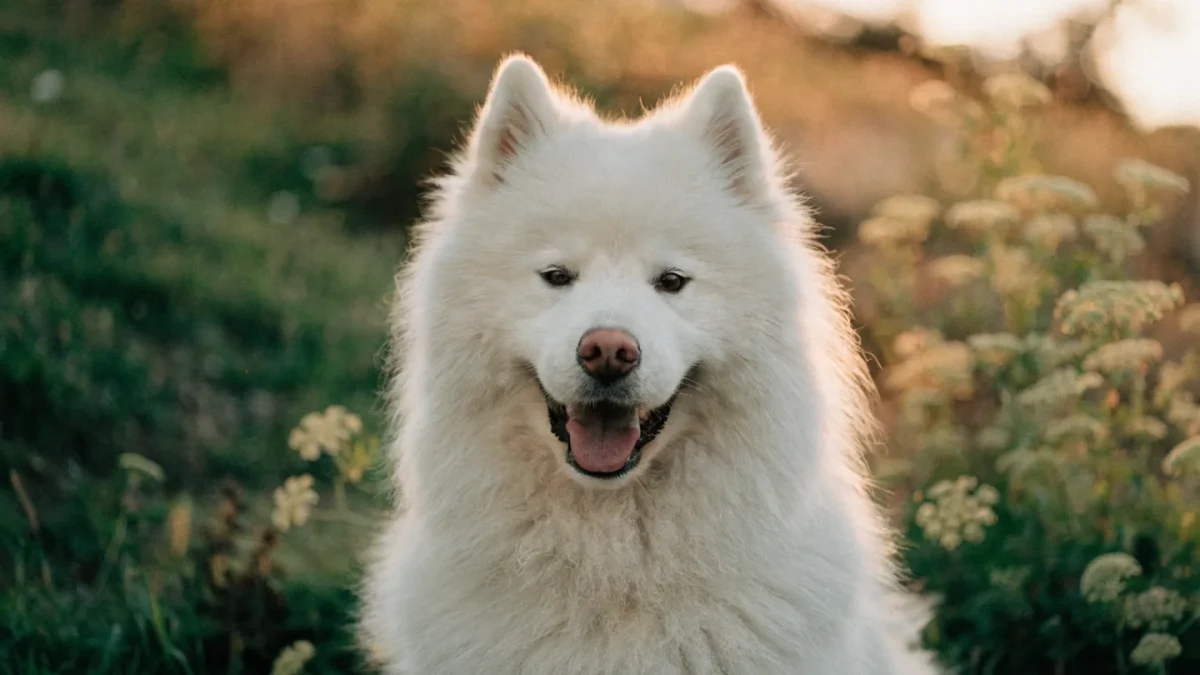
The Samoyed spent thousands of years sleeping inside tents with the Samoyede people of Siberia. Not outside. Not in a kennel. Inside, with the family, sharing body heat through Arctic winters where temperatures dropped below minus forty degrees. That arrangement — dog and human, physically close, mutually dependent — shaped a temperament that is fundamentally, almost aggressively social. Understanding samoyed temperament personality starts with understanding that this breed was never designed to be alone.
The famous "Sammy smile" — that upturned curve at the corners of the mouth — isn't just charming. It's functional. The lip shape prevents drooling, which in sub-zero conditions would form icicles on the muzzle. But the expression it creates maps perfectly onto the breed's actual disposition: this is a dog that approaches life, people, and other animals with genuine, persistent enthusiasm.
Social Drive
Samoyeds don't just tolerate human company. They require it. The breed forms deep attachments to its household and demonstrates that attachment through constant physical proximity. A Samoyed will follow you from room to room, lean against your legs while you work, position itself between you and the door, and sleep as close to you as you'll permit.
This sociability extends beyond the family unit. Most Samoyeds greet strangers with enthusiasm rather than suspicion. If you want a dog that alerts you to intruders, a Samoyed will likely alert you — by barking — and then greet the intruder with a wagging tail and an invitation to play. The breed has virtually no guard-dog instinct. They're watchdogs in the sense that they'll announce everything; they're useless as protection dogs.
With other dogs, Samoyeds are typically gregarious. The breed's pack heritage means most individuals enjoy canine company and integrate well into multi-dog households. Dog-directed aggression is uncommon in the breed, though individual temperament always varies.
The Vocal Reality
Samoyeds talk. This isn't a euphemism — the breed produces a range of vocalizations that go well beyond standard barking. Howling, "woo-wooing," yodeling, grumbling, and sustained conversational sequences are all part of the repertoire. Many owners describe it as having a furry roommate who has opinions about everything and expresses them constantly.
This vocal tendency has practical implications. In apartment or townhouse settings, a Samoyed's voice carries through walls. Neighbors will hear it. If noise restrictions apply to your living situation, this breed will test them. Training can reduce excessive barking, but the baseline vocal nature is hardwired — you're managing it, not eliminating it.
The flip side: the vocalizations are genuinely communicative. Experienced Samoyed owners learn to distinguish between the "someone's at the door" bark, the "I need to go outside" bark, the "play with me" warble, and the "I'm displeased about being left alone" sustained howl. The breed tells you what it's thinking. Constantly.
Independence Within Devotion
Here's the paradox that confuses first-time Samoyed owners: the breed is simultaneously devoted to its people and independent in its decision-making.
Samoyeds are intelligent. They learn commands quickly and understand what you're asking. Whether they comply is a separate question. This isn't stubbornness in the way it's typically described — it's the legacy of a working dog that was expected to make independent decisions in harsh conditions. A sled dog that blindly follows every command when the trail ahead is dangerous is a dead sled dog. The breed retained that evaluative quality.
In practical terms, this means a Samoyed that has been trained to "come" will weigh the recall command against whatever it's currently interested in and make a judgment call. If the squirrel is more compelling than the treat you're offering, the squirrel wins. This isn't defiance — it's cost-benefit analysis performed by a dog whose ancestors survived by making their own assessments.
The complete breed guide covers training approaches suited to this temperament. The short version: positive reinforcement, variety in training sessions, and accepting that this breed works with you rather than for you.
Separation Tolerance
This is the breed's most challenging temperament trait for modern lifestyles.
Samoyeds tolerate isolation poorly. A Samoyed left alone for extended periods — anything beyond four to five hours pushes limits for most individuals — will vocalize, destroy property, dig, pace, and demonstrate escalating distress behaviors. This isn't a training gap. It's a breed that was genetically selected for constant human proximity over thousands of years being asked to do something that contradicts its fundamental wiring.
Households where all adults work full-time away from home face a genuine compatibility problem with this breed. Dog daycare, a reliable dog walker, or a work-from-home arrangement can bridge the gap. An empty house for eight to ten hours daily cannot.
With Children
Samoyeds are generally patient and playful with children. Their size (typically 20 to 30 kg) is substantial enough that rough play from small children is tolerable without fragility concerns, while not so large that the dog is dangerous simply by moving through space. The breed's playful nature often matches well with children's energy.
That said, supervision is always necessary. Samoyeds are exuberant — they jump, they mouth, they express enthusiasm physically. A Samoyed greeting a small child with full-body joy can knock that child down with the best intentions. Young children need to learn appropriate interaction, and the dog needs consistent boundaries around jumping and mouthing.
The Temperament Behind the Smile
The Sammy smile draws people in. The temperament behind it keeps people — the right people — devoted to the breed for life. But "the right people" is a specific category: active, present, tolerant of noise, comfortable with a dog that has opinions, and home enough to meet the breed's deep need for companionship.
The breed's history explains why the temperament is what it is. Thousands of years of shared-tent living, cooperative work, and mutual survival created a dog that doesn't just want to be with you — it needs to be. That's either the breed's greatest feature or its biggest challenge, depending entirely on how you live. For readers comparing the Samoyed against the other great Siberian working breed, the Siberian Husky temperament profile covers the key distinctions in detail — the two breeds' personalities diverge more sharply than their shared cold-weather origins might suggest.