

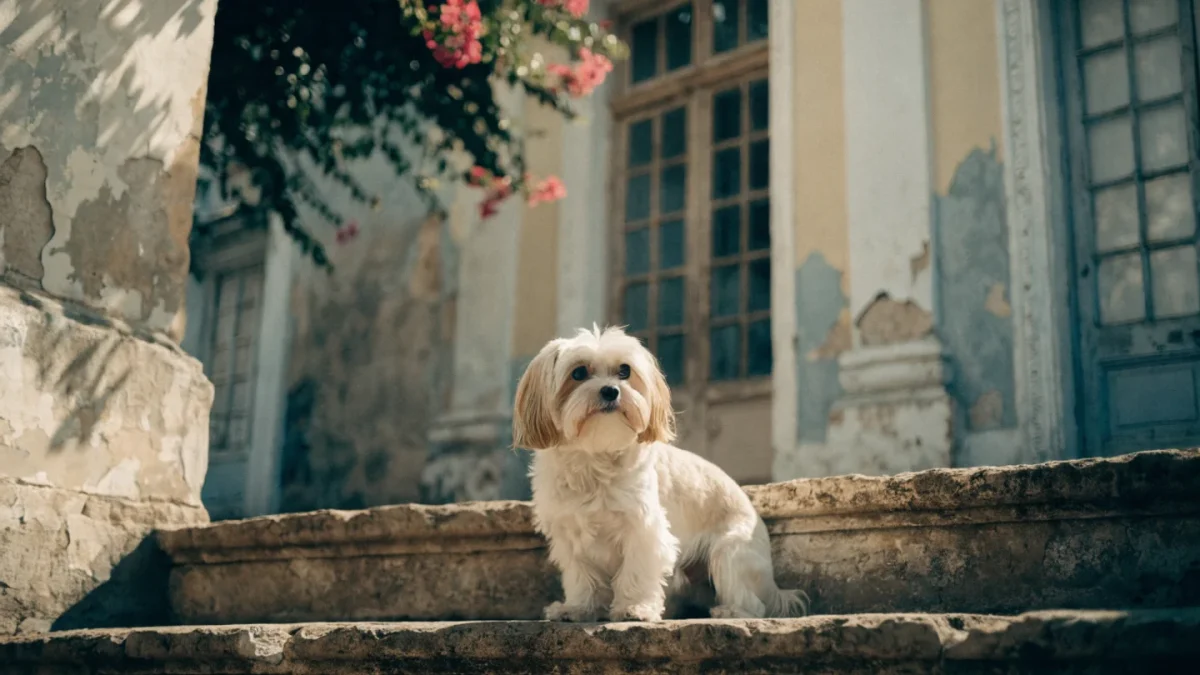
When Fidel Castro's revolutionaries swept into power in January 1959, the immediate consequences for Cuba were political, economic, and deeply human. The consequences for a small white dog breed that had spent three centuries in the parlors of Havana's elite were, in their own way, equally dramatic. Within a decade, the Havanese — Cuba's only native breed and arguably its most distinctive cultural export after cigars and music — was effectively erased from the country that created it. The havanese history origins cuba story is one of colonial luxury, political upheaval, desperate preservation, and one of the most improbable breed recoveries in canine history.
Mediterranean Roots
The Havanese didn't begin in Cuba. Its ancestors were small, white, long-coated companion dogs of the Bichon type — a family of breeds that originated around the Mediterranean basin and were widely traded by seafarers and merchants during the medieval and Renaissance periods.
The Bichon family tree includes branches that became the Bichon Frise (developed in France and Belgium), the Maltese (associated with Malta, though its exact origin is debated), the Bolognese (Italy), the Coton de Tulear (Madagascar), and the Lowchen (continental Europe). All share common ancestors: small companion dogs bred not for work, but for the social utility of being pleasant, portable, and hypoallergenic enough for indoor life alongside wealthy owners.
Spanish and Italian traders moved these dogs along Mediterranean shipping routes for centuries. When Spanish colonization of the Caribbean began in the late 1400s and early 1500s, companion dogs almost certainly traveled on the same ships as the colonists, administrators, and clergy who settled Cuba. The earliest documented presence of small companion dogs in Cuba dates to the 1500s — ship logs from Tenerife-bound vessels list dogs as passengers, and these Bichon-type dogs quickly became prized companions of the Spanish colonists — though precise records from the colonial period are sparse.
Three Centuries in Cuba
What happened next was a slow, unintentional breeding program driven by geography and climate.
Cuba's isolation from Europe meant that the Bichon-type dogs on the island bred primarily among themselves. There was no regular influx of European breeding stock to maintain conformity with continental types. Over generations — perhaps 10 to 15 generations per century for a small breed — the Cuban dogs diverged from their Mediterranean ancestors.
The tropical climate drove the most visible adaptation: the coat. European Bichon types generally carry a dense, curly, insulating coat suited to temperate climates. The Cuban dogs developed a lighter, silkier coat texture — still double-coated, but with a more open, flowing structure that allowed better heat dissipation. The coat could be profuse without causing overheating, making it both visually striking and functionally appropriate for a Caribbean environment.
Body proportions shifted slightly too. The Havanese developed a build that's fractionally longer relative to height compared to most Bichon relatives, and a unique gait — a springy, slightly rolling movement — that breed enthusiasts consider one of its defining physical characteristics. Whether this gait reflects selection, genetic drift, or some adaptation to the dogs' environment is unclear, but it's consistently present in the breed today.
By the 1700s, the Havanese was firmly established as the companion dog of Cuba's colonial aristocracy. Havana's wealthy families kept them as house pets and status symbols. The dogs appeared in Cuban art, were mentioned in travelers' accounts, and occasionally made their way back to Europe as gifts or curiosities. Charles Dickens owned a Havanese named Tim, beloved by his seven children, and he wrote about his "Cuba Shock-dog" in correspondence. Queen Victoria owned two Havanese named Chico and Goliath, documented in the Royal Collection Trust. Whether those specific claims hold up to scrutiny, the breed's presence in European aristocratic circles during the 1800s is well documented.
By the mid-1800s, the Havanese had also begun moving beyond the aristocracy in Cuba. Middle-class families adopted the breed, and it became broadly identified with Cuban cultural identity rather than exclusively with wealth. The dog's association shifted from "accessory of the rich" to "Cuba's dog" — a transition that would make its fate after 1959 both more poignant and more complicated.
The Revolution and Its Aftermath
The Cuban Revolution of 1959 didn't target a dog breed, obviously. But its economic and social upheavals dismantled the structures that had sustained Havanese breeding for three centuries.
The wealthy families who had maintained the breed's largest and most carefully managed populations were the same families most likely to flee — to Miami, to New York, to Spain. Some brought their dogs. Many could not. The logistical reality of fleeing a revolution — often quickly, with limited baggage allowances and uncertain destinations — left little room for bringing pets, particularly in an era when international animal transport was far more complicated and expensive than it is today.
On the island itself, the breed's association with the pre-revolutionary elite made it politically unfashionable. Organized breed clubs and breeding programs did not survive the cultural shift. The Havanese didn't disappear from Cuba entirely — small, unregistered populations persisted — but structured breeding effectively ended. Without deliberate breeding programs, the remaining dogs were crossed with other small breeds and strays, and the distinct Havanese type blurred.
In the United States, the Havanese population was tiny and scattered. A handful of Cuban exile families had their dogs, but there was no breed community, no registry, and no coordinated effort to maintain a breeding population. The dogs were family pets, not breeding stock, and most were not reproducing.
Dorothy Goodale and the Eleven
The breed's survival story pivots on one person: Dorothy Goodale, a Colorado-based dog enthusiast who became aware of the Havanese in the mid-1970s. Through classified advertisements, breed contacts, and direct outreach to Cuban exile communities — primarily in Florida — she identified the remaining Havanese in the United States.
The count was devastating: eleven documented dogs. Some accounts cite slightly different numbers — the most commonly cited figure across breed sources is eleven dogs from three unrelated bloodlines — but the magnitude of the bottleneck is not disputed. A breed that had numbered in the thousands on a single island was reduced to a number you could count on two hands.
Goodale acquired several of these dogs and began a deliberate breeding program aimed at rebuilding the breed from its genetic minimum. The challenges were substantial. With eleven founders — and not all of them unrelated — the mathematical constraints on genetic diversity were severe. Every mating decision had to balance the need for population growth against the risk of inbreeding depression.
The early breeders used what diversity existed and bred carefully, tracking pedigrees with precision and gradually expanding the population. The Havanese Club of America, founded in 1979, provided organizational structure for the effort. New dogs were occasionally identified — a Havanese brought from Cuba through a third country, a dog found with a family that hadn't been located in the initial search — and each addition to the gene pool was significant.
Recognition and Growth
The breed's path to recognition was steady but not rushed. The American Kennel Club added the Havanese to its Foundation Stock Service in 1996, and the breed became eligible for full registration and competition in the Toy Group the same year. This recognition opened the door to broader visibility, and the breed's population began growing rapidly.
By the early 2000s, the Havanese was one of the fastest-growing breeds in registration numbers. The combination of small size, low shedding, trainable temperament, and good health made it attractive to a demographic that was increasingly urban, apartment-dwelling, and looking for companion dogs compatible with smaller living spaces. The breed entered the top 25 in popularity and has remained there.
That growth brought the expected tensions. More demand meant more breeding, and not all new breeders shared the founding generation's commitment to genetic diversity and health screening. The havanese temperament that made the breed appealing also made it commercially viable, and commercial viability always attracts operations that prioritize volume over quality.
The founder-effect genetics remain measurable. Studies of Havanese population genetics show lower heterozygosity than breeds with larger founding populations, and certain health conditions — notably heritable cataracts, progressive retinal atrophy, and liver shunts — appear at elevated rates in the breed, consistent with founder-effect genetics amplifying deleterious recessive alleles. Responsible breeding programs actively work to maximize diversity by consulting coefficient-of-inbreeding databases before making breeding decisions.
Cuba's National Dog Today
In Cuba, the Havanese has experienced its own revival, though the details are harder to document. Dogs matching the Havanese type still exist on the island, and there has been renewed interest in preserving and recognizing the breed as part of Cuban cultural heritage. Some breeders outside Cuba have explored importing Cuban-lineage dogs to broaden the gene pool, though the logistical and regulatory barriers are significant.
The Havanese is recognized as Cuba's national dog — Cuba's only native breed — a designation that acknowledges its unique place in the country's cultural history. Whether the dogs on the island today represent a continuous, unbroken lineage from pre-revolutionary stock or a population that has been influenced by crosses with other breeds during the decades without organized breeding is an open question — and one that DNA analysis could potentially answer.
What the History Tells Us
The complete havanese breed guide covers the practical implications of the breed's genetics and bottleneck history. But the history itself reveals something broader about what the Havanese is and why it behaves the way it does.
This is a breed shaped by companionship pressure more consistently and for longer than almost any other. Three centuries of selection in Cuban parlors produced a dog that prioritizes human proximity above everything else. The temperament wasn't an accident of modern breeding — it was the entire point, reinforced over hundreds of generations.
The near-extinction also produced a breed community that, at its best, treats stewardship seriously. The people who saved the Havanese did it with eleven dogs and no guarantee of success. That founding story — desperate, deliberate, and ultimately successful against improbable odds — shapes how responsible Havanese breeders think about their obligations today. They're maintaining something that was very nearly lost, and the memory of how close the breed came to disappearing is part of the breed's living culture.
Eleven dogs. That's what stood between the Havanese and extinction. Everything the breed is today — every silky coat, every lap-seeking impulse, every tail arched over a cheerful back — traces back to that handful of survivors and the people who refused to let them be the last.