

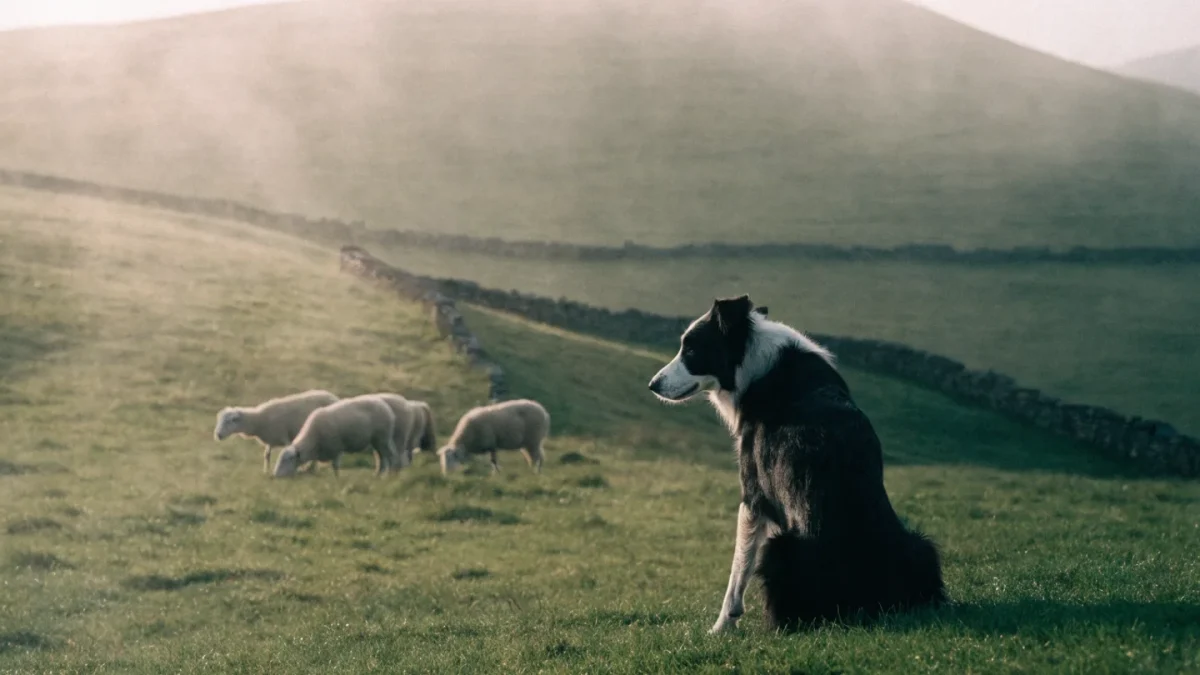
On a September day in 1893, a puppy was born on Adam Telfer's farm near West Woodburn, Northumberland. The puppy's sire was a dog named Roy, a rough-coated black and tan. His dam was Meg, a strong-eyed, black-coated female from the Scottish side of the border. The puppy was tricolor — black, white, and tan — and unremarkable in appearance. His name was Hemp.
Within a year, Adam Telfer knew he had something different. Hemp didn't work sheep the way other dogs did. Where most sheepdogs of the era relied on barking, rushing, and physical confrontation to move livestock, Hemp dropped into a low crouch and controlled sheep with nothing more than the intensity of his stare. Sheep moved for him without panic, without scattering, without the chaos that plagued most herding encounters. He was quiet, precise, and effective in a way that made every other sheepdog on every neighboring farm look clumsy by comparison.
This is the border collie history origins herding story — and it begins not with a breed registry, a kennel club, or a show ring, but with a single working dog on a Northumberland hill farm who was so good at his job that an entire breed crystallized around his bloodline.
Before Hemp: The Ancient Herding Dogs of Britain
The relationship between humans, dogs, and sheep in Britain predates written records by millennia. Herding dogs of various types have worked alongside shepherds in the British Isles since at least the Roman era, and likely earlier. The specific ancestors of the border collie, however, arrived with the Vikings.
Norse and Scandinavian settlers who migrated to Britain between the 8th and 11th centuries are traditionally credited with bringing spitz-type herding dogs adapted to the cold, mountainous terrain of Scandinavia — the standard telling has these dogs interbreeding with existing British herding types over several centuries to produce regional landrace populations. I'll flag it plainly: that's the account handed down through breed histories, but I haven't found a genetic study that actually confirms the Scandinavian contribution. What's well-documented is the landrace populations themselves — dogs that shared general working characteristics but were not a standardized breed in any modern sense.
The word "collie" itself is likely rooted in Scots dialect. The most widely cited etymology connects it to the Scots word for sheepdog, though competing theories link it to "colley" (black-faced sheep common in the Scottish Highlands) or to the Anglo-Saxon word "col" meaning black. Regardless of the word's precise origin, by the 18th century, "collie" was the common term for working sheepdogs throughout Scotland and northern England.
What these pre-Hemp herding dogs looked like and how they worked varied enormously by region. In the Scottish Highlands, dogs tended toward larger, rougher-coated types suited to brutal winters and vast distances. In the lowland border country — the rolling hills between Northumberland and the Scottish Borders — a different type emerged: medium-sized, agile, and increasingly defined by a working style that favored eye contact over physical confrontation.
The Revolution of Old Hemp
Adam Telfer was not a gentleman breeder or a theorist. He was a working shepherd who needed functional dogs. When Hemp demonstrated his exceptional abilities, Telfer did what any practical farmer would do — he bred the dog to every good female he could access and offered Hemp's services to neighboring farms.
The demand was immediate and intense. Shepherds across the border region recognized that Hemp's quiet, eye-based method produced better results with less stress on the sheep. Stressed sheep lose weight. Panicked sheep injure themselves on fences and stone walls. A calm, controlled gather meant healthier livestock and more efficient farm operations. The economic argument for Hemp's style was as compelling as the aesthetic one.
Old Hemp sired over 200 puppies before his death in May 1901. His working method bred true with remarkable consistency — a large proportion of his offspring displayed the same low crouch, the same intense eye, the same quiet authority over livestock. Within a single generation, Hemp's bloodline dominated the working sheepdog population across northern England and southern Scotland.
Three of Hemp's descendants — Sweep, Don, and Lad — were particularly influential in establishing distinct working lines that persist in modern border collie pedigrees. The concentration of Hemp's genetics in the founding population of the breed is significant — virtually every registered border collie today can trace its ancestry back to him.
The Rise of Sheepdog Trials
The formalization of sheepdog work into competitive trials was the mechanism that transformed a regional working type into a recognizable breed. The first recorded sheepdog trial took place at Bala, Wales, in 1873 — twenty years before Hemp was born. These early events were informal competitions between local shepherds, but they established a critical principle: dogs would be judged on working performance, not appearance.
The International Sheep Dog Society, founded in 1906 by shepherds and farmers in Scotland and northern England, standardized trial rules and created the first stud book for working sheepdogs. The ISDS stud book was — and remains — a performance registry. A dog is registered based on its parentage and working ability. There is no physical standard, no size requirement, no color specification, and no conformation judging.
This distinction shaped the border collie in ways that still define it. For over a century, the breed's gene pool was managed by farmers and shepherds selecting for one thing: the ability to move sheep efficiently, calmly, and over long distances in difficult terrain. Every other characteristic — size, coat, color, ear set — was incidental. If the dog worked well, it was bred. If it didn't, it wasn't. The ruthless simplicity of working selection produced a breed optimized for cognitive and physical performance to a degree that few other breeds can match.
The ISDS Supreme Championship, first held in 1906, became the proving ground for the breed's best working dogs. Winners of the Supreme earned enormous demand as stud dogs, concentrating successful working genetics in subsequent generations. The trial system also spread the breed geographically — shepherds from Wales, Ireland, and eventually other countries attended trials, observed the best dogs, and brought border collie genetics back to their home regions.
The Naming and Formal Recognition
For decades, the dogs that would become border collies were called simply "working sheepdogs," "trial dogs," or regional names like "Northumberland collies." The name "border collie" was first used formally in 1915 by James Reid, secretary of the ISDS, to distinguish the specific working type from the border region from other collie varieties — the Rough Collie (already famous as the "Lassie" dog), the Smooth Collie, and the Bearded Collie.
As discussed in the complete border collie breed guide, the breed's identity has always been defined by function rather than form. This created an unusual dynamic when kennel clubs began recognizing the border collie for conformation showing. Many working border collie enthusiasts fiercely opposed kennel club recognition, arguing that physical breed standards would inevitably compromise working ability. This tension between working and show lines persists today and has measurably influenced the breed's trajectory.
The breed gained recognition from major kennel clubs at different times: the UK Kennel Club in 1976, the FCI in 1987, and the American Kennel Club — the last of the major bodies to sign on, and the one that generated the most working-community backlash — not until 1995.
Global Spread
Border collies left Britain primarily through the sheep farming industry. Wherever sheep were raised in large numbers on challenging terrain, border collies followed.
Australia became a major secondary center for the breed during the early twentieth century. The vast sheep stations of Australia — some covering hundreds of thousands of acres — demanded dogs that could work enormous distances independently. Australian farmers imported border collies directly from top ISDS working lines and, in some cases, developed their own regional working styles. The relationship between British and Australian border collie lines remains close, with genetics flowing in both directions through working dog trials.
New Zealand, South Africa, and North America also established significant working border collie populations during this period. In each region, the dogs were valued for the same fundamental capability: the ability to manage livestock over difficult terrain with minimal handler intervention.
The breed's expansion into non-agricultural roles accelerated in the second half of the twentieth century. Border collies entered competitive obedience, agility, and flyball — sports that rewarded the same attributes that made them exceptional herding dogs. Their dominance in agility competition is particularly notable; border collies have won the majority of top-level agility championships worldwide.
The Ongoing Tension: Working Dog vs. Show Dog vs. Sport Dog
The border collie exists today as three partially overlapping populations: working farm dogs, conformation show dogs, and sport/companion dogs. These populations share ancestry but are increasingly divergent in both physical appearance and behavioral intensity.
Working border collies, registered primarily through the ISDS and its affiliated societies, remain under working selection. Breeders prioritize herding ability, stamina, and temperament. The dogs vary in appearance because appearance was never the selection criterion.
Show-bred border collies, bred to conform to kennel club physical standards, tend toward heavier coats, more uniform appearance, and in some cases, a somewhat reduced herding drive — though plenty of show-bred border collies retain strong working instincts. The border collie temperament in show lines is generally described as slightly less intense than in dedicated working lines, though individual variation is enormous.
Sport-bred border collies — dogs selected for agility, flyball, or disc dog competition — represent a newer but growing population. These dogs are often selected for physical speed, reactivity, and handler focus in ways that differ from both traditional herding selection and conformation standards.
The tension between these populations, particularly around the question of border collie genetics and inherited traits, is unlikely to resolve anytime soon. The ISDS has historically maintained that the border collie is a working breed first, and that any standard not rooted in working ability risks diluting the breed's defining characteristics. Kennel clubs counter that structured breed standards protect the breed's long-term health and consistency. Both positions have merit. The dogs, as always, are caught in the middle.
Frequently Asked Questions
Who was Old Hemp and why does he matter?
Old Hemp (1893-1901) was a tricolor working sheepdog born on Adam Telfer's farm in Northumberland, England. He revolutionized sheep herding by controlling livestock through a silent, crouching approach and intense eye contact rather than the barking and physical methods common at the time. He sired over 200 puppies, and his working style bred true so consistently that he is considered the progenitor of the modern border collie breed. Virtually every registered border collie alive today descends from him.
When did border collies become a recognized breed?
The border collie's development as a distinct breed type began in the late 19th century, with the name "border collie" first used formally in 1915. However, the breed was defined by working registries (the ISDS stud book, established 1906) long before kennel club conformation recognition. The breed spent most of its history as a working type defined by performance rather than physical standards.
Are modern border collies different from the original working dogs?
Working-line border collies remain remarkably true to the breed's original function — they are still bred primarily for herding ability and are tested in sheepdog trials with formats largely unchanged since the early 1900s. Show-bred and sport-bred border collies have diverged somewhat in physical type and behavioral intensity, though all three populations share the same fundamental ancestry and core traits. The most significant difference is between dogs under active working selection and those bred primarily for appearance or sport performance.