

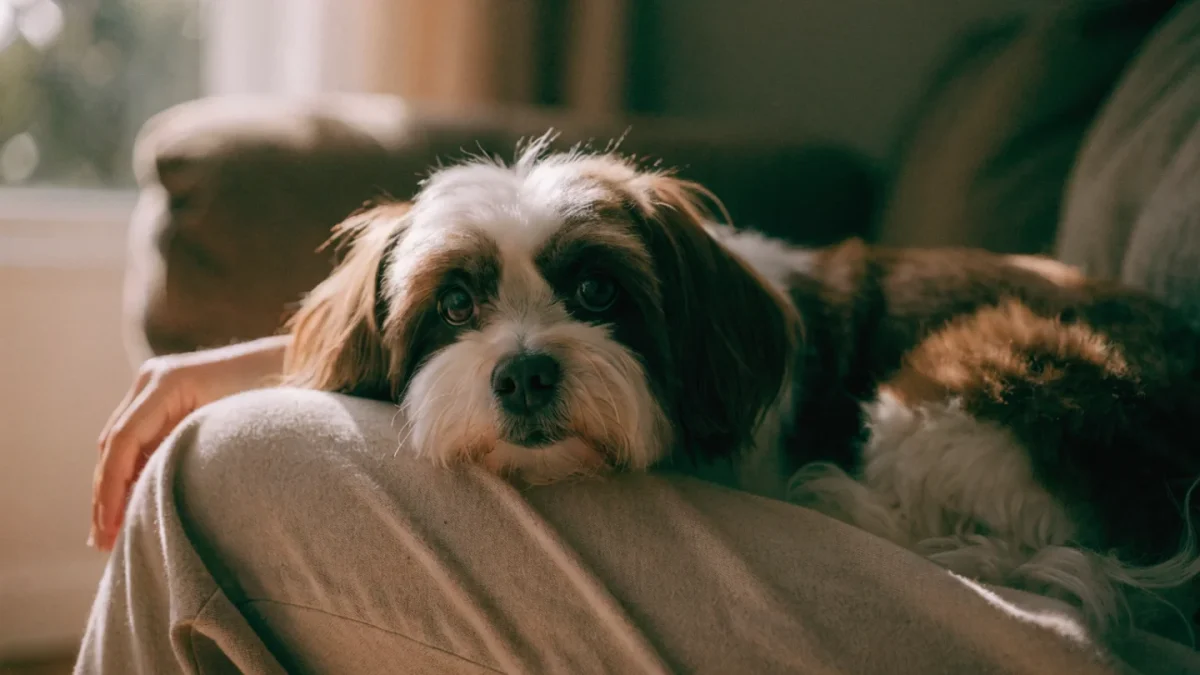
In the 1700s, Havanese didn't just sit in Cuban aristocrats' laps — they traveled there by carriage. Historical accounts from colonial Havana describe wealthy families bringing their small companion dogs to social gatherings, the theater, and church services, carried on cushions or tucked into the crook of an arm. The breed spent three centuries being selected for exactly one job: staying as close to a person as physically possible. Understanding havanese temperament personality starts with understanding that this isn't learned behavior. It's bred in.
The Havanese belongs to the Bichon family of companion breeds, but within that group, it occupies a specific niche. Where the Bichon Frise is the performer — bouncy, showy, energetic with everyone — the Havanese is the confidant. It picks its people, attaches deeply, and builds its emotional life around that inner circle. This creates a temperament that's simultaneously one of the breed's greatest appeals and its most demanding characteristic.
The Velcro Effect
The nickname "Velcro dog" appears in almost every Havanese description, and it's earned. A typical Havanese follows its primary person from room to room. Not trailing behind at a distance — shadowing. If you sit down, the dog is on your lap or against your leg within seconds. If you move to the kitchen, it's already there. If you close the bathroom door, it's waiting outside, and it knows exactly how long you've been in there.
This isn't anxious hovering in most cases. It's contentment-seeking. The Havanese is happiest in physical contact with its person, and it will quietly arrange its entire day around maintaining that contact. It's a behavior pattern so consistent across the breed that owners who've had other dogs first often describe it as a fundamentally different relationship — less "pet and owner" and more "companion who happens to be a dog."
The practical reality: you will not have personal space with a Havanese. You'll sit down and find a dog in your lap. You'll work at your desk and feel a chin resting on your foot. You'll go to bed and discover a small body has already claimed the warm spot. For people who find that appealing, it's one of the best things about the breed. For people who need physical boundaries with their animals, it's exhausting.
Attachment Versus Anxiety
Here's a distinction that matters: strong attachment is not the same as separation anxiety, though one predisposes to the other.
A well-adjusted Havanese bonds intensely and prefers to be with its people but can tolerate reasonable periods alone — an hour or two, sometimes more — without distress. It might not love it, but it manages.
A Havanese with separation anxiety cannot tolerate absence at all. The response escalates beyond preference into genuine distress: sustained vocalization, destructive behavior, pacing, trembling, house-training regression. The dog isn't acting out for attention. It's experiencing something closer to panic.
Separation anxiety is more common in Havanese than in most breeds, and that's a direct consequence of the temperament the breed was selected for. When you spend centuries breeding a dog to be inseparable from a person, you're also breeding a dog that experiences separation as abnormal and threatening. Not every Havanese develops clinical separation anxiety, but the predisposition is there, and management starts in puppyhood.
Early conditioning helps. Gradually acclimating a Havanese puppy to brief, calm departures — building tolerance in small increments rather than forcing extended isolation — reduces the likelihood of full-blown anxiety developing later. Crate training, when done correctly, provides a secure space. But the foundation is the breed's daily reality: a Havanese that gets enough companionship and presence in its routine is better equipped to handle the moments when it doesn't.
Intelligence and Trainability
The Havanese is smarter than most people expect from a toy breed. This is one of the genuinely underappreciated aspects of the temperament.
In structured learning environments, Havanese pick up new behaviors quickly — often within a few repetitions. They're responsive to positive reinforcement, read human body language with notable accuracy, and show a problem-solving capacity that exceeds the typical companion-breed profile. They've competed successfully in agility, rally obedience, and scent work at organized levels, which would surprise anyone who thinks of them as purely ornamental.
The trainability comes with a personality, though. Havanese are not the eager-to-comply, handler-focused workers that border collies or golden retrievers are. They learn fast, but they also have opinions about whether a particular exercise is interesting enough to repeat. Ask a Havanese to do something it finds boring, and you'll get a polite but unmistakable disengagement — the dog understands the command, acknowledges you've given it, and chooses to do something else. This isn't defiance. It's a companion breed's version of independent judgment.
The most effective approach is variety. Short training sessions — five to ten minutes — with frequent changes in what's being asked keep a Havanese engaged. Repetitive drilling kills motivation in this breed faster than in almost any other.
Social Behavior
With People
Havanese show more variation in stranger-response than breed profiles typically acknowledge. Some are immediately friendly with everyone who enters the home. Others are reserved — not fearful, not aggressive, but clearly evaluating new people before engaging. Both responses fall within normal breed temperament.
The common thread is that the Havanese distinguishes between its inner circle and everyone else. It may be perfectly pleasant with strangers, but the depth of engagement is reserved for its people. This is different from a breed like the Cavalier King Charles Spaniel, which tends to treat every human with roughly equal enthusiasm. The Havanese has favorites, and it's not subtle about it.
With Other Dogs
Havanese are generally non-aggressive with other dogs and often actively enjoy canine companionship. In multi-dog households, they tend to integrate smoothly — partly because they're non-confrontational by nature, and partly because their primary social interest is focused on humans rather than on jockeying for status with other dogs.
Some Havanese can be initially cautious with unfamiliar dogs, particularly larger ones. This is reasonable caution from a 5-kilogram animal, not a temperament flaw. Given time and a non-threatening introduction, most warm up readily.
With Children
The Havanese's patience and playfulness make it a plausible family dog, but the breed's small size introduces a physical vulnerability that limits the match. A Havanese can do well with older children who understand gentle handling. With toddlers and very young children, the risk of accidental injury to the dog is real — dropped, stepped on, squeezed too hard. Supervision is mandatory, and families with very young children should consider whether a sturdier breed might be a safer choice for everyone involved.
The complete havanese breed guide covers family compatibility in more detail.
What Most People Get Wrong
The misconception I hear most often: "Havanese are just cute little dogs with no depth."
People see the silky coat and the toy-breed size and assume the personality is similarly lightweight — sweet but shallow, affectionate but not complex. That undersells what's actually happening between a Havanese's ears.
This is a breed that reads emotional tone in a room, adjusts its behavior based on its owner's mood, learns routines by observation, and forms relational preferences that are consistent and sophisticated. A Havanese knows who in the household is most likely to share food, who gives the best belly rubs, and who is most susceptible to the "I haven't been fed yet" face at 5 a.m. They're manipulative in the most charming possible way — and they're good at it because they pay attention.
The second misconception is that the Havanese temperament is uniform. "They're all Velcro dogs" oversimplifies meaningful individual variation. Some Havanese are confident extroverts. Others are quiet, observant, and take weeks to fully trust a new person. Some are playful well into old age. Others settle into calm companionship early. The breed's Cuban history and development produced a wider behavioral range than most toy breeds, precisely because it drew from a relatively diverse founding population before the bottleneck of the 1970s. Readers comparing within the Bichon family — particularly those deciding between the Havanese and its closest relative — will find the Bichon Frise breed guide a useful reference for understanding where the two breeds' temperaments converge and where they diverge.
The Right Temperament Match
The Havanese temperament fits best with people who want emotional reciprocity from their dog — not just coexistence, but active, daily companionship where the dog is a participant in your life rather than a bystander.
If you value a dog that's tuned into your emotional state, that's physically present without being hyperactive, that's clever enough to keep things interesting but not so driven that it needs constant stimulation — the Havanese offers something that very few breeds do. It's a companion in the oldest, most literal sense of the word.
If you want independence, if you travel frequently without your dog, or if you find intense attachment stifling rather than endearing, this breed will frustrate you. The Havanese didn't survive near-extinction by being casual about its people. It survived because Cuban families loved it enough to carry it across an ocean — and that level of mutual attachment is exactly what the breed still demands.