

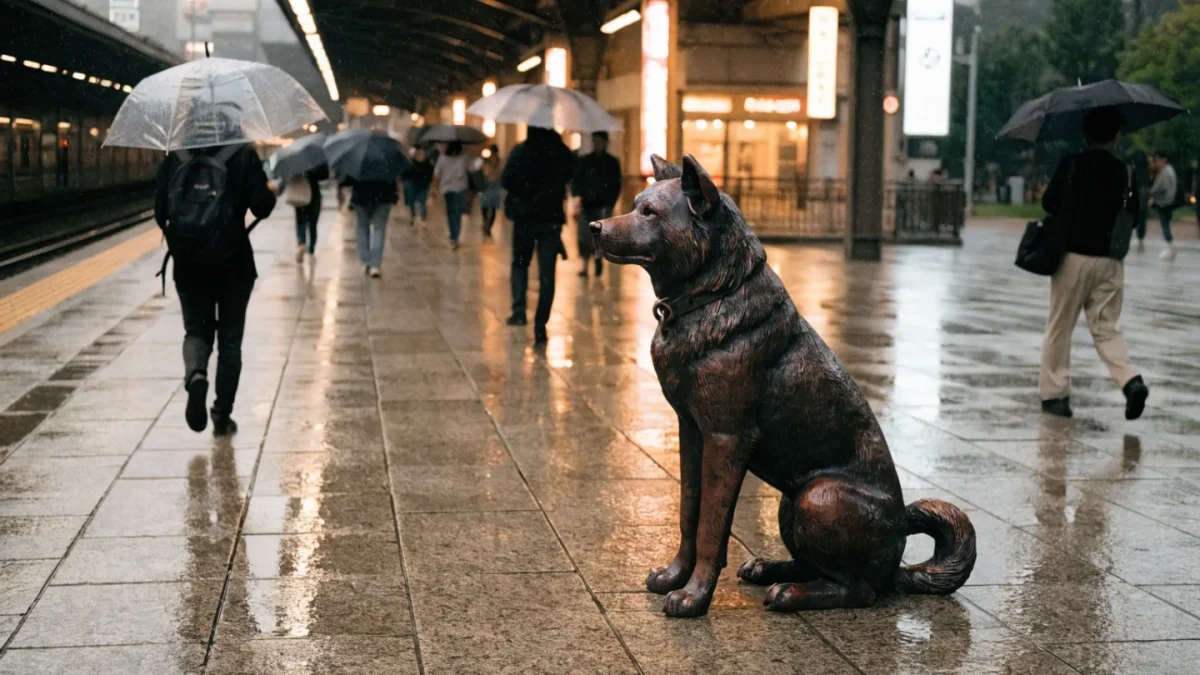
On March 8, 1935, a scruffy, aging Akita was found dead on a street near Shibuya Station in Tokyo. He had been coming to that station nearly every day for nine years, nine months, and fifteen days — waiting for a man who would never return. The dog's name was Hachiko, and by the time he died, he had become the most famous dog in Japanese history. A bronze statue had already been erected in his honor at the station the previous year. His story had been taught in schoolbooks. He had been declared a national symbol of loyalty.
But the Akita's history stretches centuries before Hachiko sat at that station, and understanding akita history hachiko japan origins requires going back to the snow-covered mountains of northern Honshu, where a very different kind of dog served a very different purpose.
The Matagi Hunters
The Matagi are an indigenous hunting people of northern Japan whose traditions predate recorded Japanese history. They hunted in the dense mountain forests of the Tohoku region — particularly in what is now Akita Prefecture — pursuing bear, wild boar, and Japanese serow through some of the harshest winter conditions in the country.
Their hunting dogs, the Matagi-inu, were medium-sized spitz-type animals built for the specific demands of this work. They needed the physical power to corner a bear and the courage to hold it at bay. They needed the independence to work at distance from the hunter, making decisions without waiting for commands. They needed a dense double coat that could withstand temperatures that regularly dropped well below freezing. And they needed the endurance to work all day in deep mountain snow.
These dogs were not pets. They were working partners in a dangerous livelihood, and the Matagi selected them ruthlessly for function. Dogs that lacked courage, stamina, or the independent judgment required for bear-baiting didn't reproduce. Over centuries, this selection pressure produced an animal with the core traits that still define the Akita: physical power, fearless independence, and unwavering commitment to its working relationship with humans.
Samurai Status
During the Edo period (1603-1868), the political and social structure of Japan changed the Akita's role. The feudal class system placed the samurai at the top of the social hierarchy, and dogs associated with the warrior class became status symbols. Akitas transitioned from mountain hunting dogs to guardians of the nobility — a role that refined the breed's protective instincts and deepened its association with loyalty and honor in Japanese culture.
Dog ownership became regulated. Elaborate rituals governed how Akitas were fed, housed, and addressed. Special leashes and feeding ceremonies developed around the breed. The dogs lived in a world of formalized devotion — both the devotion they gave and the devotion they received.
This period also introduced a darker chapter. Dog fighting became popular in the Akita region, and breeders began crossing native Akita-type dogs with larger imported breeds to produce more formidable fighting dogs. Tosa Inu, a Japanese fighting breed, were among the early crosses. Later, Western breeds including Great Danes, German Shepherds, and Saint Bernards were introduced. These crosses increased size and fighting capacity but diluted the original Matagi type considerably.
By the late 1800s, the dogs in Akita Prefecture bore limited resemblance to their Matagi ancestors. They were larger, more varied in appearance, and shaped as much by fighting selection as by hunting utility.
Near-Extinction
World War II nearly ended the Akita as a breed.
In 1944, the Japanese government ordered the culling of all non-military dogs. Food shortages made feeding pets unsustainable. Disease spread through the domestic dog population. And the military requisitioned dog pelts for winter clothing — leather from dog hides was used for military uniforms and equipment. The order exempted German Shepherds, which were classified as military working dogs.
Some Akita owners hid their dogs in remote mountain locations, returning to the breed's geographic origins as a means of survival. Others crossed their Akitas with German Shepherds to classify them as military dogs and exempt them from the cull. Both strategies saved individual dogs but further complicated the breed's genetic identity. By the war's end, the purebred Akita population had been devastated. According to Japanese breed preservation records, as few as 18 purebred Akita Inu were documented as having survived the war — though some accounts put the number even lower. The breed's survival depended on concerned breeders who had hidden their dogs in remote mountain villages with hunters and farmers in northern Japan.
The postwar rebuilding of the breed took two divergent paths — and that divergence created the two distinct Akita types that exist today.
Hachiko: The Dog Who Defined a Breed
No account of akita history hachiko japan origins can separate the breed from its most famous representative. Hachiko's story has been told countless times, but the details matter because they reveal something essential about the Akita temperament.
In 1924, Professor Hidesaburo Ueno of Tokyo Imperial University acquired an Akita puppy and named him Hachiko. Each day, Hachiko accompanied Ueno to Shibuya Station and returned in the afternoon to meet his train. On May 21, 1925, Ueno suffered a fatal cerebral hemorrhage at the university and never returned to the station.
Hachiko continued going to Shibuya Station every afternoon for the next nine years and nine months. The station's commuters first tried to shoo him away, then gradually recognized what was happening. Food vendors began feeding him. Railway workers built him a resting spot. Asahi Shimbun published his story in 1932, and he became a national sensation.
A bronze statue of Hachiko, sculpted by Teru Ando, was erected at Shibuya Station in 1934 — while the dog was still alive. Hachiko attended the unveiling ceremony. When he died the following year, his death was reported as national news. He was mourned across the country.
The statue was melted down for munitions during the war, but a replacement by Ando's son Takeshi was installed in 1948. It remains one of Tokyo's most visited landmarks, and Shibuya Station's Hachiko Exit is named in the dog's honor.
What Hachiko demonstrated was not unusual for an Akita. The akita temperament profile describes exactly this kind of attachment — singular, profound, and permanent. Hachiko's behavior was extreme in duration, but the underlying loyalty is characteristic of the breed. Akitas bond once and bond deeply. That bond doesn't require the person to be present to remain active.
Helen Keller and the American Introduction
Helen Keller visited Japan in 1937 and was deeply moved by the Hachiko story. She expressed a desire to own an Akita, and the Japanese government presented her with a puppy named Kamikaze-go from the Akita Prefecture. Kamikaze-go died of canine distemper within months of arriving in the United States. The Japanese government sent a second Akita, Kenzan-go — Kamikaze-go's littermate — and Keller raised him at her home in Connecticut.
Keller described Kenzan-go as "an angel in fur" and wrote publicly about the breed's character, introducing the Akita to an American audience for the first time. But Keller's dogs were not the beginning of the Akita's American story. They were more of a prologue. The real chapter began after the war.
Two Types, Two Paths
American servicemen stationed in Japan during the Allied occupation (1945-1952) encountered Akitas and brought dogs home. These soldiers gravitated toward the larger, heavier dogs — many of which were the product of wartime crossbreeding with German Shepherds and other Western breeds. The dogs they selected tended to have broader heads, heavier bone, and a wider range of coat colors than the pre-crossbreeding Akita type.
Meanwhile, Japanese breeders led by the Akita Preservation Society (AKIHO, founded in 1927) worked to restore the breed to its pre-crossbreeding Matagi type. They selected for the lighter frame, fox-like facial structure, and restricted color palette — red, brindle, white, and sesame — that characterized the original mountain dogs. The restoration was deliberate, disciplined, and in direct opposition to the trend toward larger, heavier dogs that American fanciers preferred.
The result was a breed that split along geographic and philosophical lines. The Japanese Akita Inu became more refined, more closely aligned with the original type, and more restricted in acceptable colors. The American Akita became larger, more diverse in color, and more heavily built. In June 1999, the FCI formally voted to split the breed into two separate standards — the Japanese Akita Inu and the "Great Japanese Dog" (later renamed American Akita in January 2006). The decision followed the 1996 World Akita Conference in Tokyo, where representatives of 14 countries concluded that the two types were sufficiently distinct to warrant separate classification. The United Kennel Club, the Kennel Club (UK), and most FCI-affiliated registries now recognize them as separate breeds.
The complete Akita breed guide details the physical and temperament differences between the two types. From a historical perspective, the divergence reflects a fundamental question that arises whenever a breed's form changes: which version is the "real" one? Japanese breeders would argue the original Matagi type. American breeders would argue the dogs have evolved and both types have legitimate claim to the name.
The answer, honestly, is that both camps have a point. The breed that emerged from the mountains of northern Japan was shaped by a specific purpose. The breed that emerged from postwar crossbreeding was shaped by different pressures. They share a common ancestor and a common name, and both carry the temperament core — the loyalty, the independence, the guarding instinct — that makes an Akita unmistakably an Akita.
Natural Monument Status
In 1931, the Japanese government designated the Akita as a Natural Monument under the Law for the Protection of Cultural Properties — one of seven native Japanese dog breeds to receive this classification, alongside the Shiba Inu, Kishu Ken, Shikoku Ken, Hokkaido Ken, Kai Ken, and the extinct Koshi-no-Inu. This designation placed the breed under cultural protection and reinforced the national effort to preserve the original type.
The Natural Monument designation was not merely symbolic. It provided institutional support for breed preservation efforts and ensured that the Akita's cultural significance was recognized alongside Japan's architectural and artistic heritage. In Japanese culture, the Akita represents loyalty, dignity, and courage — values deeply embedded in the national identity.
What History Tells Us About Today's Akita
Every behavioral trait that defines the modern Akita has a historical origin. The independence comes from centuries of working without handler direction in bear country. The guarding instinct comes from generations protecting the samurai class. The same-sex dog intolerance carries traces of the fighting era. The singular loyalty was visible in Hachiko and in countless Akitas before and since.
History doesn't excuse behavioral challenges, but it does explain them. An Akita that refuses to back down from another dog is not misbehaving — it's expressing a trait that was selected for over centuries. An Akita that evaluates your command before deciding to comply is not being stubborn — it's using the independent judgment that kept its ancestors alive in the mountains.
Understanding where the breed came from is the first step toward understanding what it needs from you.