

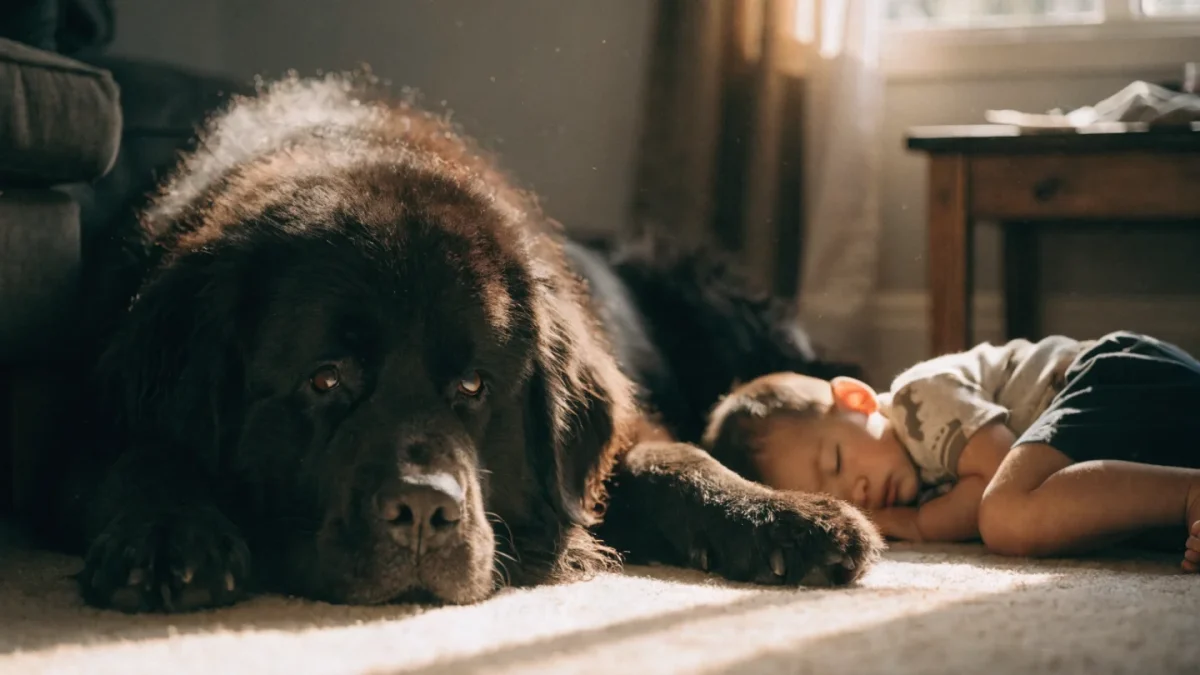
When J.M. Barrie wrote Peter Pan in 1904, he didn't choose the nursemaid dog Nana at random. Barrie based the character on his own Newfoundland, Luath, and on a very real tradition — wealthy families in Victorian England and North America kept Newfoundlands specifically as companions and guardians for their children. The breed's reputation for patience, protectiveness, and gentleness with small humans was already well established by the time Barrie put it on stage. He wasn't inventing a fantasy. He was documenting a fact.
Understanding the Newfoundland temperament means understanding a dog that was never bred for aggression, speed, or flash. Everything about this breed's personality traces back to a working relationship with fishermen who needed a dog that was powerful enough to haul nets in freezing water, calm enough to share a cramped boat for hours, and reliable enough to pull a drowning crewman to safety without panicking. Those selection pressures produced something remarkable — a giant dog with the emotional intelligence of a therapy animal and the physical capability of a marine rescue worker.
For a complete overview of the breed including health, grooming, and physical characteristics, see the full Newfoundland breed guide.
Calm Is Not the Same as Lazy
This distinction matters because it shapes every expectation about living with a Newfoundland. People see a 60 kg dog lying quietly on the floor and assume low energy. What they're actually seeing is a dog that conserves energy with purpose.
Newfoundlands were bred for a work rhythm of intense effort followed by rest — hauling a loaded net, then waiting on the boat until the next task. That pattern survives intact in the modern breed. A Newfoundland at rest is recharging, not disengaged. Put that same dog near water or present it with a situation that triggers its guardian instincts, and the transformation is immediate. The calm dissolves into focused, powerful action.
Indoors, this translates to a dog that's genuinely content to lie at your feet for hours. They don't pace, they don't demand constant attention, and they don't manufacture excitement when none exists. Compared to breeds like the Border Collie or Australian Shepherd — dogs that need constant occupation or they'll redesign your furniture — the Newfoundland's baseline state is profoundly relaxed. But mistake that relaxation for inability, and you'll be surprised when your "lazy" dog drags a full-grown adult out of a lake.
Protectiveness Without Aggression
Newfoundlands are protective, but they express it differently from guarding breeds like German Shepherds or Rottweilers. A Newfoundland doesn't bark warnings at strangers or adopt aggressive postures. Instead, they position themselves. They'll place their body between their family and an unfamiliar person. They'll stand up and move forward when someone approaches a child. They'll lean into you when they sense you're uneasy.
This is a physical, spatial form of protection rather than a vocal or confrontational one. Most strangers find it more impressive than intimidating — a 60 kg dog that silently steps between you and the door has a persuasive presence without doing anything overtly threatening.
That said, Newfoundlands are not guard dogs in any conventional sense. They rarely bark at visitors, they typically warm up to new people within minutes, and their default response to the unfamiliar is cautious curiosity rather than suspicion. If you need a dog that will aggressively deter intruders, this breed will disappoint you. If you need a dog whose sheer presence makes people think twice, that it delivers effortlessly.
Behavior with Children
The Newfoundland's patience with children is not a casual trait — it's one of the most consistent behavioral features of the breed. They tolerate ear-pulling, climbing, accidental rough handling, and the general chaos that small children produce with a level of forbearance that astonishes even experienced dog owners.
Part of this comes from their pain threshold, which is high. Part comes from the breed's overall non-reactive temperament — Newfoundlands don't startle easily, don't respond to sudden movements with snapping, and don't have the hair-trigger prey drive that makes some breeds unreliable around fast-moving children. And part of it appears genuinely instinctive — many Newfoundland owners report that their dogs actively seek out children, position themselves near them during play, and intervene (gently) when play gets rough between kids.
None of this eliminates the need for supervision. A dog this size can inadvertently injure a small child simply by standing up, turning around, or wagging its massive tail. And no breed's temperament guarantees safety — individual dogs vary, and every dog has limits. But as a breed generalization, Newfoundlands have earned their reputation as one of the most trustworthy breeds around children.
Social Dynamics with Other Animals
Newfoundlands typically get along well with other dogs. They're not competitive, they don't resource guard intensely, and they rarely initiate conflict. Their sheer size means that most other dogs defer to them naturally, which reduces the social friction that drives inter-dog aggression. When conflict does occur, Newfoundlands are more likely to walk away than escalate.
With cats and smaller animals, the picture is similarly stable. Newfoundlands have low prey drive compared to terriers, sighthounds, or herding breeds. They can coexist with cats — especially when introduced during puppyhood — and generally ignore small animals rather than pursuing them. Individual exceptions exist, but the breed tendency is toward tolerance.
Multi-dog households that include a Newfoundland often find that the Newfoundland becomes the stabilizing presence — the dog that other dogs orient around rather than conflict with. There's a reason the breed's nickname in some communities is "the gentle giant." It's not because they're passive. It's because they choose not to fight.
Separation Anxiety and Attachment
Newfoundlands bond deeply and don't handle isolation well. This is not a breed you can leave alone for 10 hours while you work and expect to find a happy, well-adjusted dog when you return. Extended solitude produces anxiety in Newfoundlands, which manifests as destructive behavior, excessive barking (unusual for the breed), drooling beyond normal levels, and depression.
They follow their people from room to room. They position themselves in doorways and hallways — central locations where they can monitor household movement. They lean against your legs. They rest their enormous heads on your lap. This is a contact-oriented breed that expresses affection physically and constantly.
For single-person households or families where everyone is away during the day, a second dog can help buffer the Newfoundland's need for companionship. But a companion animal is a supplement, not a substitute. Newfoundlands want their humans, specifically and personally.
Water Instincts and Rescue Drive
The water rescue instinct in Newfoundlands is not a trained behavior — it's genetic. Dogs that have never been near open water will, on first exposure, swim out to people and attempt to tow them toward shore. They grab arms, clothing, ropes, or anything else that provides a grip. Some will circle a swimmer and position themselves as a floating platform.
This instinct has practical implications for daily life. Newfoundlands will enter any accessible water — pools, ponds, lakes, puddles of sufficient depth, and occasionally bathtubs — without permission. They may attempt to "rescue" children or adults who are swimming perfectly fine. At the beach, they may wade in and refuse to come out. This is the breed doing what it was designed to do, and managing it requires understanding rather than frustration.
For the historical context behind how centuries of water work shaped these instincts, see the history of the Newfoundland breed.
The Quiet Factor
One of the most underappreciated aspects of the Newfoundland temperament is how quiet they are. This is not a barky breed. Newfoundlands vocalize infrequently compared to most dogs their size — or any size. They'll bark at genuine disturbances, but they don't alarm-bark at every passing car, every squirrel, or every doorbell on television.
The silence is partly a function of confidence. Dogs that bark excessively are often anxious, insecure, or over-stimulated. Newfoundlands, as a breed, are none of those things under normal circumstances. Their default emotional state is calm assurance, and calm dogs don't need to announce themselves.
For households in shared-wall living situations, this is a meaningful advantage. A 60 kg dog that barks constantly would be unlivable in an apartment. A 60 kg dog that barely vocalizes is merely impractical for other reasons. Some Newfoundland myths, including the "lazy" label, are addressed in our common misconceptions about Newfoundlands.
Living with the Temperament
The Newfoundland temperament creates a specific kind of household. It's quieter than you'd expect. It's wetter than you'd expect. It's more physically intimate than most people anticipate — this is a dog that wants to touch you at all times, and at 60 kg, you feel it.
The trade-off for the drool, the fur, the space requirements, and the shorter lifespan is a companion of extraordinary emotional depth. Newfoundlands read moods. They respond to sadness by pressing closer. They sense tension and position themselves near the person who seems most distressed. Whether this is trained, instinctive, or simply the result of a breed that has spent centuries in close partnership with humans is debatable. The effect is not.
People who have owned Newfoundlands rarely switch to another breed. The temperament is that compelling. It's not for everyone — the size alone eliminates most casual dog owners — but for the people who match this breed's needs, nothing else comes close.