

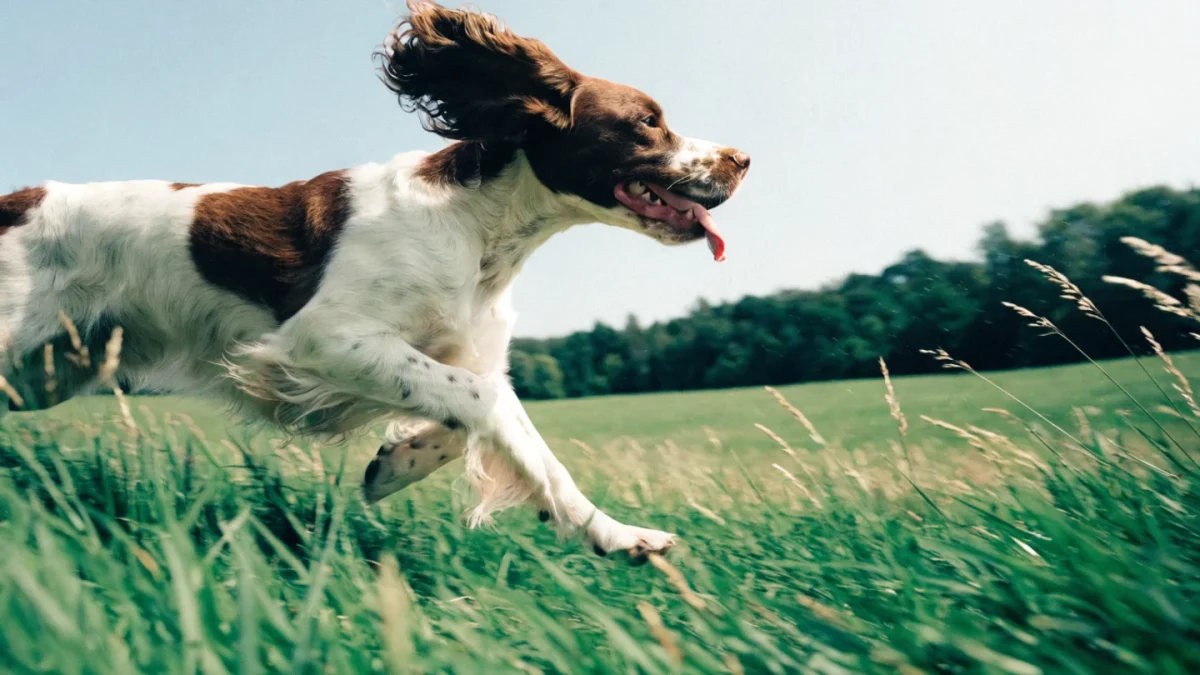
English Springer Spaniels sit in an odd space in public perception. They're popular enough that most people recognize the breed on sight, but not so overwhelmingly common that everyone has firsthand experience living with one. That gap between recognition and experience is where misconceptions thrive — and with Springers, several persistent myths lead to genuinely bad ownership decisions.
Here are five that I encounter repeatedly, each examined against what the breed actually is.
1. They're an Easy, Natural Family Dog
This is the misconception that causes the most real-world harm. Springers are friendly, people-oriented, and genuinely good with children — traits that get compressed into the shorthand "great family dog," which many people interpret as "easy dog."
They are not easy dogs. An adult English Springer Spaniel needs a minimum of ninety minutes of structured daily exercise. Not a casual stroll — running, retrieving, swimming, scent work. The breed matures slowly, and dogs under three or four years old are intensely energetic, mouthy, and exuberant in ways that overwhelm unprepared households. A young Springer that receives inadequate exercise will chew furniture, bark excessively, jump on every person who enters the house, and counter-surf with remarkable creativity.
The "family dog" label is accurate for active families who understand what they're committing to. It is dangerously misleading for families who expect a calm, low-maintenance companion that integrates seamlessly into a busy household without significant daily effort.
The complete breed guide covers what the breed demands in detail. Read it before deciding.
2. All Springer Spaniels Are Basically the Same
This myth persists because people see one breed name on the registration and assume one type of dog. In reality, English Springer Spaniels have been functionally split into two distinct populations — field-bred and show-bred — for over seventy years.
Field-bred Springers are lean, moderate in coat, and selected for extreme working drive, speed, and stamina. They are intense dogs that need experienced handling and very high levels of daily activity. Show-bred Springers are heavier-boned, carry denser and longer coats, and have substantially lower working drive. They are still active dogs, but they are meaningfully calmer and more adaptable to household routines.
The difference is not subtle. Putting a field-bred Springer in a household expecting show-line energy levels is like putting a Border Collie in a home expecting a Basset Hound. The breed name matches. The dog does not.
Anyone considering a Springer needs to determine which population their prospective dog comes from before bringing it home. This single piece of information predicts more about the ownership experience than any other factor.
3. Springer Spaniels Are Aggressive Because of Rage Syndrome
"Springer rage" or "rage syndrome" is a real, documented condition — episodes of sudden, unprovoked aggression followed by apparent confusion, as if the dog doesn't remember the episode. EEG studies of affected dogs have identified low-voltage rapid discharges characteristic of focal seizures localized to the temporal lobe, and the episodes respond to antiepileptic medication such as phenobarbital. This evidence supports classification as a rare form of limbic epilepsy, though the precise underlying genetic mechanism has not been definitively identified.
What the condition is not: common. The vast majority of English Springer Spaniels will never display anything resembling rage syndrome. Using its existence to characterize the breed as aggressive is like warning people away from all cars because a rare model has a known defect. The condition appears in a very small fraction of the population.
Aggression in Springers that is not sudden and unprovoked — resource guarding, fear-based reactivity, pain-related responses — is behavioral, not neurological, and should be addressed through professional evaluation. Labeling all aggression in Springers as "rage syndrome" prevents accurate assessment and appropriate intervention.
If you encounter claims that Springers are inherently dangerous dogs, you're reading someone who has confused a rare condition with a breed characteristic. The temperament profile covers the breed's actual behavioral patterns.
4. They'll Adapt to Any Living Situation
Springers are sometimes described as "adaptable," and in one sense that's accurate — they can live in houses, apartments, rural properties, or suburban neighborhoods. But "adaptable to different spaces" is not the same as "adaptable to different lifestyles."
The breed does not adapt to:
- Extended isolation. Springers form deep attachments and deteriorate behaviorally when left alone for more than four to five hours regularly. This isn't a preference — it's a breed trait with predictable consequences when violated.
- Sedentary routines. A Springer in a household that walks it for twenty minutes daily and considers that sufficient will develop behavioral problems. The dog's needs are not negotiable and do not decrease because the owner's schedule is busy.
- Inconsistent schedules. Springers thrive on routine. Erratic exercise, feeding, and companionship patterns create anxiety in a breed already predisposed to separation sensitivity.
The breed adapts its physical environment to the owner. It does not adapt its fundamental needs. That distinction matters.
5. Grooming Is Minimal Because They're a Sporting Breed
Some people assume that because Springers are working dogs, their coat must be low-maintenance. The reasoning goes: a field dog shouldn't need fussy grooming. It's a reasonable assumption, and it's wrong.
Field-bred Springers have shorter, less profuse coats than show-bred dogs, but they still need thorough brushing two to three times weekly. The feathering on the ears, belly, legs, and chest mats quickly if neglected. Show-bred Springers with their heavier coats need even more frequent attention — often daily brushing to prevent tangles.
Then there's ear care. The breed's long, pendulous ears create a warm, moist environment that breeds bacteria and yeast. Weekly ear cleaning is mandatory. After swimming or any water exposure, ears must be dried thoroughly. Owners who skip ear maintenance trade a five-minute weekly task for recurring veterinary visits for chronic otitis — infections that are painful for the dog and expensive to treat.
Professional grooming every six to eight weeks rounds out the commitment. Coat trimming around the ears, feet, hocks, and head maintains both appearance and function.
A Springer is not a wash-and-go breed. It's a breed that rewards consistent grooming with a healthy, functional coat and punishes neglect with mats, hot spots, and ear infections.
The Common Thread
All five misconceptions share the same root: underestimating the breed. The English Springer Spaniel is a serious sporting dog packaged in an appealing, medium-sized, friendly exterior. People see the wagging tail and assume the rest is equally effortless. It isn't. The breed gives enormously, but it demands honestly. Meeting those demands produces one of the most rewarding companion relationships in the sporting group. Falling short of them produces a frustrated dog and a regretful owner.