

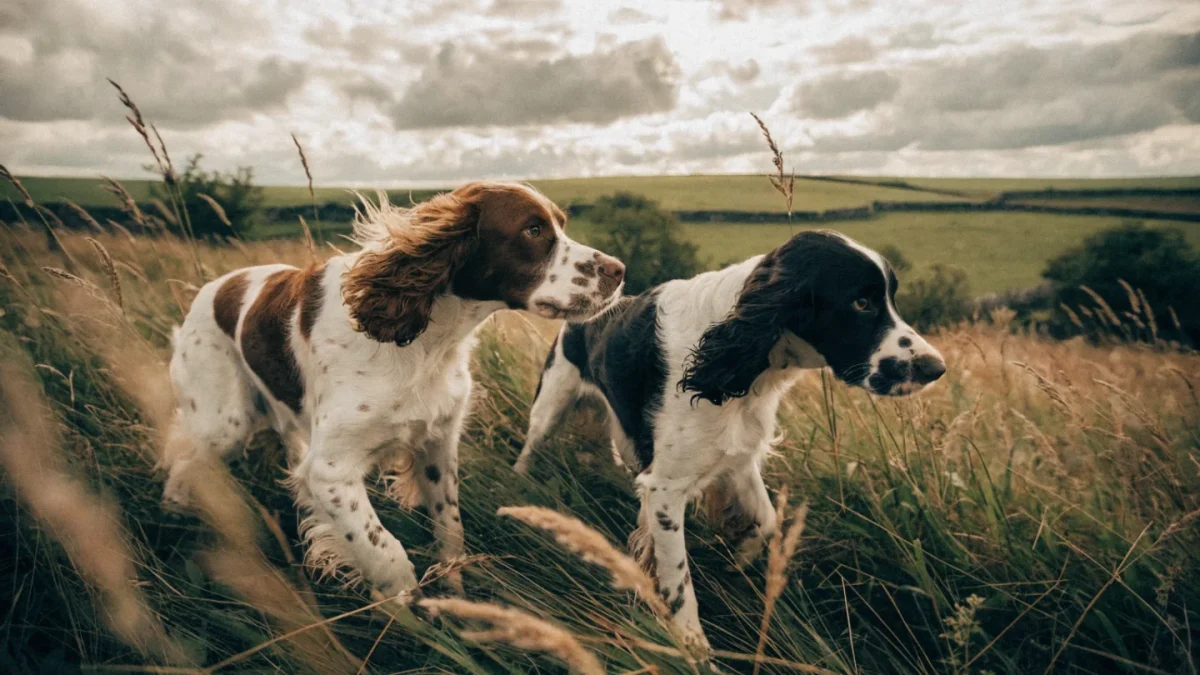
The name tells you the whole job. A springer springs — it drives game birds out of cover with enough explosive energy to flush them into the air, where a hunter can take a shot. Every part of the English Springer Spaniel's physical design traces back to that function: the moderate size to push through dense hedgerows without getting hung up, the pendulous ears that direct scent upward while the nose works low cover, the docked tail (historically) acting as a gauge for the dog's position in thick brush. This is a purpose-built tool for a specific task, and the task gave the dog its name centuries before breed registries existed.
What I find compelling about Springer history is how logical it is. Most breed histories involve some combination of guesswork, myth, and nationalistic invention. The Springer's history is unusually traceable — the function was consistent, the type was consistent, and the name stuck because the job never changed. Understanding where this breed came from explains, with unusual clarity, why the dog behaves the way it does today.
The english springer spaniel history origins story is one of the longest in the sporting dog world, predating formal breed registries by hundreds of years. Tracing it means following a line from medieval hunting estates through the arbitrary classification of spaniel litters, the slow separation of "springer" from "cocker," the formalization of breed standards in the early 1900s, and the dramatic split that created two functionally different dogs under one breed name.
Before Breeds: The Land Spaniels
The ancestors of all British spaniel breeds were "land spaniels" — a loose category of medium-sized flushing dogs that worked cover to drive game toward hunters. These dogs appear in English and Welsh texts from at least the 1300s, and their presence in British hunting culture was well established by the time the Tudor monarchs were using them for hawking.
The word "spaniel" itself points to Iberian origins. The most widely accepted etymology traces it to the Old French espaigneul, meaning "Spanish dog." Whether the original spaniel-type dogs arrived in Britain from Spain directly or through French intermediaries is debated, but the connection to Spain appears repeatedly in medieval sources.
By the 1500s, land spaniels were a standard component of British field sport. They worked alongside falconers and, later, hunters using firearms. Their job was straightforward: find game birds hiding in dense ground cover, flush them into the open, and — once guns made it possible — retrieve downed birds. The dogs that did this job well were bred. The rest weren't.
The Springer-Cocker Distinction
For centuries, the distinction between springers and cockers was not a breed division. It was a size classification applied within individual litters.
A litter of land spaniels would produce puppies across a range of sizes. The larger puppies — those heavy enough to physically spring game from dense hedgerows and strong enough to retrieve across rough ground — were called "springing spaniels" or simply "springers." The smaller puppies, better suited to working in tight cover after woodcock, were called "cocking spaniels" or "cockers."
Same parents. Same litter. Different jobs based on the size they grew to. This practice was so routine that nobody thought of springers and cockers as different breeds. They were functional categories, not genetic populations. A breeder might produce both from every mating and place each puppy according to its build.
This arrangement persisted for remarkably long — well into the 1800s. The gradual shift toward treating springers and cockers as distinct breeds was driven by the emergence of dog shows and breed registries in the late 1800s, which demanded categories that could be written down and judged against fixed standards. The history of the Cocker Spaniel traces the smaller branch of this split in detail.
Formalization: 1800s Through Early 1900s
The transformation from functional category to recognized breed happened in stages.
In the mid-1800s, selective breeding began to fix type within the springer category. The Boughey family's breeding program at Aqualate in Staffordshire is widely cited as one of the foundational lines. They maintained springer spaniels for field work over several generations, creating a recognizable and consistent type by the 1870s and 1880s.
The Sporting Spaniel Society, founded in 1885, began the process of separating spaniel types into formal breed classifications. Before this, spaniels competed against each other in mixed classes at shows regardless of size or type. The society pushed for distinct classes based on weight and working style, which laid the groundwork for breed recognition.
The Kennel Club in Britain officially recognized the English Springer Spaniel as a distinct breed in 1902. The first breed standard, adopted in 1903, described a medium-sized spaniel of balanced proportions, moderate coat, and active, merry temperament. The emphasis was on function — a dog built to work the field all day.
In North America, the AKC registered its first English Springer Spaniel in 1910. The English Springer Spaniel Field Trial Association was founded in 1924 and became the parent breed club, shaping the breed's development in North America for the next century.
The Golden Age of the Dual-Purpose Springer
The 1920s through the 1940s represent what breed historians often call the golden age of the English Springer Spaniel. During this period, dogs competed successfully in both field trials and conformation shows — winning in the ring and the field within the same careers.
Dogs from this era — names like FTC/CH Donerail Doublecross and Dual Ch. Green Valley Donatello — could earn championships in both disciplines. They were compact, moderate in coat, athletic enough for sustained field work, and correct enough in structure and type to win under conformation judges. The dual-purpose Springer was the breed's ideal, and for roughly two decades, it was achievable.
That era ended. What replaced it defines the breed today.
The Great Divergence
Beginning in the late 1940s and accelerating through the 1950s and 1960s, the English Springer Spaniel split into two increasingly distinct populations.
Field trial breeders selected for speed, prey drive, stamina, and nose — the traits that won trials. They deprioritized coat density, head proportions, and adherence to the conformation standard. Show breeders selected for coat, structure, head type, and breed-standard correctness. They deprioritized working speed and field drive.
By the 1970s, the two populations had diverged enough that a competitive field trial Springer looked nothing like a competitive show Springer, and neither could seriously compete in the other's domain. The last dual champion in the breed — Green Valley Punch — earned that distinction in 1938, nearly nine decades ago. No English Springer Spaniel has held both a field trial championship and a conformation championship since.
The divergence was not unique to Springers — English Setters, Irish Setters, and several other sporting breeds underwent similar splits. But in the Springer, the gap became particularly pronounced because field trial competition in the breed emphasizes extreme speed and drive, selecting for traits that pull away from the moderate, balanced build the original standard described.
Today, field-bred and show-bred English Springer Spaniels share a breed name, a registration, and a deep ancestry. In practical terms, they are different dogs suited to different purposes, and breeders rarely cross between the two populations. The complete breed guide covers what this means for prospective owners.
The Springer in Modern Field Trials
English Springer Spaniel field trials remain one of the most demanding tests of any sporting breed. In a typical trial, dogs must quarter ahead of their handler, flush game on command, remain steady to flush and shot (not chase), and then retrieve to hand on command. The dog works at high speed, responding to whistle and hand signals, in terrain that ranges from plowed fields to dense bramble.
Springer field trials differ from pointing breed trials in a crucial way: the dog makes contact with the game. A pointer locates and indicates. A Springer locates, enters the cover, and physically pushes the bird into the air. This requires a combination of drive, courage, nose, and handler responsiveness that few other breeds demonstrate at the same level.
The breed's dominance in spaniel field trials across multiple countries is the most direct evidence that the original working qualities described in the 1500s are alive and unchanged.
The Springer in Popular Culture
The English Springer Spaniel has maintained a lower cultural profile than breeds like the Labrador or Golden Retriever, but it has had notable visibility.
The breed has appeared at the highest levels of conformation competition, winning Best in Show at Westminster six times — in 1963 (Ch. Wakefield's Black Knight), 1971 and 1972 (Ch. Chinoe's Adamant James, back-to-back wins), 1993 (Ch. Salilyn's Condor), 2000 (Ch. Salilyn 'N Erin's Shameless), and 2007 (Ch. Felicity's Diamond Jim). It has served extensively in detection work — Springers are widely used by police and military organizations for explosives and narcotics detection, valued for their nose, their manageable size, and their willingness to work in confined spaces that larger detection breeds cannot access.
Several Springer Spaniels have gained recognition in military service. The breed's combination of scenting ability, handler focus, and drive makes it particularly suited to detection roles where the dog must work methodically and respond to subtle handler cues.
What the History Tells You
The temperament profile of the modern English Springer Spaniel — the handler focus, the tireless energy, the need for partnership — isn't a quirk of individual dogs. It's five hundred years of breeding for a specific set of working traits, compressed into a companion animal.
Every behavioral characteristic that defines the breed traces to a functional origin. The handler focus comes from centuries of working within gun range of one person. The energy comes from being expected to quarter miles of heavy cover in a single day. The sociability comes from working alongside other dogs and around groups of hunters. None of it is random. All of it is history expressing itself in the dog lying at your feet.
Understanding that history isn't academic. It's practical. It tells you what the dog needs, why it needs it, and what happens when those needs aren't met. The English Springer Spaniel was built to work hard, stay close, and never quit. Five centuries haven't changed that.