

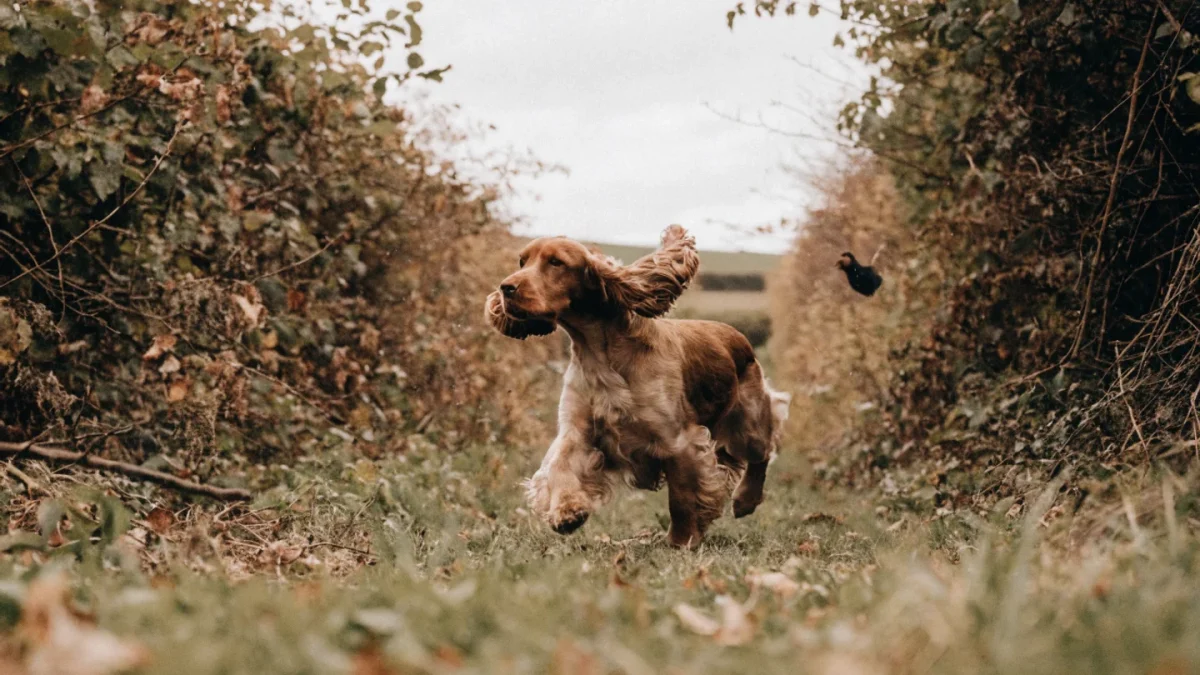
The first thing you notice about a cocker spaniel — the real thing, field-bred and working — is the nose. It goes down and it stays down, and the dog attached to it moves through cover with a kind of fluid, side-to-side intensity that has nothing to do with the show ring. Then you notice the ears: long, pendulous, curtaining the sides of that working head, acting as airfoils that push scent up toward the nostrils as the dog quarters the ground. Everything about the cocker spaniel's head is engineered for one purpose. The rest of the dog — compact, muscular, low to the ground — follows from that same logic.
I've spent enough time around field-bred cockers to understand how completely the show world reinvented this animal. The breed you see winning in the ring today barely resembles the dog that gave it its name. The cocker was named for the woodcock — a woodland wading bird — because generations of hunters bred a dog specifically tuned to finding and flushing that one species from dense, tangled cover. That function shaped a dog. What came afterward shaped a very different one.
The cocker spaniel didn't emerge from a single breeding event or a single breeder's vision. It was shaped gradually — by medieval hunters, by Victorian sportsmen who formalized dog breeding into a science, and by twentieth-century show ring culture that pulled the breed in a direction its originators never imagined.
Spaniels Before Breeds
The word "spaniel" appears in English texts as early as the 1300s. Geoffrey Chaucer referenced spaniels in The Canterbury Tales, and the Master of Game — the oldest English-language hunting manuscript, translated by Edward of Norwich, 2nd Duke of York, between 1406 and 1413 from Gaston Phoebus's Livre de la Chasse — includes a chapter describing spaniels and their use in finding and flushing game birds for hunters working with hawks and nets.
These early spaniels were a functional type, not a breed. They varied enormously in size, coat, and build. What united them was their working style: quartering through cover, using scent to locate ground-nesting birds, and flushing them into the air for the waiting falcon — or, after the development of sporting firearms, into the path of the gun.
For centuries, a single spaniel litter might produce dogs ranging from 9 to 25 kg. Breeders didn't sort them by pedigree. They sorted them by size and function. The largest became "springing spaniels" or "field spaniels" — dogs that could cover ground and flush larger game. The smallest became "cocking spaniels," specialists at pushing woodcock from the dense, low-lying cover where these secretive birds hide.
Woodcock inhabit thick bramble, undergrowth, and wet woodland margins. Flushing them requires a dog small enough to penetrate that cover, bold enough to push through thorns and tangled vegetation, and persistent enough to keep working when the sensible response would be to give up and find easier ground. The cocker's compact size wasn't a cosmetic preference. It was a functional specification.
The Formal Split: 1892
The boundary between "cocker" and "springer" remained informal and porous until the late nineteenth century. In many litters, the same parents produced puppies that could have been registered as either type based solely on their adult weight. The Kennel Club in Britain settled this ambiguity in 1892 by establishing the cocker spaniel as a breed with its own registry and standard, separate from the English springer spaniel.
The key distinction was weight. Dogs under approximately 11 kg were classified as cockers. This was crude taxonomy — defining a breed by a single physical measurement — but it formalized a separation that hunters had been making informally for generations. The English Springer Spaniel, which took the larger portion of the spaniel type, followed its own distinct development path from that same 1892 split.
Obo and his progeny dominated the early show bench. His tight build, level topline, and dark coat became the template that judges rewarded, and breeders responded accordingly. Within a decade, the cocker spaniel had shifted from a working dog assessed on field performance to a breed increasingly shaped by conformation standards.
The complete breed guide covers how those early decisions still influence the breed's physical structure and health today.
Crossing the Atlantic
Cocker spaniels arrived in North America in the late 1800s, and their trajectory on that continent diverged quickly from the British path. American breeders favored certain aesthetic traits that British breeders did not: a rounder, more domed skull; larger, more prominent eyes; a shorter muzzle; and increasingly abundant coat, particularly the long feathering on the ears, chest, and legs.
By the 1920s, the differences between American-bred and English-bred cockers were visible at a glance. American dogs were developing the rounded head, profuse coat, and compact body that define the modern American cocker. English dogs retained the longer muzzle, flatter skull, and moderate coat of their working origins.
The two types were shown in the same classes until breeders on both sides began arguing that they were, functionally, different breeds. Crossbreeding between the types was common into the 1930s, which complicated pedigrees and frustrated breeders trying to maintain type consistency.
The English Cocker Spaniel Club of America, founded in 1935, advocated for formal separation. Their position was straightforward: the types had diverged enough that judging them against a single standard was unfair to both. After years of debate, the AKC recognized the English cocker spaniel as a breed separate from the (American) cocker spaniel in 1946.
The Popularity Surge
What happened next is a cautionary tale about what runaway popularity does to a dog breed.
The American cocker spaniel became the most registered breed with the AKC in 1936 and held that position continuously until 1952. The demand was enormous. Breeders who might have produced one or two litters per year scaled up. New breeders entered the market with little knowledge of genetics, structure, or temperament. The priority was puppies — as many as possible, as fast as possible, in the colors that buyers wanted.
The consequences were predictable. Temperament consistency eroded. Health problems that might have been managed through careful selection proliferated. The breed's reputation for the merry, stable disposition that had made it popular began competing with reports of nervousness, aggression, and anxiety in dogs from high-volume operations.
This pattern — popularity drives demand, demand drives overbreeding, overbreeding drives health and temperament decline — has repeated with other breeds since. The cocker spaniel was one of the earliest and most dramatic examples.
The Show Ring Transformation
The American cocker's physical evolution accelerated through the mid-twentieth century. Each generation moved further from the field dog that Obo would have recognized. Coats grew longer and denser. Skulls became rounder. Muzzles shortened. The body became more compact. By the 1960s and 1970s, the show cocker was a dramatically different animal from the working spaniels still used in upland fields.
The transformation wasn't accidental. Show ring judging rewards exaggeration — within breed standard limits, the dog with the most impressive coat, the most refined head, the most striking silhouette tends to win. Each generation of champions pushed the breed's appearance further from its functional origins.
English cockers, while also affected by show breeding, retained more of their working structure. Field trials for English cockers remained active and influential, creating a functional check against purely cosmetic breeding that the American type lacked. Working English cockers and show English cockers diverged into distinct lines, but neither moved as far from the breed's origins as the American show cocker did.
Cultural Presence
The cocker spaniel's cultural footprint extends beyond registration numbers. The breed appears in art and literature dating to the 1700s, but its most prominent cultural moment came in 1955 when the animated film Lady and the Tramp featured a cocker spaniel as its lead character. The film cemented the breed's image as the idealized family dog — gentle, beautiful, and devoted.
That image drove another wave of adoption demand, which drove another cycle of high-volume breeding, which produced another generation of dogs that didn't always match the screen ideal. The pattern is familiar because it kept repeating.
Presidential cockers also raised the breed's visibility. Richard Nixon's cocker spaniel Checkers became nationally famous through the 1952 televised "Checkers speech" during his vice-presidential campaign, and John F. Kennedy kept an English cocker spaniel named Shannon at the White House. The breed's association with domesticity, family, and wholesome living made it a natural choice for public figures cultivating accessible images.
Where the Breed Stands Now
The cocker spaniel's registration numbers have declined significantly from their mid-century peak, which is arguably the best thing that's happened to the breed. Lower demand has reduced the incentive for high-volume breeding. Dedicated breed clubs have promoted health testing, temperament evaluation, and responsible breeding practices. The temperament discussion covers how those decades of overbreeding still influence behavioral variation within the breed today.
Some breeders have returned to field work with American cockers, entering dogs in flushing trials and demonstrating that the hunting instinct — dormant in many show lines — can still be activated when selection pressure favors it. These field-bred American cockers look noticeably different from their show counterparts: leaner, shorter-coated, longer-muzzled, and built for function over form.
The cocker spaniel's history is, in many ways, a compressed version of what happens when human preferences take control of a working animal's destiny. The breed started as a specialist — a small, tenacious bird dog built for a specific task in a specific habitat. It became a cultural icon, a fashion accessory, a registration-chart champion, and a cautionary example of what mass popularity costs. That it remains, at its best, a genuinely wonderful companion dog is a testament to the breed's resilience and to the breeders who kept temperament and health as priorities when the market rewarded everything else.