

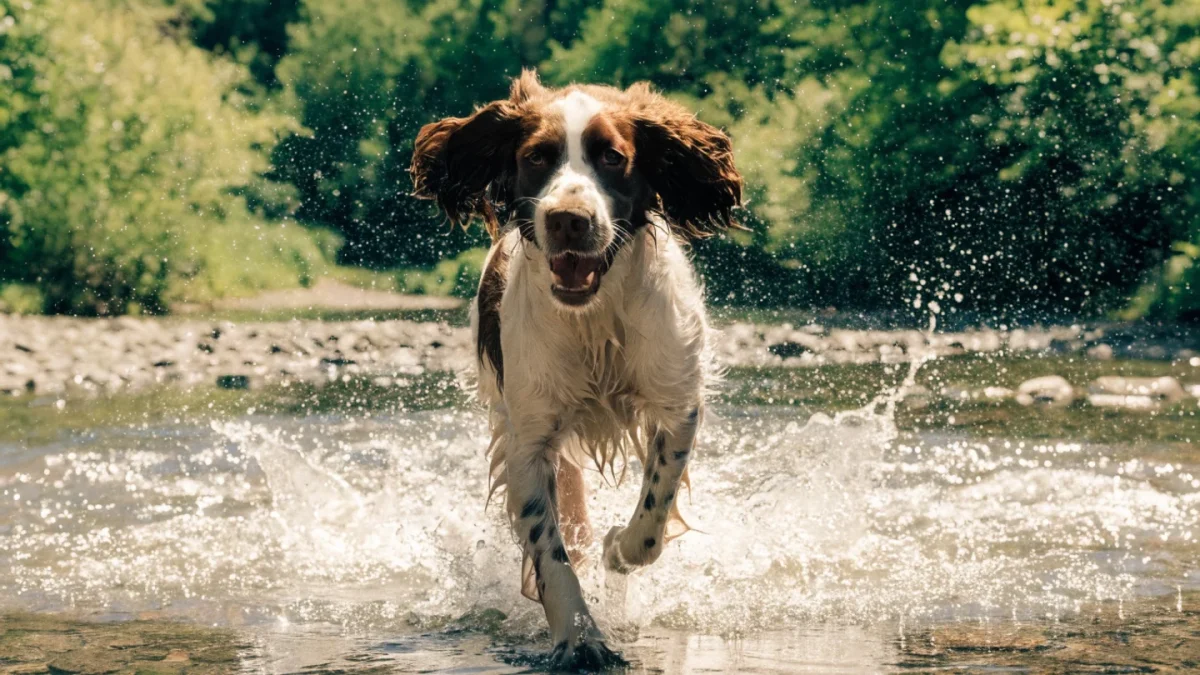
Before you buy an English Springer Spaniel, there's one question that matters more than any other: show-bred or field-bred? Not because one is better. Because they are, behaviorally, almost different dogs — and making the wrong choice for your household is one of the most common mistakes I see prospective owners make with this breed.
A show-bred Springer is a calmer, more adaptable dog. Still needs exercise, still bonds closely, still has the spaniel's innate sociability. But manageable for a family with a reasonably active lifestyle and no sporting ambitions. A field-bred Springer operates at a different frequency. The drive is higher, the handler focus is more intense, the need for genuine physical and mental work is not optional. I've met field-bred Springers owned by non-hunting families who had genuinely loving homes but could not meet the dog's needs — and everyone involved paid for that mismatch. Understanding the split before you choose the dog makes the difference.
The Handler Bond
The most distinctive behavioral trait in the English Springer Spaniel is the strength of its attachment to a primary handler. While many breeds bond closely with their families, Springers develop a singular focus on one person that goes beyond preference. They orient toward that person physically, check in frequently during activity, and read their handler's body language and emotional state with unsettling accuracy.
This isn't learned behavior. It's bred in. The breed's history tracks directly to why: for centuries, Springer Spaniels worked within gun range of a single handler, reading hand signals and body position to know where to cast next. A dog that lost focus on its handler lost birds. The ones that maintained that connection were selected for breeding. Generations of that selection pressure produced a dog that is, at its core, a handler-tracking system wrapped in a dog.
The practical outcome: a Springer at home follows you. Room to room. Upstairs and down. Into the bathroom. To the door when you leave and directly back to the door to wait until you return. For some owners, this closeness is the breed's greatest appeal. For others, it's claustrophobic. There's no training it away because it isn't a behavior — it's the dog's fundamental operating mode.
Energy: Understanding the Scale
Springers are high-energy dogs. That sentence appears in every breed description, and it tells you almost nothing because "high energy" means different things in different breeds. A Jack Russell is high energy in bursts. A Border Collie is high energy in the form of focused intensity. A Springer is high energy in a sustained, generalized way — the dog wakes up at full capacity and stays there for most of the day.
Field-bred Springers are the more extreme end of this spectrum. They were selected for the ability to work at speed for hours without flagging, and that stamina translates directly into home life. A field-bred Springer that has been exercised for ninety minutes may rest for an hour and then look at you with an expression that clearly communicates: "So, what's next?"
Show-bred Springers operate at a lower intensity but are still energetic dogs by any standard comparison. A show-bred Springer needs less volume of exercise than a field-bred dog, but it still needs substantially more than breeds like Cavalier King Charles Spaniels or Bulldogs. Calling a show-bred Springer "calm" is accurate only if you're comparing it to the field-bred version.
The breed generally begins to moderate its energy between ages four and six. Before that, particularly during the one-to-three age window, living with a Springer feels like managing a perpetual motion machine with strong opinions about how close it should be to you at all times. For more, see Cocker Spaniel Temperament: Merry, Gentle, and Eager to Please.
Social Temperament
Springers are broadly sociable dogs. They approach new people with interest rather than suspicion, interact well with other dogs in most contexts, and generally integrate into multi-pet households without serious friction.
With children, the breed is typically a strong match — patient, playful, and engaged. The caution isn't temperament-based but physics-based: a Springer in full enthusiasm is a twenty-plus-kilogram projectile that doesn't always account for the size of the person it's greeting. Toddlers get knocked over. It happens with predictable regularity. Supervision during interactions with small children isn't about preventing aggression — it's about preventing accidental collisions.
With other dogs, Springers are usually confident and playful. They tend to initiate play rather than wait, and their style skews active — chasing, wrestling, and retrieving games. Dog-selective individuals exist, as in any breed, but outright aggression toward other dogs is uncommon and not breed-typical.
Stranger reactivity is low. Most Springers greet visitors with tail wagging and a toy in their mouth. They are not natural watchdogs and will not reliably alert you to unfamiliar people on your property. If you need a dog that discriminates between welcome guests and uninvited visitors, look elsewhere.
Separation Sensitivity
This is where the Springer's handler focus becomes a liability rather than a strength. English Springer Spaniels do not handle isolation well. The breed's deep attachment to its person means that person's absence creates genuine distress — not boredom, not inconvenience, but a state of anxiety that manifests in predictable ways.
Common separation behaviors in Springers include destructive chewing (focused on exit points — doors, window frames, crate bars), excessive barking or whining, pacing, drooling, and in severe cases, self-injury. These aren't the actions of a bored dog entertaining itself. They are stress responses from a dog whose fundamental need — proximity to its person — is unmet.
Building tolerance for short absences through gradual training helps. Providing enrichment during departures helps. But the underlying reality is that English Springer Spaniels are not suited to households where they will be alone for seven or eight hours daily. Four to five hours is the practical ceiling for most individuals, and many do better with less.
If your household schedule means the dog is alone for a full workday, this breed will need a midday visit, a dog walker, or a daycare arrangement. Pretending the issue doesn't apply to your specific Springer is how people end up with demolished door frames and noise complaints from neighbors.
Trainability and Intelligence
Springers learn quickly and retain well. They rank in the top tier of sporting breeds for trainability, a reflection of their handler focus and desire to work cooperatively. This makes them responsive to positive reinforcement, quick to pick up new commands, and genuinely enthusiastic about training sessions.
The flip side: a Springer's intelligence doesn't idle gracefully. A smart dog with nothing to learn becomes a smart dog that teaches itself things you didn't want it to know — how to open cabinets, how to unzip bags, how to rearrange your belongings into configurations that serve its own purposes. Mental stimulation through training, puzzle toys, and scent work isn't a supplement to physical exercise. It's a parallel requirement.
Harsh training methods backfire badly with this breed. Springers are sensitive to their handler's emotional state, and punitive corrections produce anxiety rather than compliance. A corrected Springer doesn't think "I shouldn't do that again." It thinks "my person is angry, and I don't know how to fix it." That anxiety compounds into avoidance behaviors that make the dog harder to train, not easier.
Behavioral Considerations
One topic that appears in discussions of English Springer Spaniel temperament deserves direct acknowledgment: so-called "Springer rage" or "rage syndrome." This term describes episodes of sudden, unprovoked aggression followed by apparent confusion or normal behavior, as if the dog has no memory of the episode.
The condition is real but rare. EEG studies have documented epileptiform activity in the temporal lobe of affected dogs, and episodes respond to antiepileptic medication — supporting classification as a form of limbic epilepsy. Preliminary investigations into serotonin pathway genetics have not yet identified a definitive causative gene. Solid-colored Springers have been reported as over-represented in cases compared to parti-colored dogs, though the data supporting this pattern is limited. The vast majority of English Springer Spaniels never display anything resembling rage syndrome, and the existence of the condition should not be used to characterize the breed's general temperament.
Aggression in Springers that is not sudden and unprovoked — resource guarding, fear-based reactivity, pain-related snapping — should be evaluated and addressed like aggression in any other breed: with professional assessment and structured behavior modification.
The Right Temperament Match
The English Springer Spaniel's temperament is its greatest strength and its most demanding feature, and they are the same thing. The breed's complete guide covers the full picture of ownership, but temperament is where the decision really lives. The handler focus that makes a Springer responsive and trainable is the same trait that makes it clingy and separation-anxious. The energy that makes it a tireless outdoor companion is the same energy that makes it destructive when confined.
This temperament works brilliantly for people who want an active, engaged, ever-present dog that participates fully in their daily life. It is a poor fit for anyone who values independence — their own or the dog's. Springers do not give you space. They do not entertain themselves. They do not settle for being a background presence in your household. They are, for better and worse, all in.