

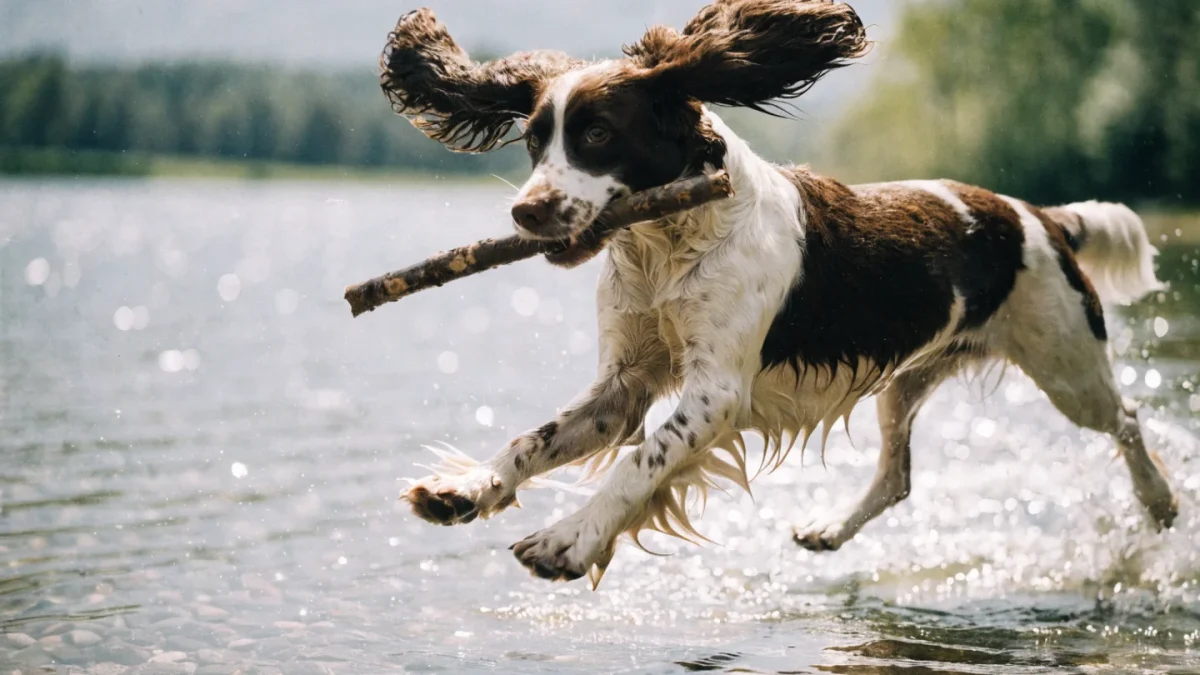
A working English Springer Spaniel in the field covers between eight and fifteen kilometers in a typical half-day shoot — not in a straight line, but in constant quartering patterns through heavy cover, often at a run. That's the athletic baseline the breed was developed for. Nobody expects a companion Springer to replicate field-trial conditioning, but the gap between what the breed was built to do and what many owners provide is where behavior problems live.
English springer spaniel exercise needs are among the highest of any medium-sized breed. Understanding the numbers, the type of activity that actually satisfies the breed, and how requirements shift between field and show lines is the difference between a content dog and one that channels its unspent energy into your furniture.
The Baseline: Ninety Minutes, Minimum
An adult English Springer Spaniel in good health needs at least ninety minutes of exercise daily. That's the floor, not the ceiling, and it assumes a show-bred dog with moderate drive. Field-bred Springers often need two hours or more to reach a genuinely settled state.
Split the time across at least two sessions. A single long outing works less effectively than two moderate ones. Springers benefit from the pattern of activity, rest, and renewed activity — it mirrors the working rhythm their bodies and brains were designed for. A forty-five-minute morning session and a forty-five-minute evening session is a functional starting framework. Adjust upward based on your dog's individual need.
On-leash walking counts toward the total but should not be the entire program. A Springer on a six-foot lead, moving at human walking pace, is operating at a fraction of its physical and mental capacity. The dog is getting fresh air and leg movement, but its working instincts — quartering, scenting, running at speed — remain completely unengaged.
What Counts as Real Exercise
The activities that actually tire a Springer share one characteristic: they engage the dog's body and brain simultaneously.
Retrieving is the most natural fit. The breed's foundational job is to flush and retrieve, and games that simulate retrieval — ball launchers, bumper drills, thrown toys — tap directly into instinctive drives. A twenty-minute retrieving session on soft ground can tire a Springer more effectively than an hour-long walk because the dog is running at speed, tracking the fall, and making repeated return trips with full focus.
Swimming is outstanding for the breed. Most Springers take to water naturally and will swim with enthusiasm in any available body of water. Swimming provides high-intensity exercise with minimal joint impact — particularly valuable for older dogs or those with orthopedic concerns. A Springer that swims for thirty minutes has genuinely worked.
Scent work engages the brain harder than any physical activity. Hide treats or toys and let the dog search. Use snuffle mats for meals. Set up simple trailing exercises in the yard. Springers have excellent noses, and scent-focused activities produce a kind of mental fatigue that physical exercise alone cannot match. A fifteen-minute nose work session followed by a nap is a common pattern.
Free running in a secure area lets the dog move at its own pace and pattern — quartering, investigating, sprinting, doubling back. This is the closest approximation to natural field work that most companion Springers get. A securely fenced area where the dog can run off-leash is one of the most valuable resources a Springer owner can access.
Hiking and trail running suit the breed's stamina and terrain adaptability. Springers handle uneven ground, moderate inclines, and varied surfaces well. They are excellent trail companions for active owners, with the endurance to match most human hikers for distance.
Field Lines vs Show Lines
The difference in exercise needs between field-bred and show-bred Springers is not minor. It's substantial enough to affect daily scheduling.
Field-bred Springers carry decades of selection for sustained high-output work. Their energy is not just high — it's persistent. A field-bred dog that has been exercised for ninety minutes will rest for a period, then rise and look for more. Two hours of mixed activity — running, retrieving, swimming — is a more realistic daily target for most field-bred individuals.
Show-bred Springers are genuinely easier to satisfy. Ninety minutes of varied activity typically brings them to a settled state, and many show-line dogs will self-regulate their rest periods more naturally than field dogs. They still need structured exercise — this is not a sedentary breed by any standard — but the volume and intensity required is measurably lower.
If you're uncertain which type you have, the dog's behavior will tell you. A field-bred Springer that hasn't been adequately exercised will not settle. It will pace, whine, seek attention, chew inappropriate objects, and generally make its dissatisfaction obvious. A show-bred Springer in the same situation may settle eventually but with restless, unsatisfied energy that emerges as neediness or mild destruction.
The Under-Exercised Springer
The behavioral consequences of insufficient exercise in this breed are predictable and well-documented in the temperament profile. Destructive chewing is the most common, focused on soft household items — cushions, shoes, remote controls, children's toys. Excessive barking, particularly when left alone, escalates. Jumping on people intensifies. Counter-surfing becomes persistent.
These behaviors are not training failures. They are energy management failures. A Springer that destroys things when left alone after a twenty-minute walk is communicating a simple message: you didn't give me enough to do, so I found something myself.
The relationship between exercise and behavior in Springers is almost linear. Increase the quality and duration of daily activity, and problem behaviors decrease proportionally. It's one of the most straightforward cause-and-effect relationships in dog ownership.
Puppy Exercise
Springer puppies are energetic from the start, but their exercise needs differ from adults in important ways. Growing joints, developing bones, and open growth plates are vulnerable to repetitive impact. Forced exercise — jogging on hard surfaces, intensive retrieving drills, sustained running — risks damage that creates lifelong orthopedic problems.
The general guideline of five minutes of structured exercise per month of age, twice daily, provides a reasonable framework for puppies. A four-month-old Springer gets two twenty-minute sessions. Free play on soft surfaces — grass, earth, sand — is separate from structured exercise and can be more liberal, as puppies naturally self-regulate their intensity during free play.
Growth plates in most Springers close between twelve and eighteen months. After that point, gradual increases toward adult exercise levels are appropriate. Don't rush the transition. A six-month-old Springer that looks physically mature is not skeletally mature, and treating it like an adult dog creates risk.
Building an Exercise Routine
A practical daily routine for an adult, moderately active show-line Springer might look like this:
Morning: 30- to 40-minute walk with off-leash running in a secure area, incorporating a five-minute retrieving session.
Midday: 15-minute scent work session or puzzle feeder for the main meal.
Evening: 40- to 50-minute session combining walking, running, and either swimming or retrieving.
For a field-bred dog, extend each session by 15 to 20 minutes and add intensity — longer retrieves at greater distances, more demanding terrain, additional scent work. The total daily commitment for a field-bred Springer in its prime is realistically two hours.
This breed is the right choice for people who are already active or genuinely want to become active. The complete breed guide covers the full ownership picture, but exercise is where the daily commitment lives. A Springer whose exercise needs are met is one of the most pleasant, settled, responsive dogs you'll live with. A Springer whose needs are unmet will make sure you know it.