

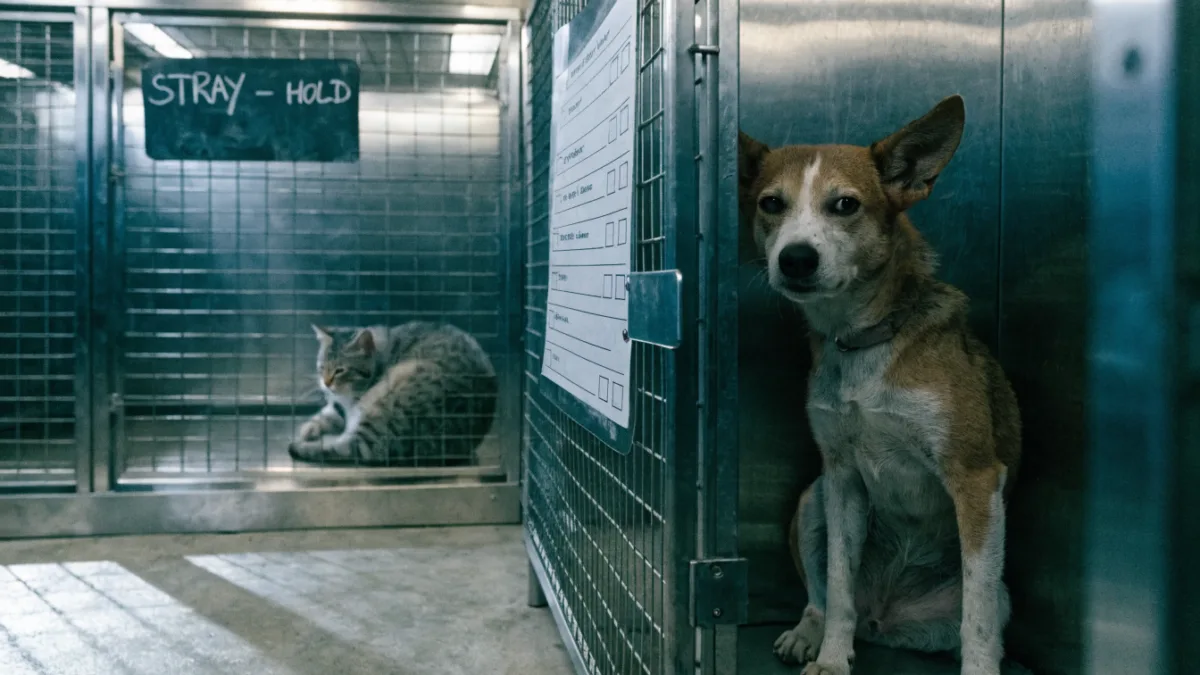
Imagine you’ve been picked up by strangers, locked in a room that smells like bleach and terrified animals, and surrounded by a deafening wall of noise. Then, someone you’ve never met walks in with a clipboard and asks you to perform a series of tasks to determine your entire future. Sounds completely rational, right?
This is the reality for millions of animals entering the shelter system every year. We desperately want a foolproof mathematical equation to tell us if a stray dog is safe to send home with a family, or if a rescued cat is going to thrive in a living room. But animal behavior isn’t math. It’s messy, heavily influenced by environment, and wildly unpredictable when an animal is operating in pure survival mode.
The truth is, the way rescues evaluate a stray dog’s aggression and a cat’s stress requires entirely different playbooks. One is loud and highly scrutinized; the other is quiet and easily missed. And honestly? Both are deeply flawed if we don’t account for the sheer trauma of the shelter environment itself.
The “Shelter Shock” Factor and the Temperament Test Debate
If there is one thing I want to scream from the rooftops about shelter assessments, it’s this: a dog in a kennel is not a dog in a home. The extreme stress of the shelter environment significantly impacts the accuracy of behavioral evaluations. The noise, the confinement, the constant barrage of unfamiliar smells and faces—it triggers survival instincts that completely mask a dog’s true personality.
[1] constantly highlight this exact dilemma. We see dogs that are returned after passing shelter assessments with flying colors, only to bite “without warning” once they settle into a home. Are shelters missing subtle warning signs, or is the home environment simply too different from the kennel to predict behavior? Usually, it’s the latter.
Traditional temperament tests inherently favor dogs that are naturally resilient, confident, and able to positively respond to unfamiliar people. Dogs that are more fearful or shut down by the chaos are unfairly penalized. And a fascinating [2] confirmed that observing a dog’s behavior is actually one of the most reliable ways to assess its stress levels—potentially even more accurate than measuring physiological metrics like cortisol. But if the behavior we are observing is just extreme stress, how can we possibly judge the animal’s baseline temperament? Standard shelter behavior assessments simply have not proven to be highly accurate or precise when used to predict post-adoption aggression.
The Problem with Pass/Fail Testing
Relying on a single pass/fail temperament test is a disaster waiting to happen. It leads to massive false positives—labeling a dog “aggressive” when it’s really just terrified—and dangerous false negatives, where a dog suppresses its stress until it finally relaxes in a home, leading to sudden, unexpected behavioral shifts.
Take my friend’s scruffy terrier mix, Arlo. Arlo was tagged as “food aggressive” in the shelter because he growled when a rubber hand on a stick was shoved into his bowl during his evaluation. But here’s the context: Arlo had been surviving on street trash for a month. Of course he guarded the first real meal he’d seen in weeks. He wasn’t a monster; he was a traumatized survivor. Three years later, he happily drops half-eaten french fries on the rug for my cat to play with. A plastic hand doesn’t tell you a dog will bite a human face; it tells you the dog doesn’t trust a disembodied rubber claw stealing its food.
How Do We Safely Test Dog-to-Cat Reactivity?
One of the most nerve-wracking things a shelter has to figure out is whether a stray dog can safely live with a cat. Historically, shelters would do a “cat test” by walking a highly aroused, stressed-out stray dog into a room with a “bomb-proof” resident shelter cat. If the dog didn’t eat the cat, they passed.
Ethically and practically, this is a nightmare. It places immense physical danger and psychological stress on the cat. Experts like those at the [3] argue strongly against direct cross-species contact for initial evaluations.
Instead, modern rescue protocols rely on observing the dog’s body language when exposed to cat sounds, scents, or video playback from a safe distance. Shelters can use barriers and observe the dog’s arousal levels. Does the dog fixate, stiffen, and lock onto the scent of a cat bed? Or do they sniff casually and move on? Gathering this information safely is infinitely better than throwing a stray dog and a live cat in a concrete room and hoping for the best.
The Quiet Crisis of Feline Stress
While dog assessments are loud and unpredictable, a cat’s stress in a shelter is quiet, insidious, and easily overlooked by people looking for dramatic signs of distress.
When a dog is stressed, they might bark, lunge, or pace. When a cat’s world falls apart, they freeze. They hide. They shut down completely. Evaluating feline stress requires a highly specialized, deeply observant approach. You aren’t testing a stray cat for “aggression”—you are trying to measure exactly how terrified they are.
My oldest cat, Pepper, was dumped at a rural shelter. Her intake notes described her as “feral and highly aggressive.” The reality? She has zero teeth and weighs seven pounds soaking wet. She was hissing and swatting because she was a deeply socialized house cat who had just lost her entire universe, and she was trapped in a metal cage surrounded by barking dogs. She wasn’t feral. She was having a panic attack.
Cats require environments where they can conceal themselves to feel safe. A cat lying flat in the back of a kennel, dilated pupils, refusing to eat, is not being “stubborn” or “mean.” Their nervous system is overwhelmed. Assessing them accurately means understanding that their behavioral shutdown is just as severe a stress indicator as a dog snarling at the front of its cage.
The Shift Toward “Lived Experience” Assessments
Thankfully, the rescue world is changing. We are seeing a massive shift away from formalized, one-time temperament tests toward something much more accurate: “lived experience” assessments.
Instead of putting a dog through a 15-minute battery of weird, unnatural tests on day two, shelters are moving toward observing the dog’s behavior during daily routines over a period of days or weeks. How does the dog act when the kennel staff leashes them for a walk? What happens during feeding time? How do they play in a quiet room without a stranger staring them down?
This modern approach, backed by the recent 2025 research emphasizing holistic observation, recognizes that true behavior emerges only when the animal begins to decompress. It takes time, patience, and a willingness to look past the initial survival instincts.
What This Means for Adopters
The next time you visit a shelter, remember that the animal you are looking at is quite literally wearing emotional armor. That dog spinning in circles or that cat shrinking into the corner of the litter box is showing you their fear, not necessarily their permanent personality.
When shelters ask you about your home environment, they aren’t just being nosey; they are trying to match your “lived experience” with the animal’s eventual decompression needs. If you’re adopting, be patient. Give that stray dog or terrified cat weeks or even months to drop their guard. The shelter assessment is just chapter one of their story. The real evaluation begins the moment they finally realize they are safe in your living room.
Sources
- Community discussions among rescuers — facebook.com
- 2025 study by V. Gazzano et al. — pmc.ncbi.nlm.nih.gov
- University of Wisconsin Shelter Medicine Program — sheltermedicine.wisc.edu