
Dogs that are anxious around strangers, fearful of children, or reactive to people in hats, uniforms, or beards — these are all expressions of insufficient or negative experiences with people during critical periods. And they're much harder to fix than to prevent.
The Variety Problem
Most dogs meet their owner's friends and family. They don't always encounter:
- People with hats, hoods, sunglasses, beards, umbrellas
- Children (who move differently and sound different from adults)
- People with mobility equipment (wheelchairs, walkers, canes)
- People in uniform (delivery workers, postal workers, medical scrubs)
- People of different genders, ages, body sizes, skin tones
- People carrying large or unusual objects
A dog that seems fine with "people" but panics at a man in a high-visibility jacket has been exposed to a subset of people, not to people broadly.
The Principles
Let the dog choose. Never push a dog toward a person or allow a person to crowd a dog that is trying to create distance. The dog's choice to approach is more valuable than a forced approach.
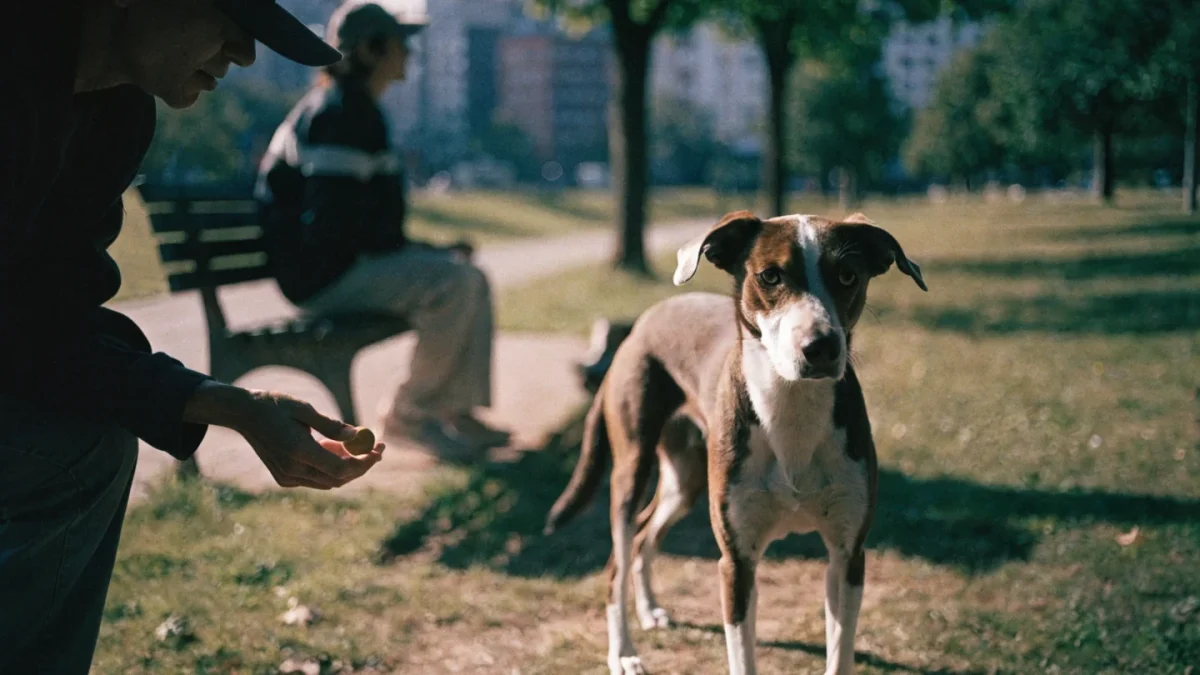
Strangers = treats. Have strangers offer treats rather than pets, initially. Some dogs that are unsure of touch are fine with someone from whom food is appearing. Build the association first.
Read the dog. A tail wag doesn't always mean comfort. Watch for: looking away, lip licking, yawning, trying to move away, stiffening, ears back. Any of those signals mean the interaction should slow down or stop.
Keep encounters brief at first. A short positive interaction is better than a long one that ends with the dog going over threshold.
Socializing With Children
Children move unpredictably, make higher-pitched sounds, and often approach dogs without reading the dog's signals. Dogs that are fine with adults sometimes struggle with children.
Key principles:
- Teach children how to approach dogs before the interaction
- Never leave a dog and young child unsupervised
- Always allow the dog to move away from the child — if the dog can't leave, they may feel they have no option but to escalate
- If the dog shows discomfort with children, increase distance and add treats; don't try to push through
See introducing dogs to babies for the specific preparation when a new baby is coming home. (See also: jumping, mouthing, and pulling.)
The complete socialization guide covers the full approach.
The goal of people socialization is simple: your dog's default assumption about unknown people should be "probably harmless, possibly amazing." Build enough positive experiences with enough variety, and that becomes the baseline.