

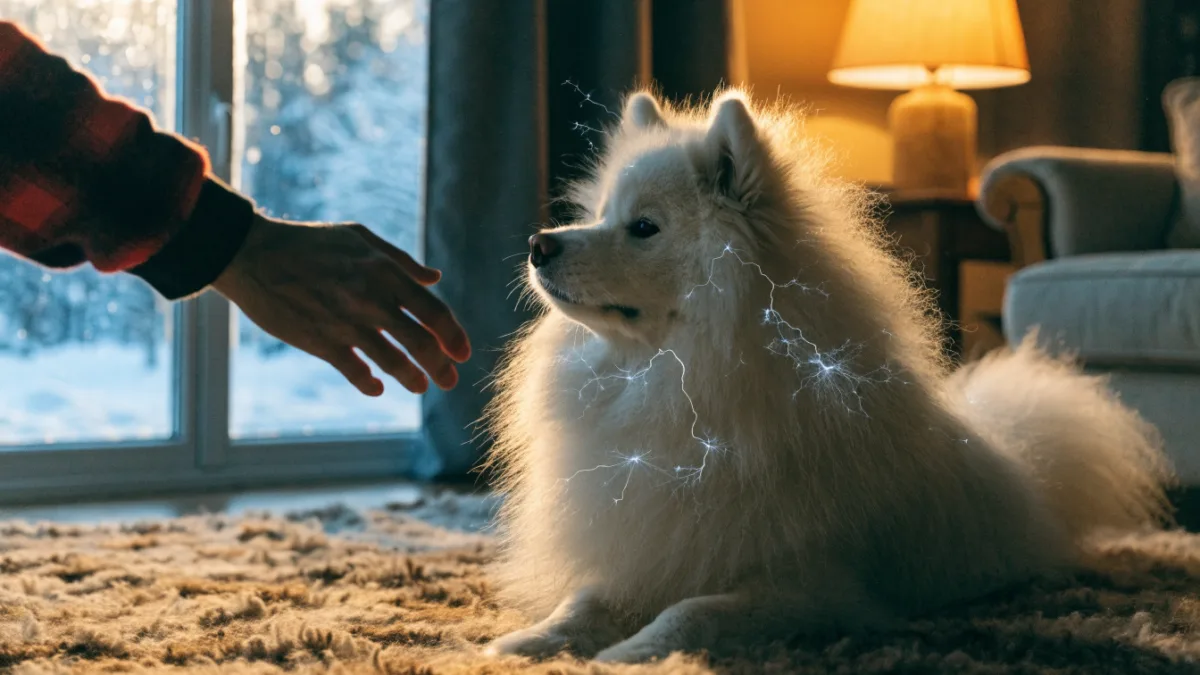
Last January, a client named Mark brought his four-year-old Golden Retriever, Barnaby, into the clinic. Mark looked completely defeated. He told me that Barnaby, a dog who usually lived for cuddles on the couch, had started hiding under the dining room table every evening. “He thinks I’m punishing him,” Mark said, his voice heavy with guilt. “Every time I reach out to pet him, he flinches.”
I knelt down in the dim light of the exam room, reached out to scratch behind Barnaby’s ears, and immediately understood the problem. Before my fingers even fully made contact with his thick golden fur, I heard it: a sharp, audible crack. A bright blue spark jumped from his ear to my fingertip. It stung my hand, and Barnaby immediately tucked his tail.
Barnaby wasn’t being stubborn or distant. He was getting painfully zapped every time the person he loved most tried to show him affection. Welcome to the unseen misery of pet shock in winter.
Why Your Pet is a Walking Tesla Coil
If you’ve spent a winter in a cold, dry climate, you know the feeling. You shuffle across the carpet in your socks, reach for a doorknob, and get a nasty jolt. Now, imagine you are covered head-to-toe in thick, fluffy hair.
The science behind this seasonal nuisance is surprisingly straightforward. As,[1] cold air is physically incapable of holding as much moisture as warm air. When we crank up our indoor heating systems to stay warm, we suck whatever remaining humidity is left right out of the environment. We essentially turn our homes into low-humidity deserts.
Static electricity needs two things to thrive: dry air and friction. When your dog rolls around on the carpet, or when your cat rubs up against their fleece bedding, electrons are transferred from one surface to another. In humid conditions, a thin layer of invisible moisture on the hair shafts acts as a natural conductor, allowing those rogue electrons to quietly bleed away. In dry winter air, that moisture layer is gone. The electrical charge just sits there, building up in your pet’s coat, waiting for a grounded target—like your hand—to discharge all at once.
As,[2] this is exactly why static shock is astronomically more common during the winter months. And when it comes to static electricity dog hair is the perfect insulator. Thick double-coated breeds—think Huskies, German Shepherds, and Retrievers—along with fluffy long-haired cats like Maine Coons and Persians, are essentially walking static generators. Their dense coats trap dry air and generate massive amounts of friction.
The Hidden Fire Hazard You Never Thought About
Now, let’s address the title of this piece. You might be wondering: can my pet actually catch on fire? Let’s clear the air. Static electricity will not spontaneously ignite your dog’s fur or your cat’s coat. The voltage required to set keratin (what hair is made of) on fire is far higher than a winter static shock can produce.
However, there is a genuine, hidden danger here that I discuss with my clients every winter. As noted in a fascinating,[3] static sparks produce visible electrical discharges. The real fire hazard lies in the environment around your charged-up pet.
A few winters ago, I treated a Persian cat named Luna. Luna’s owner was treating a minor skin irritation on the cat’s back leg. She had laid out a highly flammable fleece blanket on the bed, sprayed a flammable aerosol medical spray on the cat’s skin, and went to rub it in. Luna, heavily charged with static from the fleece, released a spark the moment her owner’s hand touched her nose. The spark didn’t hurt Luna, but it ignited the aerosol vapor. Thankfully, the owner only lost some eyebrow hair and a singed blanket, but it was a terrifying wake-up call.
If you are using medical oxygen for a pet, applying aerosol topicals, or even using rubbing alcohol near heavily charged, fluffy coats, that tiny little spark is more than enough to ignite flammable vapors. It’s a rare scenario, but one worth knowing about.
The Dryer Sheet Debate: A Popular Hack Gone Wrong
Whenever the topic of pet static comes up, someone inevitably suggests the internet’s favorite home remedy: rubbing a laundry dryer sheet over the dog or cat. I understand the impulse. Dryer sheets work wonders on human clothes, so why not on dog hair? I’ve even seen some old forum posts recommending it, but I’ve changed my mind on this over the years as the science caught up.
Please, do not use laundry dryer sheets on your pets.
Dryer sheets get their anti-static properties from a coating of fatty chemicals called cationic surfactants. These chemicals are highly toxic to dogs and cats. When you wipe a sheet over your pet’s coat, they ingest these chemicals later when they groom themselves. Even the “unscented” or “natural” varieties pose a severe toxicity risk, leading to drooling, vomiting, and oral ulcers. Similarly, using human skin lotions might seem like a good way to moisturize, but they often contain essential oils (like tea tree or eucalyptus) and artificial fragrances that are dangerous for pets to ingest.
Safe Moisturizing: How to Safely De-Charge Your Pet
So, how do we stop the sparks and get our cuddle buddies back? The goal is to safely introduce moisture back into the equation without stripping their natural oils or using toxic chemicals.
1. Master the Environment
The single best defense against winter static is a good humidifier. You don’t need anything fancy—just a clean, functional unit placed in the rooms where your pet spends the most time. By pushing humidity back into the air to around 40-50%, you restore that invisible layer of moisture to their hair shafts, allowing static charges to dissipate naturally.
2. The Damp Towel Technique
If you don’t have a humidifier, or if you need an immediate fix before a grooming session, try the damp towel method. Take a clean washcloth, run it under the faucet, and wring it out until it is just barely damp. Lightly wipe it over your pet’s coat. This safely discharges the built-up electricity without soaking their skin.
3. Rethink Bath Time and Grooming Tools
There is an ongoing debate about bathing pets in the winter. Over-bathing strips the coat of its natural sebum (skin oils), making dry skin and static much worse. However, skipping grooming entirely leads to dense, matted fur, which creates even more friction.
For proper winter cat grooming and canine care, stretch out the time between full baths, and when you do bathe them, look for moisturizing, oatmeal-based pet shampoos that are free of harsh sulfates. For daily brush-outs, you can look into the newer ionic pet grooming brushes hitting the market; they are designed to neutralize electrical charges without relying on chemical sprays.
4. Hydrate from the Inside Out
Finally, look at their food bowl. Pets experiencing dry winter coats are often slightly dehydrated. Encourage water intake by feeding a moisture-rich diet or adding warm water or unflavored, pet-safe bone broth to their kibble. I also highly recommend talking to your vet about adding an Omega-3 fatty acid supplement (like fish oil) to their diet. Omega-3s help the skin retain its natural moisture barrier, keeping the hair shafts supple and less prone to building up a charge.
Winter can be tough on our pets’ skin and coats, but with a little proactive moisture management, you can keep the air clear of blue sparks. Barnaby is back on the couch now, by the way. Mark invested in a bedroom humidifier, started wiping Barnaby down with a damp cloth before their evening TV time, and added an Omega-3 supplement to his breakfast. The static is entirely gone, and more importantly, so is the flinching. Remember, every time you reach out to your pet, it should be an experience of comfort and trust. By keeping their coats safely moisturized, you ensure that the only thing sparking this winter is the joy of their companionship.
Sources
- Discovery explains — discovery.com
- meteorologists point out — 13newsnow.com
- scientific discussion on the topic — reddit.com