

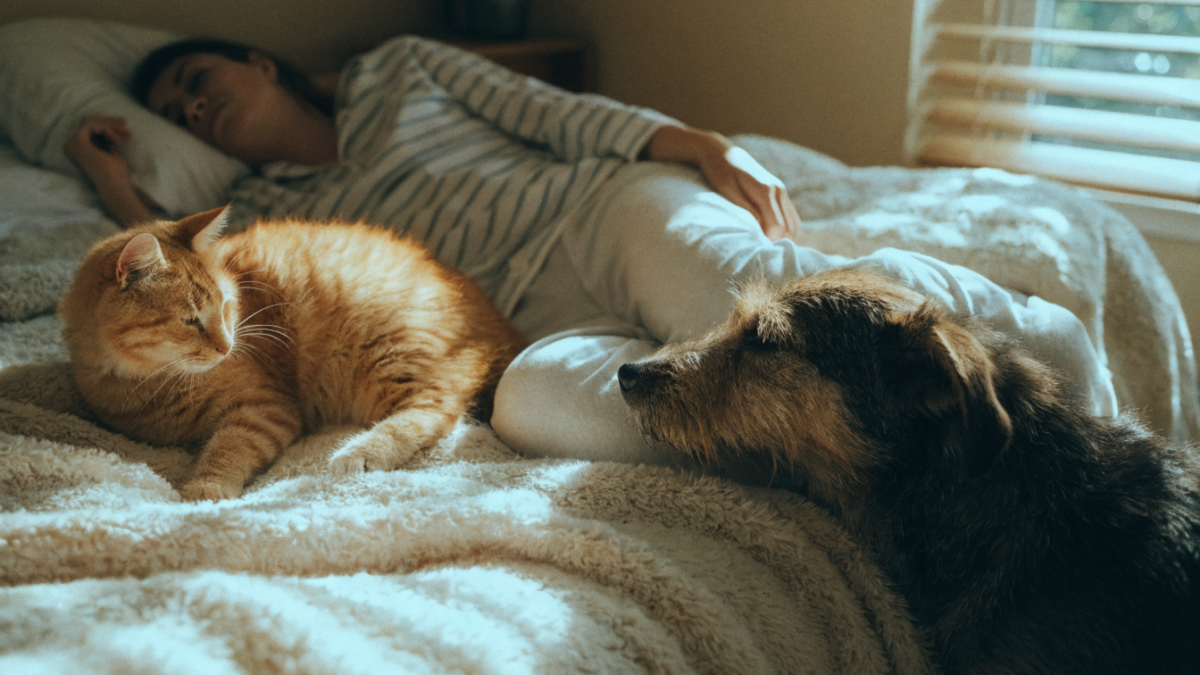
There is a specific, slightly agonizing phenomenon that happens in my apartment around 10:30 every night. My cat, Mochi—a 12-pound tortoiseshell with the delicate disposition of a Victorian fainting goat—will park herself directly on my stomach and begin aggressively stomping her paws into my intestines. She does this with her claws out. Meanwhile, if my neighbor’s massive Labrador is visiting, he’ll usually throw his entire 80-pound frame against my legs with the grace of a falling redwood, effectively pinning me to the mattress.
I wouldn’t change a thing, and honestly, neither would you. We let our pets compromise our spinal alignment and blood circulation every night because this intense, slightly uncomfortable physical contact is actually a profound display of primal trust. While a cat kneading your stomach might seem like a quirky (and mildly painful) bedtime routine, and a dog leaning heavily against your legs might feel like a passive-aggressive demand for attention, both behaviors are rooted in the exact same science of animal attachment.
The Chemistry of “Making Biscuits”
Let’s start with Mochi and her nightly biscuit-making operation. When cats rhythmically alternate their front paws, pushing in and out against a soft surface (usually your most vulnerable fleshy bits), they are actually triggering a cascade of feel-good brain chemicals. According to,[1] kneading activates the release of endorphins and oxytocin. These chemicals promote profound relaxation, well-being, and stress relief.
Neonatal Nostalgia
But why the stomping motion in the first place? It all traces back to kittenhood. Nursing kittens instinctively press their paws against their mother’s mammary glands to stimulate milk flow. When an adult cat does this to you, they aren’t literally expecting a snack—though knowing cats, they wouldn’t complain. They are mentally regressing to the safest, most secure moment of their lives.
When your adult cat kneads your stomach, they are explicitly telling you that they view you with the same unconditional trust they held for the creature that kept them alive as a newborn.
It is the ultimate compliment, even if it leaves you with tiny puncture wounds in your favorite pajamas. As the experts at [2] point out, kneading is a neonatal instinct that has been beautifully repurposed in adulthood as a mechanism for pure, unadulterated self-soothing.
The Physics and Psychology of the Canine Lean
Now, let’s look at the dog. When Mochi is done stomping on me and curls up on the pillow, that visiting Lab will inevitably shift his weight until he is pressed flush against my legs. Sometimes, he’ll rest his heavy chin right on my ankle. This isn’t just a dog being lazy or clingy; it is a classic pack behavior deeply embedded in canine ethology.
Dogs are intensely tactile creatures. In the wild, and among their wolf ancestors, physical touch is the literal glue that holds the family unit together. When a dog leans or sleeps heavily against your legs, they are relying on physical touch to demonstrate pack unity. They are also claiming you. Dogs have scent glands along their bodies, and by pressing into you, they are subtly leaving their pheromones behind, effectively marking you as a core member of their family.
Moving Past the “Dominance” Myth
For a long time, outdated dog training advice pushed the idea that a dog leaning on you was trying to assert dominance. Modern veterinary behavioral science has thoroughly debunked this. The current scientific consensus focuses on attachment theory. Your dog isn’t trying to stage a household coup; they are engaging in a secure attachment behavior that perfectly mirrors a human child clinging to a parent’s leg. They lean on you because they want to feel physically secure enough to enter a vulnerable sleep state.
Plot Twist: Dogs Make Biscuits, Too
Because we naturally separate “cat people” and “dog people” into these neat little categories, we often miss the beautiful overlap in their biology. Here is the shocking truth: dogs knead, too.
If you’ve ever seen a dog rhythmically pawing at their dog bed, a plush blanket, or even your lap before circling three times and collapsing, you are witnessing cross-species mirroring. Just like cats, dogs engage in suckling or kneading to recreate the warmth and security of their litter. A fascinating discussion over at [3] highlights how common this behavior actually is among our canine companions. Whether it’s a cat or a dog, the goal is the same: to self-soothe, induce sleep, and build a safe, comfortable nesting space out of thin air.
The Vulnerability of Sleep
To truly understand why your pets treat you like a body pillow, you have to look at the biological reality of sleep. Going to sleep is the most fundamentally vulnerable act for any animal in the wild. You drop your defenses, close your eyes, and enter a state where you cannot detect approaching predators.
When your dog presses his spine against your thigh, or your cat burrows under the covers to knead your ribs, they are communicating something deeply profound. They are saying, without a shadow of a doubt, that they trust you with their lives. They are using your body heat—harkening back to sleeping in a pile with littermates for thermoregulation—and your presence as a shield against the world.
I’ll leave the formal training methods to my colleague Jake, but from a behavioral standpoint, if your pet is pressing their body against yours at bedtime, you are officially the designated safe zone. You are their protector.
Love, Anxiety, and the Claw Dilemma
Of course, no scientific explanation makes tiny cat claws in your spleen feel physically pleasant. Because cats knead using their claws, it can be a highly painful experience for the owner, which leads to a minor debate among animal behaviorists and pet parents alike: do you gently redirect the behavior, or do you simply accept it as the unavoidable price of your cat’s affection?
I have a strict policy: I keep a thick, folded blanket next to the bed. When Mochi is ready to make biscuits, I slide the blanket between her claws and my flesh. It’s a compromise. She gets to stimulate her endorphins and regress to a state of blissful kittenhood, and I get to keep the top layer of my skin.
However, there is a slightly more serious debate regarding the root cause of adult kneading and leaning. While mostly viewed as a sign of contentment, some experts argue that excessive, frantic kneading or suckling—especially in adult dogs—can be a sign of premature weaning or underlying separation anxiety.
If your dog is obsessively suckling a blanket to the point of destroying it, or your cat is kneading so frantically they can’t settle down, it’s worth a chat with your vet. But for the vast majority of us, these bedtime routines are just a primal, healthy way for our pets to relieve the stress of a busy day of napping and begging for treats.
When we talk about animal welfare and conservation, we usually think about wild habitats or rescue shelters. But for domestic dogs and cats, our homes are their entire ecosystem. The preservation of the human-animal bond relies entirely on us understanding and accommodating these deeply ingrained, primal behaviors. Translating a heavy lean or a painful knead into what it actually is—a biological request for security and an offering of unconditional love—is the ultimate act of conservation for the animals sharing our roofs. We are their safe harbor. And honestly, a few puncture wounds are a small price to pay for that kind of trust.
Sources
- PetMD — petmd.com
- Figo Pet Insurance — figopetinsurance.com
- JR's Pups N Stuff — facebook.com