
I used to think dogs had a sixth sense for bad weather. I remember sitting with a client in her living room a few years ago. Her German Shepherd, a rock-solid dog named Atlas, suddenly jumped off the couch, started pacing, and shoved his hundred-pound body under the coffee table. The sun was still shining. Ten minutes later, the sky turned green and a massive thunderstorm rolled in. But here’s what really got me: while Atlas was having a meltdown, the client’s two cats had completely vanished. They were nowhere to be found. They didn’t panic or pace. They just ghosted. If you’ve ever watched your own pets react to an incoming storm, you’ve probably noticed this exact same split.
Your Dog Isn’t Psychic, Just Built Differently
We humans rely mostly on our eyes and ears. When we see lightning or hear thunder, we know a storm is happening. Dogs and cats, on the other hand, are walking weather stations. They don’t need to see the sky to know a front is moving in. They can actually feel it.
As atmospheric pressure drops before a storm hits, our pets pick up on that exact shift through their highly sensitive nervous systems. Dogs are also incredibly sensitive to changes in static electricity. If you’ve ever seen your dog refuse to go outside right before a rainstorm, it isn’t because they’re being stubborn. Their internal early-warning system is already screaming at them that the environment is changing. By the time you hear the first raindrop, your dog or cat has already been experiencing the storm for a while.
Beyond the Thunderclap: The Hidden Triggers
Most of us assume storm phobia is strictly about the loud booms of thunder. I used to make that exact mistake. A guy on an online pet forum recently mentioned that his dog loses his mind whenever it rains, even when there’s no thunder in the forecast. He thought the dog was just acting out. The truth is, thunder is only one piece of a much larger, multi-sensory puzzle.
Think about what a storm actually sounds like to an animal with hearing far superior to ours. The heavy, pounding noise of rain hammering on a roof or smashing against windows is incredibly loud. Combine that with howling wind, the sudden darkening of the sky, and the drop in barometric pressure, and you’ve got a recipe for sensory overload.
It’s also crucial to understand that a dog’s reaction to a storm is usually a magnification of their baseline anxiety. If you have a highly anxious dog who stresses out about loud trucks or the doorbell, they are a prime candidate for severe storm phobia. The storm just takes whatever underlying anxiety they already carry and cranks the volume all the way up.
The Tale of Two Species: Panic vs. Ghosting
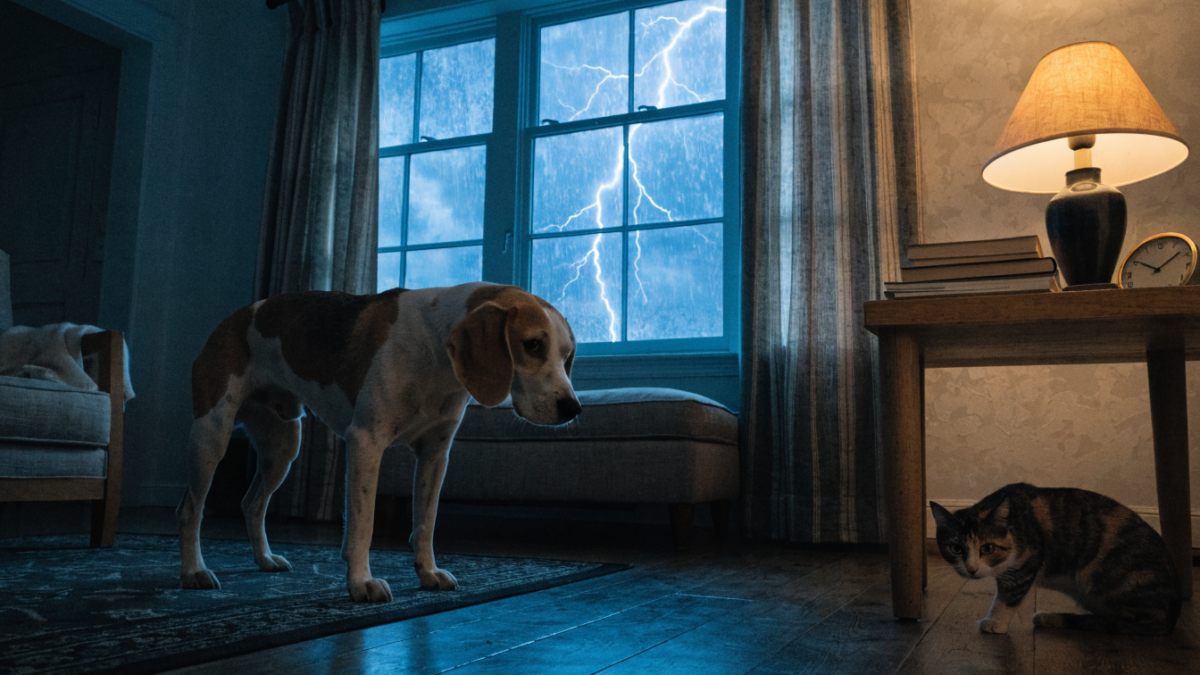
So why do dogs throw a massive fit while cats simply disappear? It all comes down to how the two species are wired to handle perceived threats.
The Canine Meltdown
Dogs are pack animals. When a dog gets scared, their instinct is often to seek out their pack—which, in this case, is you. A panicked dog will rarely suffer in silence. They want you to know they are terrified, and they want you to fix it.
I’ve seen dogs absolutely destroy baseboards, claw through drywall, and break their own teeth trying to get out of a crate during a storm. They pace, they drool, they pant heavily, and they turn into hundred-pound lap dogs. They act out because they are looking for human intervention and a way to escape the invisible pressure they feel.
The Feline Vanishing Act
There’s a long-standing debate among pet owners about whether cats actually get scared during storms or if they just don’t care. I’ve heard plenty of folks say their dogs are terrified while their cats are completely unbothered. But veterinarians will tell you a different story: cats absolutely do get afraid. The debate exists purely because cats manifest their fear in the exact opposite way dogs do.
Cats are solitary survivors. When a predator or a threat approaches, a cat’s best evolutionary defense is to mask their fear and find a secure, enclosed hiding spot. They don’t howl for help because making noise would attract predators in the wild. Instead, they silently retreat to the darkest, tightest corner they can find—under the bed, inside a closet, or even deep inside a box spring. When the first drop of rain falls and your cat disappears, they aren’t being aloof. They are executing a survival strategy to wait out the threat until the storm passes.
The Great Cuddling Debate: Does Comfort Equal Reward?
There’s an old-school piece of advice that still floats around: if you cuddle or comfort your dog during a storm, you are rewarding their fear and making it worse. Let me be clear—I used to believe this. I used to tell owners to ignore their dogs when they panicked. I was completely wrong.
Modern animal behaviorists agree that you cannot reinforce an emotion. Petting your dog when they are terrified of a loud boom isn’t going to teach them to be more afraid next time. Comfort won’t make the fear worse, but the problem is that just holding them usually isn’t enough to fix the panic, either.
The consensus has shifted toward finding a balance. Yes, offer your support. Speak softly, pet them gently, and be a calm presence. But you also need to teach them to utilize a “safe zone.” Relying entirely on your physical contact isn’t a great long-term strategy, especially if a storm hits while you aren’t home. You want to encourage them to seek out a covered crate, an interior closet, or a quiet basement bathroom.
Proactive Beats Reactive Every Time
Waiting for the sky to crack open to suddenly address your dog’s anxiety is a losing battle. You have to handle storm phobia proactively, long before the barometric pressure drops.
First, figure out where your pet naturally wants to go when it rains. If your dog runs to the downstairs bathroom, make that space cozy for them. Put down their favorite blankets, close the blinds to block the lightning, and maybe play some white noise or classical music to help drown out the sound of the heavy rain on the roof. If your cat hides under the guest room bed, leave them there. Don’t drag them out. Make sure they have access to a litter box and water nearby so they don’t have to brave the “scary” house until they feel safe.
You can also try an anxiety wrap. These are snug-fitting shirts that apply gentle, constant pressure to a dog’s torso, similar to swaddling a baby. When you’re shopping for one, look for a vest made of breathable, stretchy fabric that has adjustable fasteners so you can get a secure fit without restricting their movement. Many owners swear by pheromone diffusers, too, which release synthetic calming signals into the air.
If your dog’s baseline anxiety is through the roof, you might want to look into desensitization training. This involves playing storm sound effects at a very low volume while doing high-value activities like feeding or playing fetch, slowly increasing the volume over weeks or months.
And please, drop the guilt about talking to your vet. If your dog is destroying drywall or putting themselves in physical danger, storm anxiety is a legitimate, severe psychological phobia. Modern veterinary medicine has made great strides here. There are excellent anti-anxiety medications available that can take the edge off just enough for a panicked dog to actually process the comfort and training you’re offering them. It isn’t a failure to use medication; it’s giving your dog the relief they desperately need.
Whether you have a dog who climbs into your lap at the first flash of lightning or a cat who turns into a ghost the second it starts pouring, remember that their reactions are deeply ingrained in their biology. They aren’t being naughty, and they aren’t giving you a hard time—they’re having a hard time. Our pets are still carrying the instincts of their wild ancestors. When we take the time to understand how they experience the world, from the static electricity in the air to the pounding rain on the roof, we stop getting frustrated by their behavior and start becoming the safe harbor they need to ride out the storm.