

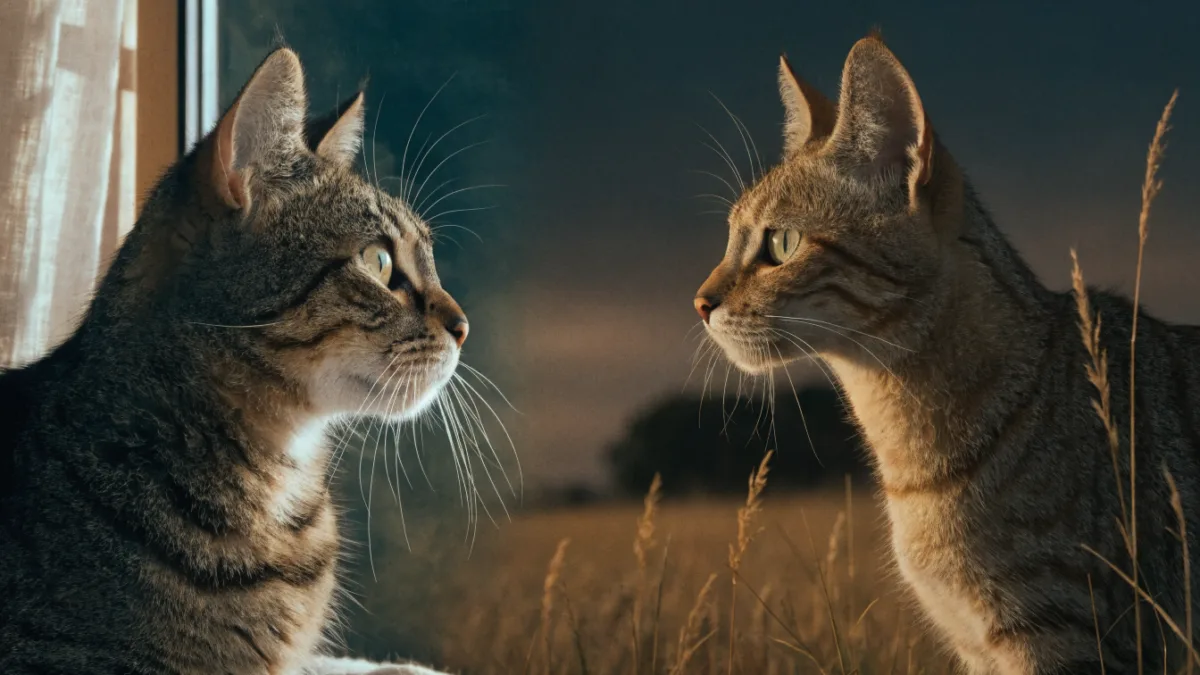
I once fostered an Abyssinian named Cyrus who could hear a mouse twitch in the walls from two rooms away. He’d freeze mid-yawn, rotate his ears like satellite dishes, and then spend the next hour glued to the baseboard. That cat had hardware that belonged on the savanna — and the thing is, every domestic cat does. The more I’ve learned about comparative sensory biology, the more I’ve come to accept something that sounds strange but is just plain true: your house cat is essentially a small wildcat that tolerates you. Dogs walked a completely different evolutionary road, and the sensory differences between the two species tell that story better than any genetic study can.
Taste Buds Don’t Lie
Let’s start with something that sounds trivial but is actually one of the cleanest examples of ancestry written into biology. Cats — every single one of them, from a Maine Coon in Manitoba to a Scottish wildcat denning in the Cairngorms — cannot taste sweetness. They carry a mutation in the Tas1r2 gene that prevents their sweet taste receptors from binding to sugary molecules. The receptor is broken. It has been broken since before domestication.
This isn’t a quirk. It’s a record. The ancestors of modern cats committed to a strict-meat diet so completely that the ability to detect carbohydrates became irrelevant. A broken gene only stays broken if nothing in the environment punishes you for having it, which tells you cats haven’t needed to locate starches or sugars for millions of years. Dogs, by contrast, can taste sweetness just fine — because their ancestors ate whatever was available, including fruit, tubers, and eventually human garbage.
I think about this every time someone tells me their cat “loves” cake or ice cream. They don’t love the sweetness. They’re after the fat and the amino acids. The sugar is invisible to them.
The Cat That Domesticated Itself
Light Domestication, Wild Senses
Here’s where cats and dogs diverge in a way that matters for every sense organ they possess. When humans domesticated wolves into dogs, we applied intense selective pressure over thousands of years. We bred dogs to track scent, herd sheep, retrieve game, guard property, and fit into human social structures. That process reshaped everything from skull shape to brain volume to olfactory receptor counts. A bloodhound’s nose and a bulldog’s nose are not the same instrument.
Cats got none of that. The archaeological record places cat domestication roughly 10,000 years ago in the Fertile Crescent, and it happened because cats figured out that human grain stores attracted rodents, and rodents were worth hanging around for. Humans didn’t select cats for anything. We just stopped killing the ones that were useful. The 2007 Driscoll study and subsequent genomic work have confirmed that domestic cats show almost no reduction in genetic diversity compared to their wild ancestor, the African wildcat (Felis lybica). A house cat’s genome is roughly 95.6% identical to a wildcat’s. Genetically, morphologically, and sensorially, they are barely a step apart.
That tapetum lucidum — the reflective layer behind the retina that makes cat eyes glow green in your headlights — is identical in structure to what you’d find in a wildcat. Their olfactory epithelium, the tissue inside the nasal cavity where scent molecules bind to receptors, is the same. Those independently rotating ears, driven by 32 separate muscles, are the same mechanism wildcats use to pin down the direction of prey in tall grass. Nothing about your cat’s sensory hardware was softened by domestication. It was left exactly as it was because nothing needed to change.
Where Dogs Diverged
Dogs are the more interesting case study precisely because their senses did change. The domestication process selected for animals that could read human social cues, digest new food sources, and work alongside us rather than independently. A 2013 study out of Uppsala University identified that dogs carry specific gene variants for starch digestion that wolves lack — meaning dogs didn’t just behave differently around humans, they biochemically adapted to eat our food.
That dietary shift shows up in the senses. Dogs retained an extraordinary sense of smell — far better than ours — but the relationship between smell and behavior changed. Where a wolf uses its nose primarily to locate and track live prey across miles of territory, many dog breeds were selected to use scent in partnership with a handler. Pointers freeze and indicate. Retrievers mark fallen game and respond to whistle commands. Hounds vocalize on a trail so the hunter can follow. The hardware stayed powerful, but the software — the behavioral wiring that connects smell to action — was rewritten by human selection.
I’ve handled working-line German Shepherds whose noses are genuinely awe-inspiring, and I’ve met show-line dogs who couldn’t find a treat in an empty room. That range is a product of selective breeding. Wolves don’t have that range. Cats don’t either, because nobody spent a thousand years breeding cats to do specialized sensory tasks.
Why People See “Wild” When It Isn’t There
The misidentification problem is real, and it stems directly from how little sensory and morphological distance exists between certain domestic animals and their wild ancestors. I’ve seen people insist a Bengal cat is “half-leopard” — it’s not, the breed crosses the Asian Leopard Cat several generations back, but the rosetted coat, the long legs, and the intense, fixed stare of a cat whose pupils still dilate like a jungle hunter’s make the perception understandable. Savannah cats, bred from serval crossings, trigger the same reaction. The animal moves like a wild thing because its nervous system and sensory processing are closer to wild than most people expect from something that eats from a bowl on the kitchen floor.
On the canine side, wolfdog misidentification runs in the opposite direction. People see a dog with a wolf-like coat and yellow eyes and assume it has recent wolf ancestry, when in reality northern breeds like the Alaskan Malamute and Siberian Husky carry zero wolf genetics but retain primitive physical traits because those traits were never bred out. The upright ears, the dense double coat, the almond eyes — those are ancient canid features, not evidence of hybridization.
The ethics of actual hybrid breeding — Bengals, Savannahs, wolfdogs — is a subject I have strong feelings about. When you breed an animal whose sensory drives are calibrated for survival in the wild, you get an animal whose sensory drives don’t fit neatly into a living room. Bengals and Savannahs frequently have nocturnal activity patterns, intense prey drives, and spatial needs that exceed what most owners can provide. The result is surrendered animals, behavioral euthanasia, and frustrated owners who were marketed an “exotic companion” and got something closer to a wild animal with a collar.
The Conservation Problem Nobody Wants to Talk About
Because domestic cats are so genetically and sensorially close to wildcats, they pose a direct threat to wild populations through hybridization. In Scotland, the European wildcat population has been so thoroughly diluted by interbreeding with feral domestic cats that researchers debate whether any genetically pure Scottish wildcats remain. South Africa faces a similar crisis with the African wildcat, where the boundary between domestic and wild gene pools has effectively collapsed in some regions.
And then there’s the predation issue. A cat with wildcat-grade senses — night vision, rotational hearing, a nose calibrated for small mammal scent trails — loose in an ecosystem that didn’t evolve to defend against it is an ecological disaster. Studies in North America estimate that free-ranging domestic cats kill billions of birds and small mammals annually. This isn’t malice on the cat’s part. The sensory hardware is doing exactly what it evolved to do. The problem is that humans put that hardware in places it was never meant to operate.
Dogs cause their own conservation headaches — feral dog populations disrupt wildlife in numerous regions — but the cat situation is uniquely pressing because the species is, biologically, still a wildcat in nearly every measurable way.
If there’s a takeaway from all of this, it’s that domestication is not a uniform process. It reshaped the dog into something genuinely new, a sensory creature adapted to coexistence with humans. It barely touched the cat, leaving us with an animal that can purr on your lap and then stalk a grasshopper across the yard with the same eyes, ears, and instincts its ancestors used on the African savanna. Respecting that reality — by keeping cats indoors, by refusing to support hybrid breeding, by understanding that the animal on your rug has wilderness baked into its DNA — is the least we owe them.