

I’ll never forget a Tuesday afternoon a few years ago when a client brought her four-year-old Siamese cat, Leo, into the clinic. Leo had lost a alarming amount of weight, his once-glossy coat was dull and falling out in clumps, and he was so lethargic he barely lifted his head. When I asked what Leo was eating, his owner proudly told me she had recently transitioned him to a strict vegan diet. She was a lifelong vegan herself and wanted her lifestyle to align with her pet care. Her intentions were rooted in deep love and compassion, but unfortunately, cats simply do not possess the biological hardware to survive on a plant-based diet.
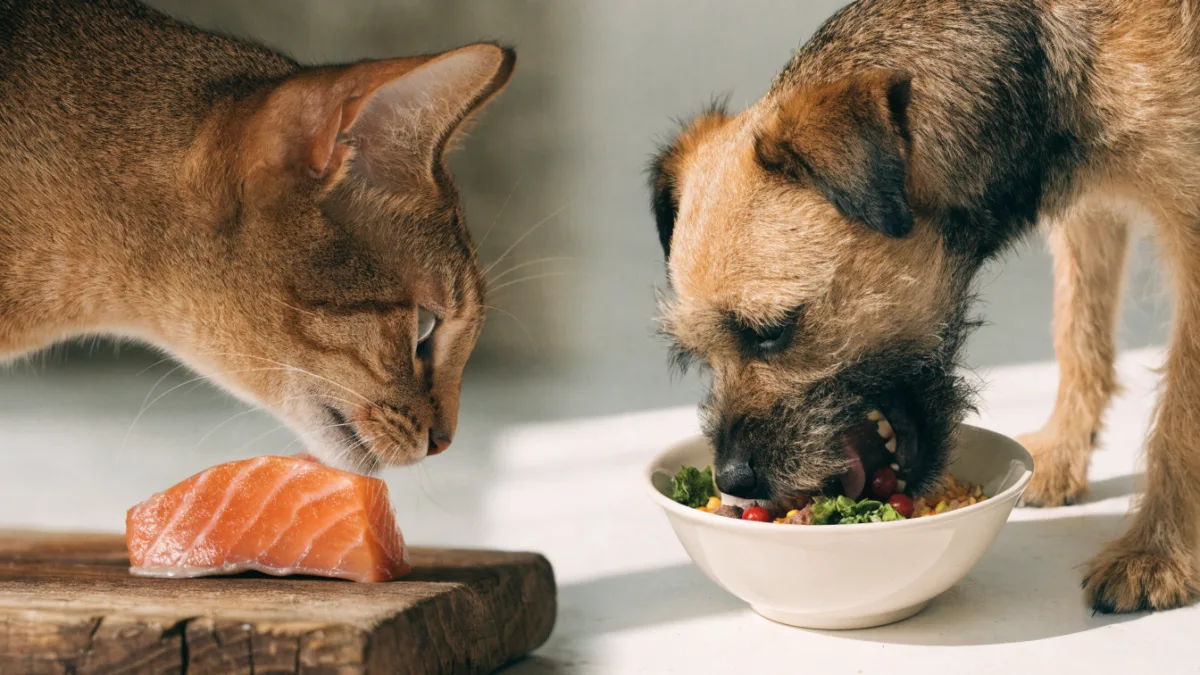
This is a conversation I have frequently in the exam room. Well-meaning owners want to share their dietary philosophies with their pets, but doing so requires us to understand a fundamental biological divide between our two most popular companion animals. When we look at cats and dogs, we are looking at two entirely different evolutionary blueprints. Cats are obligate carnivores, meaning they must eat animal tissue to survive. Dogs, on the other hand, are scavenging omnivores or adaptable carnivores, meaning they have the physiological flexibility to extract nutrients from a much wider variety of food sources.
The Myth of the Vegetarian Cat: Understanding the Obligate Carnivore
To understand why a vegan diet will eventually kill a cat, we have to look at their ancestry. Domestic cats trace their lineage directly back to the African Wildcat. These wild ancestors were solitary hunters that consumed prey containing minimal amounts of carbohydrates. Because their natural diet was almost exclusively made up of protein and fat, cats never evolved the biological machinery required to break down plant cellulose or synthesize vital nutrients from plant matter. They are what we call “true” or “obligate” carnivores.
The clearest way to explain this is to break down what happens in the cat’s liver. Humans and dogs have specific liver enzymes that allow us to convert plant-based compounds into the active amino acids and vitamins our bodies need. Cats lack these enzymes entirely.
The Taurine and Vitamin A Factor
Take taurine, for example. Taurine is an amino acid essential for normal heart function, vision, and reproduction. Most mammals can synthesize taurine from other amino acids found in plants. Cats cannot. They lack the necessary enzyme pathway to make this conversion, meaning they must consume pre-formed taurine, which is found exclusively in animal tissue like muscle meat and organs. Without it, cats develop a fatal heart condition called dilated cardiomyopathy (DCM) and go irreversibly blind due to retinal degeneration.
The same rule applies to Vitamin A. While a dog or a human can eat a carrot and convert the beta-carotene into active Vitamin A, a cat’s body lacks the intestinal enzyme to make this conversion. They need pre-formed Vitamin A, which is naturally found in liver and fish oils. No matter how much plant matter a cat eats, their cells will starve for these vital nutrients.
Why Your Dog Acts Like a Living Vacuum
Now, let’s look at the other side of the waiting room. If you have a dog, you’ve probably watched them hoover up a dropped piece of broccoli, a chunk of bread, or half a sweet potato with absolute glee. Dogs are classified as scavenging omnivores or facultative carnivores. While their dental anatomy is still designed around tearing and shearing meat, their gastrointestinal tract has evolved to handle variety.
Historically, dogs evolved alongside human settlements for thousands of years. As we transitioned from hunter-gatherers to agricultural societies, dogs became our scavengers. They survived on our leftover scraps, waste, and refuse. Over millennia, this close proximity to human agriculture permanently altered the dog’s genome.
Modern dogs possess multiple copies of a gene called AMY2B, which allows them to produce significant amounts of amylase—the enzyme responsible for breaking down starches and carbohydrates. Wolves, by contrast, have very few copies of this gene. This genetic adaptation is exactly why your Golden Retriever can digest a bowl of rice or sweet potato without issue, whereas a wolf would struggle to process those carbohydrates efficiently.
The Vegan Dog Debate
Because of this biological flexibility, the debate over feeding dogs a strictly vegan or vegetarian diet is highly controversial. While it is universally agreed in the veterinary community that cats cannot be vegan, the conversation around dogs is much more nuanced. Proponents point to a dog’s ability to digest plant starches, while detractors—myself included—urge extreme caution.
I’ve changed my mind on this over the years. Early in my career, I was completely dismissive of meat-free diets for dogs. Today, I recognize that because dogs are omnivores, they can technically survive on a carefully formulated, synthetically supplemented plant-based diet. However, surviving is not the same as thriving. Synthetic supplements are often a poor substitute for the complex, whole-food animal proteins that provide optimal bioavailability. If an owner is determined to feed their dog a diet lower in meat, I always redirect them to evidence-based, commercially formulated options and insist on bloodwork monitoring, rather than recommending home-cooked meat-free recipes.
Navigating the “Carnivore Fantasy” in Commercial Cat Food
Understanding feline biology also forces us to look critically at what we put in their food bowls every day. One of the biggest frustrations I have as a clinician is the “carnivore fantasy” sold by the commercial pet food industry. Because dry kibble requires carbohydrates to bind the food together and allow it to pass through the manufacturing extruders, many commercial cat foods are incredibly high in carbohydrates.
When we feed a high-carb, plant-heavy dry kibble to an animal that has zero evolutionary drive or biological need for carbohydrates, we set them up for metabolic disaster. Cats are not designed to process steady streams of dietary sugar. Their natural diet would consist of around 2-3% carbohydrates. When their diet consists of 30-40% carbs, it overworks the pancreas and liver, leading to a rampant epidemic of feline obesity and type-2 diabetes.
When I diagnose a cat like a nine-year-old tabby named Barnaby with diabetes, the very first thing I do—before reaching for insulin—is change his diet. By transitioning Barnaby to a high-protein, low-carbohydrate, moisture-rich diet that actually mimics his biological needs, we often see his blood sugar regulate naturally. The food is the medicine.
Looking Forward: Lab-Grown Meat and Ancestral Diets
Fortunately, the pet food industry is beginning to catch up with feline biology. There has been a massive surge in high-protein, biologically appropriate diets, including the “BARF” diet (Biologically Appropriate Raw Food). While raw diets carry their own risks regarding bacterial contamination and nutritional balancing, they highlight a growing push to move cats away from high-carb kibble and toward lower-carb, higher-moisture alternatives.
One of the most exciting recent developments is the introduction of lab-grown, or cultured meat, for pets. This technology allows us to provide biologically essential animal protein to obligate carnivores like cats without the heavy environmental toll or ethical concerns of traditional factory farming. It offers a fascinating middle ground for owners who want to minimize their pet’s environmental pawprint without compromising their biological need for meat.
At the end of the day, when we bring animals into our homes, we make a promise to care for them according to their needs, not our human philosophies. It is a beautiful thing to want to reduce our impact on the planet, but we must remember that our domestic cats carry the exact same biology as their wild ancestors. In fact, the African Wildcat—the direct ancestor of our house cats—is currently facing severe habitat loss and fragmentation across its native range in Africa and the Middle East. When we look at our domestic felines, we are looking at a wild predator that simply chose to share our hearths. By feeding them the animal-based nutrition their bodies were meticulously designed to process, we honor their wild heritage and keep them thriving in our living rooms for years to come.