

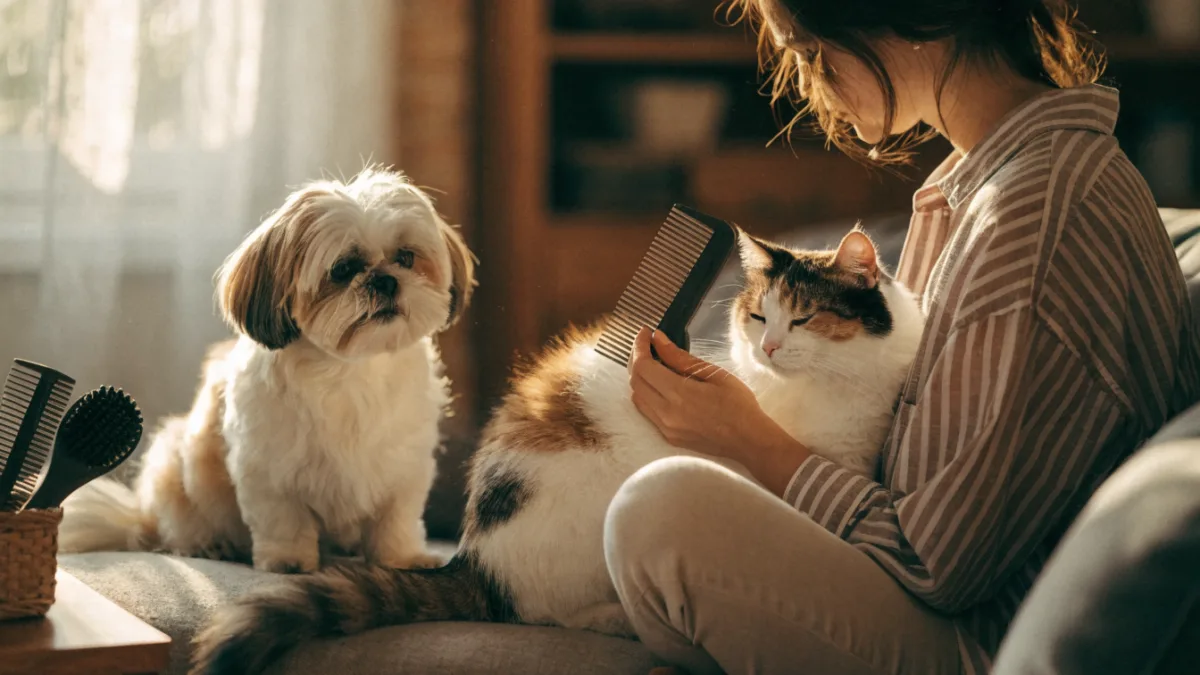
I once fostered a rescue Persian cat named Barnaby who came in looking like he’d been assembled from discarded carpet samples. His coat was a solid sheet of felted hair pulled so tight against his skin he couldn’t rotate his neck to clean himself. The vet had to sedate him just to shave the coat down safely. That single de-matting session cost the rescue over $150. Barnaby was a extreme case, but the principle applies to every dog and cat sharing your house. Professional grooming is expensive, and the vast majority of the damage groomers have to fix is entirely preventable with five minutes of your time every day.
The Real Cost of Skipping the Brush
Let’s talk about the math. A standard professional groom for a small to medium dog starts around $40 just for a bath and blowout, and that is before you add the $10 nail trim, ear cleaning, and haircut. For long-haired dogs and cats, a full groom runs anywhere from $80 to $150 depending on your area and the condition of the coat. Long-haired pets require a full groom every 4 to 8 weeks to stay manageable. If you let them turn into a walking briar patch, groomers charge a dematting fee—or worse, they have to shave the coat down to the skin.
Brushing your pet isn’t just a cosmetic luxury. It is a basic health requirement. When dead undercoat gets trapped against the skin, it blocks airflow. Moisture gets locked in, bacteria breeds, and the skin underneath starts to rot. Matting is painful. The hair continuously pulls on the follicles, creating a constant, dull ache. I’ve seen dogs who refused to sit down because the matted hair on their rear ends was pulling their skin tight. When you brush your pet daily, you are protecting their skin and preventing severe, painful conditions that require veterinary intervention.
How to Actually Brush (Most People Do It Wrong)
The biggest mistake pet owners make is doing a surface sweep. You take a soft-bristle brush, stroke the top of the dog’s back a few times, and call it a day. The top layer looks shiny, so you assume the coat is fine. Meanwhile, the undercoat is turning into concrete right against the skin.
To brush effectively, you need a slicker brush and a steel comb. The comb is your truth-teller. If the comb goes through the coat down to the skin without catching, the coat is actually tangle-free. You work in sections. Push the hair up with one hand, and brush down a small line of hair all the way to the root. Move over an inch, and do it again. This is called “line brushing,” and it is the only way to get through a thick double coat or a fine, cottony coat like a Poodle or a Doodle.
Short-Haired Pets Still Count
Don’t assume your short-haired Pitbull or Siamese cat gets a free pass. They don’t mat, but they still shed, and they still need their coat worked. A rubber curry comb or a hound glove takes two minutes to pull out the dead, loose hair. This stops them from ingesting it when they self-groom, keeps your furniture clean, and distributes natural oils across their skin to keep the coat healthy.
The Anatomy of a Five-Minute Routine
Five minutes a day is all it takes to completely change your pet’s coat health and stretch your grooming budget. According to the ASPCA and experts like Amy Shojai, who developed the “30 Days to Pawfection” at-home grooming guide, a complete maintenance routine touches on a few core areas. You don’t have to do all of them every single day, but the daily brushing is the anchor. Here is how to break down your daily five minutes:
- Minutes 1-3: Line Brushing. Target the friction zones. This means behind the ears, under the collar, the armpits, and the groin. If a cat or dog is going to mat, it will happen in these high-friction areas first.
- Minute 4: Eyes and Ears. Take a damp cotton round and wipe away the eye crust. Check the ears for dirt or excess wax. Catching an ear infection a week early saves you a $200 vet bill.
- Minute 5: The Combing Pass. Run your steel comb through the areas you just brushed to verify there are no hidden knots. Follow up with a quick wipe of their paw pads to remove debris.
If you do this every day while you watch television or wait for your coffee to brew, you will never have to pay a groomer to dematt your pet again.
Knowing Where to Draw the Line
The rise of “vet hacks” and DIY pet care is empowering, but we need to be realistic about safety limits. A complete professional groom encompasses five things: bathing and brushing, fur trimming, “paw-dicures” (nail trims), eye and ear cleaning, and skincare. You can absolutely handle the brushing, eye cleaning, and ear maintenance at home. You should leave the rest to the professionals unless you have been properly trained.
Cutting hair with scissors is one of the most dangerous things a pet owner can attempt. Dogs and cats have incredibly thin skin, especially on their ears, underbellies, and the folds of their legs. When a dog jumps because you accidentally pulled a tangle, those scissors can slice straight through the skin, resulting in an emergency vet trip that costs ten times more than the groom you were trying to save money on.
Nail trims are also risky for inexperienced owners. Cut into the quick—the blood vessel and nerve inside the nail—and your pet will bleed everywhere and develop a lifelong fear of having their feet touched. If you don’t know how to find the quick, let a pro handle it. There is no shame in relying on mobile groomers who charge $10 to swing by your house for a quick nail trim, or dropping your dog off for a professional bath and haircut every six weeks. You are still saving money because your daily brushing habit ensures the groomer doesn’t have to charge you for dematting time.
Killing the “Hypoallergenic” Myth
Before you buy a Poodle mix or a Bichon Frise because you heard they don’t shed, you need to understand the reality of those coats. There is no such thing as a truly hypoallergenic dog or cat. Allergens are found in pet dander, saliva, and urine, not just the hair itself.
When people talk about “hypoallergenic” breeds, they are referring to dogs with hair instead of fur. Hair continuously grows and rarely falls out on its own. This sounds great until you realize that a dog with continuously growing hair requires constant brushing. Hair left unbrushed does not fall on your floor; it stays tangled in the coat, wrapping around itself and pulling neighboring hairs until the entire coat forms one giant mat. This is why Doodle owners end up at the groomer every four weeks begging for a shave-down. If you want a non-shedding dog, be prepared to commit to that five-minute brushing routine with absolute religious dedication.
Respecting the Animal in Front of You
We domesticated dogs and cats, bringing them into our climate-controlled homes and modifying their genetics to grow hair that would put a prize-winning show sheep to shame. Because we engineered them to look the way we want, we owe them the basic dignity of maintaining their physical comfort. Leaving a dog or cat to suffer in a matted, painful coat because grooming is “too expensive” or “too much work” is a failure of our responsibility to that animal. Spend the five minutes. Buy a steel comb. Keep their skin healthy and their hair free of tangles, and I guarantee both your pet and your bank account will be better off for it.