

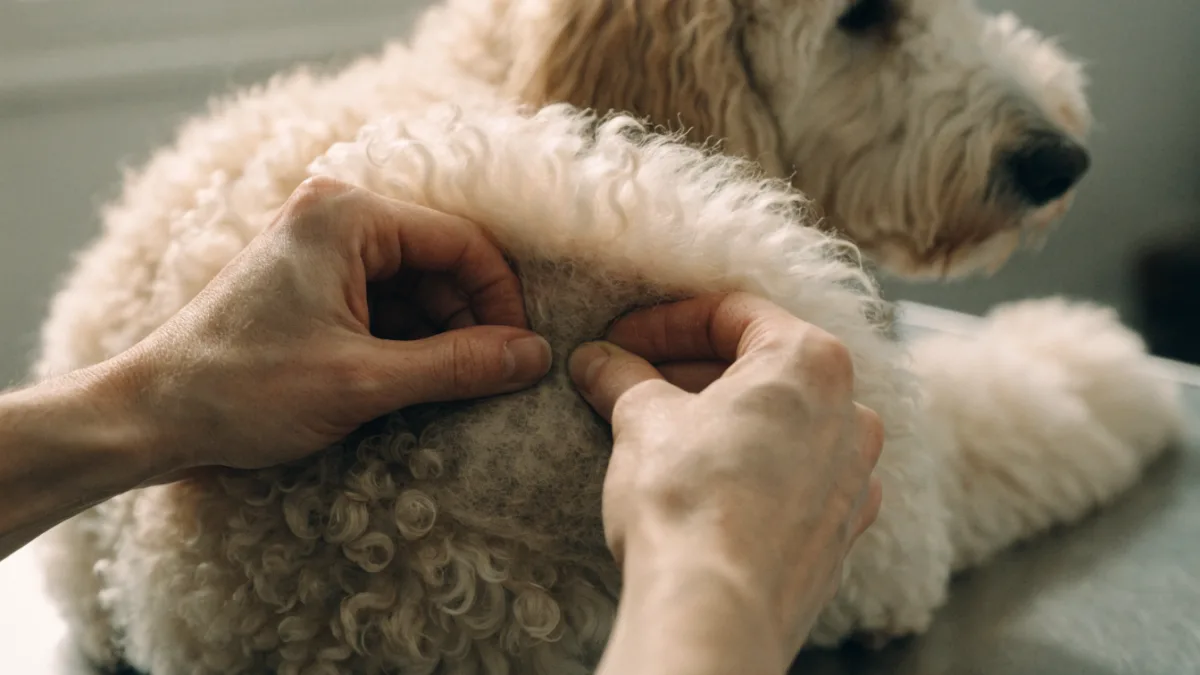
I’ll never forget the first severely matted Doodle I saw up close. A friend who grooms dogs in Asheville texted me to stop by — she had a Goldendoodle on her table that the owner had booked for “just a tidy-up.” From across the room, the dog looked fine. Fluffy, cream-colored, smiling that ridiculous Doodle smile. Then she lifted his ear flap, and underneath was a solid sheet of felted fur pressed so tight against the skin that I couldn’t slide a fingernail between the hair and the flesh. The owner had been brushing him. She’d been brushing the top layer every week — the part that looked good, the part she could see — while the coat underneath was quietly turning into a felt blanket.
That’s the insidious thing about matting. It hides. And by the time most people realize what’s happening, the only humane option is to shave the whole coat down and start over.
The Mechanics of a Mat: How Fur Becomes Felt
A mat isn’t just a tangle. A tangle is loose — you can pull it apart with your fingers. A mat is structurally different. It’s what happens when shed hair, live hair, dirt, moisture, and friction all combine and compress into a dense mass that locks onto the coat like Velcro.
Here’s the process. Dogs and cats shed — even the ones marketed as “non-shedding” lose hair; it just stays trapped in the coat rather than falling onto your floor. Normally, that loose hair gets brushed out or naturally falls away. But in a curly or long coat, the shed hair has nowhere to go. It wraps around neighboring hairs, catches on texture, and begins to clump. Add friction from movement, collars, or play, and those clumps tighten. Add a little moisture — a swim, a walk in the rain, even damp grass — and the whole thing compresses further, felting into a solid mass that bonds to the live hair down to skin level.
Once a mat reaches skin level and tightens, brushing it out is genuinely painful. The hair is pulling on the skin with every movement. Imagine someone grabbing a fistful of your hair close to the scalp and twisting — now imagine that across large sections of your body, and you can’t reach it to fix it.
Why Doodles Mat Worse Than Almost Anything Else
The Doodle coat situation is, frankly, a grooming crisis that the breeding community created and left everyone else to deal with. I say this as someone who genuinely likes Doodles — I’ve met some wonderful ones with fantastic temperaments. But the coat genetics are a mess.
Poodles have a single-layer curly coat that grows continuously and rarely sheds. Golden Retrievers and Labrador Retrievers have double coats — a dense, shedding undercoat beneath a longer topcoat. When you cross these, you don’t get a predictable result. You get a genetic lottery. Some Doodles inherit a poodle-like coat that’s relatively manageable. Others inherit a coat that’s curly on top with a shedding undercoat underneath — and that combination is, from a grooming perspective, the highest-maintenance coat type in the domestic dog world.
What happens is this: the undercoat sheds normally, but the curly topcoat traps every shed hair. Each loose undercoat hair becomes a building block for a mat. The curls act like tiny hooks, grabbing debris, catching on each other, and compressing with every bit of friction. A Doodle with this coat type can go from freshly brushed to matted in under two weeks if the owner isn’t line-brushing — getting down to the skin and working through every layer — on a near-daily basis.
The Friction Zones
Mats don’t form evenly. They cluster where movement and contact create the most friction: behind the ears, under the collar or harness, in the armpits, around the groin, and along the haunches where the legs rub together. A dog that wrestles with other dogs will mat faster than one that doesn’t — all that body contact compresses the coat and grinds debris deeper into it. A dog that swims and then air-dries? The moisture causes the curls to tighten and lock, accelerating the whole felting process. I knew a Labradoodle in my neighborhood who swam in a creek every morning, and his owner could not understand why he was matted again within days of every grooming appointment. Water + curly coat + friction = mats. Every time.
When Cats Felt: A Different Mechanism, Same Result
Long-haired cats face their own version of this problem, and the mechanics are different enough to be worth understanding. Cats have barbed tongues — tiny backward-facing keratin spines called papillae that act like a built-in comb. When a cat grooms, those barbs pull loose fur out of the coat. In a short-haired cat, most of that fur passes through the digestive tract (occasionally producing a hairball). But in a long-haired cat — a Persian, a Maine Coon, a Ragdoll — the barbed tongue pulls loose fur into the surrounding long coat rather than fully removing it. That loose fur then compacts, helped along by the cat’s own continued grooming pressure, into dense felted masses that bond to the undercoat.
Cats who groom themselves obsessively can actually make the problem worse. Over-grooming — often triggered by stress, allergies, or pain — means more tongue-barbs working the coat, more loose hair pulled into the surrounding fur, and faster felting. Senior cats are especially vulnerable because they develop arthritis and can’t physically reach the areas they need to groom. The lower back and base of the tail are classic spots for felting in older long-haired cats — they simply can’t twist far enough to care for those areas anymore.
What Mats Actually Do to the Body
People tend to think of matting as a cosmetic problem. It’s not. It’s a medical one.
A severe mat pulls on the skin constantly. That tension restricts blood flow to the area, which can cause bruising, skin necrosis, and in extreme cases, tissue death. Underneath a large mat, the skin is warm, dark, and moist — the perfect environment for bacterial and fungal growth. Yeast infections flourish. Hot spots — those raw, weeping, painfully inflamed patches of infected skin — can develop under a mat within days. I’ve seen dogs come into shelters with mats so tight and so extensive that the skin underneath was split open and infected, and the dog had been living with that for weeks.
There was a Goldendoodle who went viral a while back — a shelter intake whose coat had progressed past matting into full dreading. The fur had locked into thick ropes that hung off his body like dreadlocks, pulling his skin into ridges. The grooming team had to shave him entirely, and the reveal showed skin that was red, irritated, and infected across large portions of his body. The dog’s demeanor change after the shave-down was immediate — the relief was visible. That’s not a rare story..[1]
The Shave Debate: Why Groomers Insist on Starting Over
Here’s where owners and groomers collide. A dog comes in matted. The owner wants the mats brushed out so the dog keeps its length and style. The groomer wants to shave the coat down to the skin and start fresh.
The groomer is right. I understand the owner’s frustration — you’ve spent months growing out a beautiful coat, and now someone wants to take clippers to it. But dematting a severely matted dog means hours of pulling on skin that’s already irritated and compromised. It causes brush burn, stress, and sometimes genuine injury. No ethical groomer will do it. The humane answer is a short clip and a reset.
The objection I hear most is that “shaving ruins the coat.” For double-coated breeds like Huskies or German Shepherds, this has some truth — shaving can damage the guard hairs and disrupt the coat’s temperature regulation. But Doodles aren’t double-coated in the traditional sense, and clipping a curly or wavy Doodle coat doesn’t permanently change its texture. It grows back. The only thing a shave-down “ruins” is the aesthetic — and that’s a trade-off worth making when the alternative is pain and infection.
“Hypoallergenic” Marketing and Its Consequences
I have to address this because it’s the root of so much Doodle suffering. Doodles are frequently marketed as “hypoallergenic” and “low-shedding,” and owners hear “low maintenance.” There is no such thing as a hypoallergenic dog — allergens come from dander, saliva, and urine, not just hair. Some Doodles shed less than their parent breeds, which can reduce allergen spread in the home, but that does not mean the coat is easy to care for. In fact, low-shedding coats require more maintenance because the hair that doesn’t fall out on your floor is staying in the coat, building up, and forming mats.
The.[2] Breeders who sell Doodles without educating buyers about coat maintenance are setting up dogs for a lifetime of painful grooming sessions, shelter surrenders, and unnecessary suffering. If you’re considering any Doodle, budget for professional grooming every 4 to 6 weeks and plan to line-brush at home between appointments. If that sounds like too much, that’s a perfectly reasonable reason to choose a different dog.
Prevention: The Work Nobody Warned You About
Preventing mats comes down to two things: brushing correctly and brushing often. “Correctly” means line-brushing — using a slicker brush to work through the coat in thin sections, lifting each layer to ensure you’re reaching the skin. Surface brushing does nothing. It smooths the top layer and leaves the undercoat locked underneath, which is exactly how hidden matting develops. A greyhound comb is your honest test: if it slides through the coat from skin to tip without catching, the coat is truly mat-free. If it snags, there’s a mat forming that your brush missed.
For long-haired cats, a stainless steel comb used twice to three times weekly — focusing on the armpits, belly, and lower back — will prevent most felting. Many long-haired cat owners keep their cats in a “lion cut” — clipped short except for the head, legs, and tail tip — especially in warm months. It looks unusual, but it eliminates the problem entirely, and most cats are visibly more comfortable.
For Doodles, the reality is that many owners keep their dogs in a short maintenance clip — an inch or two all over — because it’s the only realistic way to stay ahead of matting without daily grooming sessions. A longer Doodle coat is a lifestyle commitment, not a default.
If there’s one thing I want people to take away from all of this, it’s that matting is not a failure of character — it’s a failure of information. Most owners aren’t neglectful; they’re underprepared. They bought a dog based on marketing that promised “easy coat” and discovered — usually around month eight, when the adult coat starts coming in — that they’d signed up for a second job. The dogs don’t need judgment. They need brushes, combs, groomers, and owners who understand what the coat actually does. Meet the coat where it is, not where the breeder’s website said it would be, and the dog underneath will be healthier and more comfortable for it.
Sources
- Groomers see versions of this every week — facebook.com
- grooming community has been sounding this alarm for years — teddybearschnoodles.com